
Basics of Insolvency and Bankruptcy Code(IBC) Framework
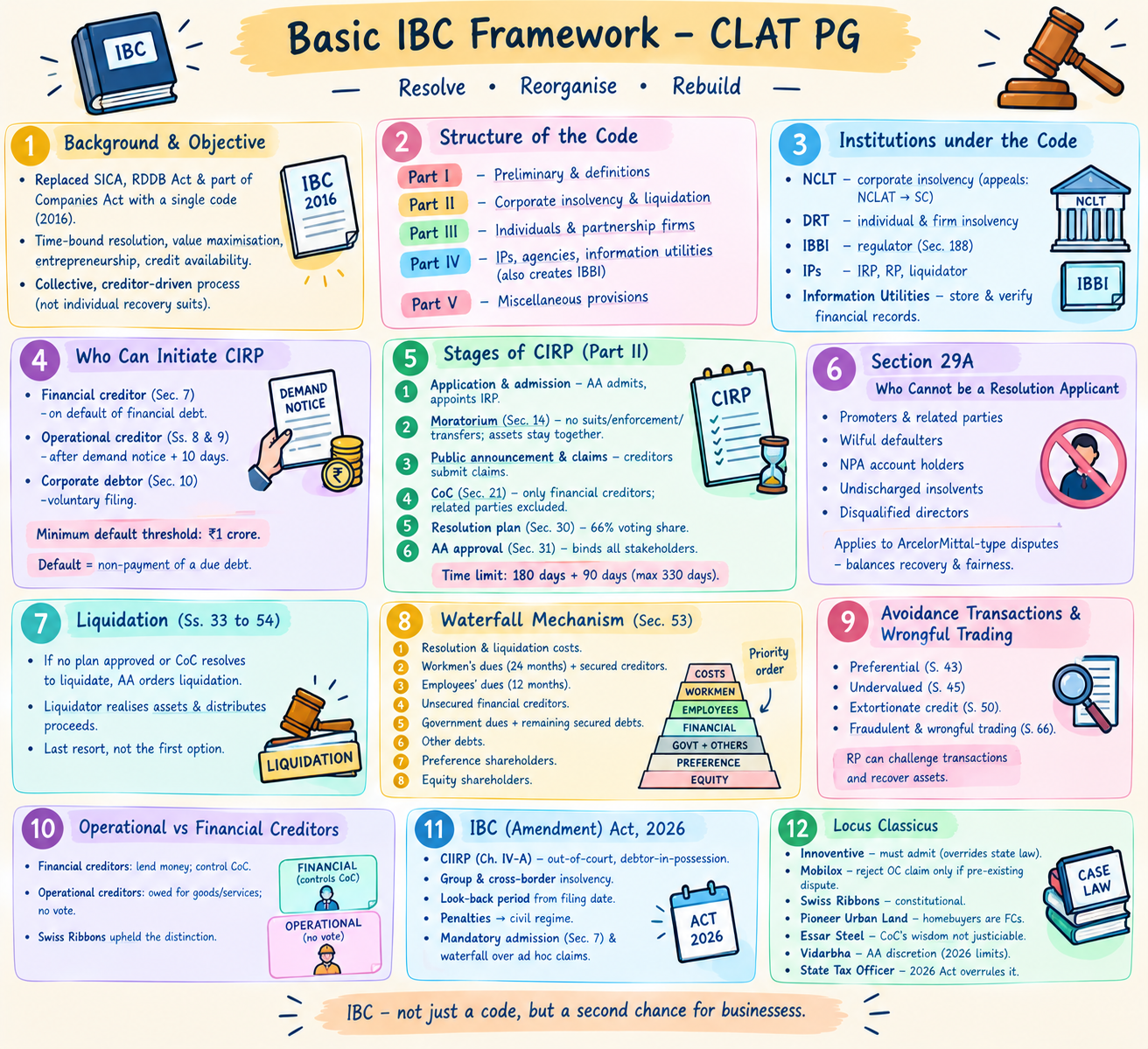
The Insolvency and Bankruptcy Code, 2016 replaced a scattered set of laws (SICA, the Recovery of Debts Act, and parts of the Companies Act) with a single code. This is the basic IBC framework relevant to CLAT PG which you must read which shifts the focus from penalizing debtors to maximizing the value of assets, ensuring entrepreneurship thrives while safeguarding the rights of stakeholders.
Its preamble aims at time-bound resolution, maximisation of asset value, promoting entrepreneurship and credit availability, and balancing the interests of all stakeholders. The Code’s core idea is that insolvency should be resolved through a collective, creditor-driven process and not through individual recovery suits.
Structure of the Code
- Part I: preliminary and definitions.
- Part II: insolvency resolution and liquidation of corporate persons.
- Part III: individuals and partnership firms.
- Part IV: regulation of insolvency professionals, agencies and information utilities (this part also creates the IBBI).
- Part V: miscellaneous provisions.
Institutions under the Code
- NCLT (Adjudicating Authority): handles corporate insolvency; appeals go to the NCLAT and then the Supreme Court.
- DRT: handles individual and firm insolvency.
- IBBI: the regulator, set up under Section 188.
- Insolvency Professionals (IPs): run the process through IRP, RP and liquidator roles.
- Information Utilities: store and verify financial records of debt, which helps prove default.
Who Can Initiate CIRP
- Financial creditor (Section 7): On default of a financial debt.
- Operational creditor (Sections 8 and 9): After serving a demand notice and the corporate debtor failing to repay or dispute within 10 days.
- Corporate debtor (Section 10): Voluntary filing.
The minimum default threshold is ₹1 crore. A default means non-payment of a debt that has become due and payable.
Stages of CIRP (Part II)
- Application and admission: the AA admits the application and appoints an Interim Resolution Professional (IRP).
- Moratorium (Section 14): suits, enforcement, recovery and transfers of assets are barred, so the debtor’s assets stay together.
- Public announcement and claims: creditors submit claims to the IRP.
- Constitution of the Committee of Creditors (Section 21): only financial creditors vote, and related parties are excluded.
- Resolution plan (Section 30): invitations are issued, plans are evaluated and put to vote. Approval needs a 66% voting share.
The overall time limit is 180 days, extendable by 90 days, with an outer limit of 330 days including litigation time.
Section 29A: Who Cannot Be a Resolution Applicant
This section bars promoters and others from regaining control of a failed company cheaply. It applies to wilful defaulters, persons with NPA accounts, undischarged insolvents, disqualified directors, and their related parties. It is tested often because it connects to ArcelorMittal-type disputes and to the balance between recovery and fairness.
Liquidation (Sections 33 to 54)
If no resolution plan is approved, or the CoC resolves to liquidate, the AA orders liquidation. A liquidator takes charge, realises the assets and distributes the proceeds. The Code treats liquidation as the last resort and not the first option.
Waterfall Mechanism (Section 53)
Proceeds are distributed in this order:
- Insolvency resolution and liquidation costs.
- Workmen’s dues (24 months) together with secured creditors.
- Employees’ dues (12 months).
- Unsecured financial creditors.
- Government dues and the remaining debts of secured creditors.
- Other debts.
- Preference shareholders.
Avoidance Transactions and Wrongful Trading
The RP can challenge transactions that harm creditors before commencement of insolvency.
These are preferential transactions (Section 43), undervalued transactions (Section 45), and extortionate credit (Section 50). Section 66 covers fraudulent and wrongful trading, where directors continued the business knowing insolvency was unavoidable. Courts can order recovery and make responsible persons contribute to the assets.
Operational vs Financial Creditors
Financial creditors lend money for a time value of money and control the CoC. Operational creditors are owed for goods and services and have no vote. The Supreme Court upheld this classification in Swiss Ribbons because the two groups differ in their commercial interests and in how they assess the debtor’s viability.
IBC (Amendment) Act, 2026
The IBC (Amendment) Act, 2026 (Act No. 6 of 2026) received Presidential assent on 6 April 2026 and is described as the biggest overhaul of the insolvency framework since 2016. The Ministry of Corporate Affairs notified 26 May 2026 as the date on which many of its provisions came into force.
- CIIRP: a new Chapter IV-A (Sections 58A to 58K) creates an out-of-court, debtor-in-possession resolution process started by creditors.
- Group and cross-border insolvency: new provisions enable coordinated resolution of group companies and set up a framework for cross-border insolvency.
- Look-back period: the period for preferential, undervalued and extortionate credit transactions now runs from the date the insolvency application is filed, and not only from admission.
- Penalties: the criminal offences in Sections 74 and 76 are replaced by a civil penalty regime.
- Mandatory admission: the Amendment is reported to restore the mandatory character of admission under Section 7 and to confirm the waterfall’s primacy over ad hoc claims to secured status.
Locus Classicus
- Innoventive Industries Ltd v. ICICI Bank: once default is established, the AA must admit the application. The Code is a complete code and overrides state laws on conflicting points.
- Mobilox Innovations v. Kirusa Software: an operational creditor’s claim can be rejected only if a pre-existing dispute exists.
- Swiss Ribbons v. Union of India: the Code, including the FC/OC distinction and Section 29A, is constitutional.
- Pioneer Urban Land v. Union of India: homebuyers are financial creditors.
- Essar Steel v. Satish Kumar Gupta: the CoC’s commercial wisdom is not justiciable, and the AA cannot rewrite a plan.
Subscribe for updates
Join 10,000+ subscribers.
HA
Hanspal Bakul
Contributing author
Have a doubt about this?Ask Doubts