
Can Advocates Use Social Media for Promotion?
The Bar Council of India (BCI) has recently looked at the increasing trend of lawyers and advocates advertising themselves on social media and through digital advertisements. Reels featuring court buildings, lawyers in their robes, client testimonials, ‘guaranteed' legal outcomes and paid online promotions have caused legal services to appear similar to ordinary commercial products. In response, the BCI has issued circular on 17 July 2026.
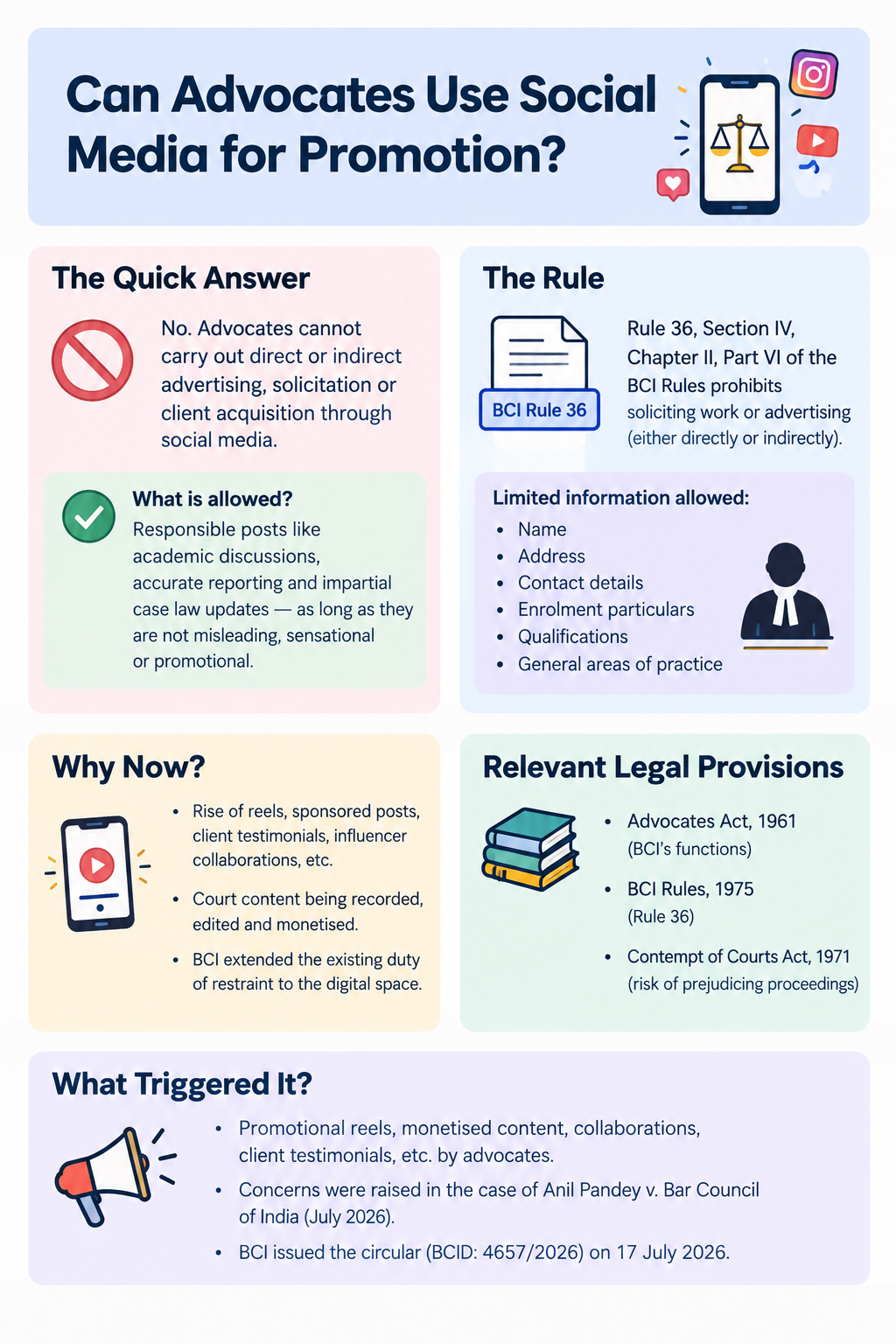
The simple answer is that it is not allowed for advocates to carry out direct or indirect advertising, solicitation or client acquisition through social media. However, the circular does not ban all legitimate posts. Advocacy in a responsible manner, academic discussion, accurate reporting and the provision of impartial updates on case law may still take place, as long as such posts are not misleading, sensational or promotional.
Evolution of the issue
The rule in question is by no means entirely new. According to Rule 36, Section IV, Chapter II, Part VI of the Bar Council of India Rules, an advocate is prohibited from soliciting work or advertising, either directly or indirectly. The rule permits only a limited amount of information about an advocate such as his name, address, contact details, enrolment particulars, qualifications and the general areas in which he practices, provided that this information is given in the way allowed by the Rules.
When newspapers, visiting cards and physical advertisements were the main way of getting publicity, this rule was drawn up. Although social media has altered the method it has not changed the fundamental ethical concern. A reel, a sponsored post, a collaboration with an influencer or a client testimonial can carry out the same role as an advertisement, even if it is offered in the form of entertainment or as 'legal awareness'. That is why the BCI has extended the existing duty of restraint to the digital environment rather than viewing the internet as a separate ethical area.
The situation also arose since court-related content started to be recorded, edited and passed on in order to attract a viewership and followers. The Supreme Court’s ruling in Swapnil Tripathi v. Supreme Court of India acknowledged the advantages of live-streaming court sessions for the purposes of transparency and access to justice. However, that acknowledgement does not imply that it is possible to record the proceedings freely, edit them, turn them into a source of income or present them out of context.
In July 2026 the Supreme Court sent a notice in the case of Anil Pandey v. Bar Council of India, a case which brought forward concerns regarding promotional reels, monetised legal content, collaborations with influencers, client testimonials and the digital self-promotion carried out by advocates. The BCI circular came about as a result of this broader discussion and of the Bar Council's own internal review of digital ethics.
Factual background of the issue
The BCI said that it had become aware of advocates, law students, interns and other people who produce legal content uploading reels, short clips, memes, dramatic presentations and photographs relating to courts, chambers, internships and professional work. In some cases the content made use of court corridors, robes, case files or judicial proceedings as visually appealing material.
The issue is not merely that a camera is employed. Through selective editing, the use of music, captions and sensational commentary a serious hearing can be made to seem like entertainment. A brief excerpt might leave out the relevant legal background and thus give an unfair impression of a judge, a lawyer, a party to the case or the case as a whole. The BCI also regarded fake judgments, fabricated citations, false assertions of having appeared or having been successful, misleading legal advice and AI-generated deepfakes as serious risks.
The circular extends to cover not only practicing advocates but also law students, interns, research scholars, legal educators, law firms, chambers and those who produce legal content. This is significant since students and interns might come by confidential information or gain access to work carried out in the courts and in chambers before they have been admitted as advocates.
Relevant legal provisions
The legal framework rests mainly on three provisions:
- The Advocates Act of 1961 specifies the functions of the BCI, one of which is the establishment of standards of professional conduct and etiquette.
- The disciplinary procedure for any misconduct by an advocate, whether professional or of another kind, is set out in Section 35. If a State Bar Council decides it wishes to, it can refer the case to its disciplinary committee, which is then able to impose the penalties allowed by the Act.
- The power to make rules regarding the standards of professional conduct and etiquette is given to the BCI by section 49(1)(c).
The most direct reference to advertising is found in Rule 36, while other professional obligations are also important. Advocates have to preserve their dignity in court, avoid exerting improper influence, keep client confidentiality and use careful language. These duties do not cease when an advocate moves from the courtroom to platforms such as Instagram, YouTube, LinkedIn or others.
Key directives issued by the BCI
- The circular requests that advocates should not use the court buildings, the name of the court, their robes, the bands, the cause lists, the files, client documents or their chambers as a means of personal branding.
- The recording of physical, virtual or hybrid proceedings is limited by the relevant court rules and, in cases where it is required, by written permission.
- Legal representatives should not distribute altered recordings of the hearings which mock, or distort the proceedings.
- They are not permitted to publish any confidential information, including pleadings, drafts, communications regarding settlements, case strategy, medical records or details about clients.
- The BCI also cautions people against clickbait and promises relating to the outcome such as ‘guaranteed bail’, ‘sure acquittal', ‘instant relief' or similar statements.
What was the reason for the circular?
The circular is important for four reasons.
- Firstly, since legal advice has an impact on liberty, property, family life and a number of other important matters, misleading online promises may take advantage of people who are already in a vulnerable position.
- Secondly, court proceedings are not meant as entertainment and careless editing can therefore harm the reputation of the courts and erode public confidence in the justice system.
- Thirdly, once material has been posted online client confidentiality and legal privilege can be permanently compromised.
- Fourthly, because AI can make fabricated orders, voices and images seem convincing, professional accountability has become more essential.
The circular should not be understood as a prohibition on lawyers having an online presence. A lawyer can, for example, give a true explanation of case law, write an article, discuss constitutional principles or offer accurate legal information.
The difference lies in the purpose and the method employed. Providing education is aimed at informing the public, whereas promotion is intended to attract clients or draw commercial attention. A post which moves into the area of solicitation, makes guarantees about the results, claims to be superior or misuses their professional identity may breach Rule 36 even if it is labelled ‘content'.
Conclusion
The circular issued by the BCI on 17 July 2026 brings the established principles of professional ethics into the digital age. Although advocates can use social media, they must not make use of it as an advertising marketplace for their legal services. The fundamental principle is simple i.e. although the medium may change, the advocate’s obligations regarding dignity, restraint, confidentiality and professional conduct remain unchanged.
Subscribe for updates
Join 10,000+ subscribers.
JU
Julie Nigam
Contributing author
Have a doubt about this?Ask Doubts
