
Can an Accused Be Denied a Copy of the FIR? Understanding the Legal Position in India
The question of whether an accused person can be denied a copy of the First Information Report has moved from an academic debate to a live constitutional concern. Recent years have seen a growing pattern of police authorities withholding FIR copies, often citing the vague ground of "sensitivity."
A bench headed by the Chief Justice directed the Ghaziabad Police Commissioner to hand over a copy of the FIR and related CCTV footage to independent journalist Abhishek Upadhyay, who had been booked in connection with a road rage incident.
The Statutory Framework
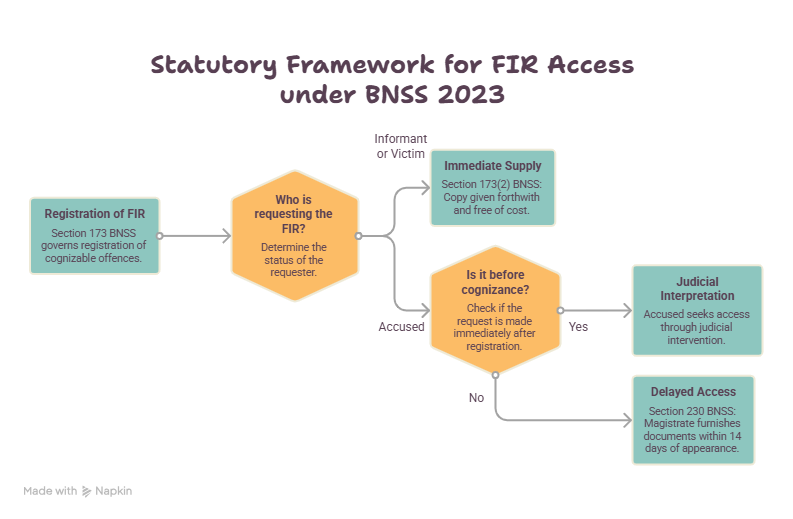
Under the Bharatiya Nagarik Suraksha Sanhita (BNSS), 2023, which has replaced the Code of Criminal Procedure, the registration and supply of FIRs continues to follow the broad principles laid down under the earlier CrPC regime. Section 173 BNSS (corresponding to Section 154 CrPC) governs the registration of information relating to cognizable offences.
The statutory position on this question is more layered than it first appears. Section 173(2) of the Bharatiya Nagarik Suraksha Sanhita requires that a copy of the FIR be given "forthwith" and free of cost - but this obligation runs to the informant or the victim, not explicitly to the accused.
As far as the accused is concerned, the BNSS text itself only guarantees access at a later stage: Section 230 obliges a magistrate to furnish the accused with copies of documents relied upon by the prosecution, but only within fourteen days of the accused's appearance or production before the court.
The accused's right to a copy, however, has largely developed through judicial interpretation rather than express statutory text. The real controversy arises at an earlier stage, before cognizance, when the accused seeks the FIR immediately after registration.
The Youth Bar Association Judgment
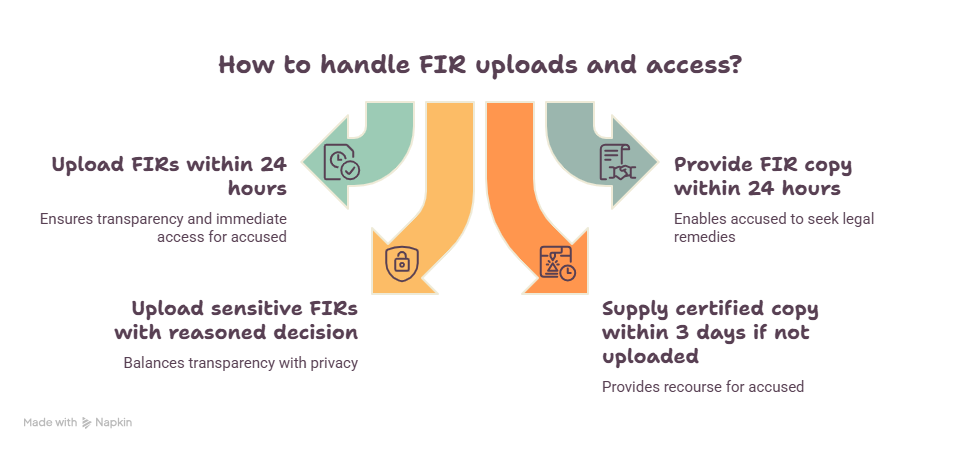
The Supreme Court's decision in Youth Bar Association of India v. Union of India (2016) 9 SCC 473 remains the definitive authority on this question. The Court held that FIRs must ordinarily be uploaded on the official police or state website within twenty-four hours of registration.
This was intended to ensure transparency and to allow the accused, or any person connected with the case, immediate access.
In Court on its Own Motion (through Mr. Ajay Choudhary) v. State (2010), the Delhi High Court laid down a practical mechanism allowing an accused to access the FIR even while investigation is ongoing, well ahead of the Section 230 timeline.
The Court went further and directed Delhi Police to upload FIRs onto its website within twenty-four hours of registration — with sensitive FIRs carved out, but only where withholding is backed by a reasoned decision from an officer not below the rank of Deputy Commissioner of Police.
More recently, in Rama Nand Rathore v. State of Himachal Pradesh (2024), the Himachal Pradesh High Court reaffirmed that police must supply a copy of the FIR to the accused within twenty-four hours of a request, reinforcing that this is not a discretionary courtesy but an enforceable expectation.
The Court's reasoning rested on the principle that early access to the FIR is essential to enable an accused to seek appropriate legal remedies, including anticipatory bail or regular bail. Delay or denial at this stage can materially prejudice a person's ability to defend themselves, particularly where custodial interrogation is imminent.
Importantly, the judgment also created a fallback mechanism. Where the FIR is not uploaded due to sensitivity, the accused or their authorised representative can approach the court to which the FIR has been forwarded.
That court is directed to supply a certified copy within three days of the application being made. This provision was meant to ensure that no accused is left entirely without recourse.
The Sensitivity Exception and Its Misuse
The judgment does recognise a narrow exception. Certain categories of offences, including sexual offences, cases under POCSO, matters relating to insurgency and terrorism, and other similarly sensitive categories, may be excluded from the requirement of online publication. The rationale is understandable: public and unrestricted access to FIRs in such cases could compromise victim privacy or ongoing investigations.
However, a conflation has crept into police practice. The exception was designed narrowly, to limit uploading the FIR for public access, not to deny the accused their own certified copy. Courts and commentators have pointed out that paragraph 12(h) of the Youth Bar Association guidelines has, in practice, been read more broadly than intended, allowing police to withhold copies from the accused altogether under the guise of sensitivity.
This has produced friction in several recent cases. The Delhi Police's resistance to supplying an FIR copy in the Parliament security breach case is a prominent illustration.
A trial court directed the investigating officer to furnish the FIR to the accused's counsel, but the police challenged this order, arguing that sensitive matters require the accused to approach a designated committee rather than receive the FIR directly.
Constitutional Underpinnings
The right to access an FIR is not merely procedural convenience; it flows directly from constitutional guarantees. Article 21 protects the right to life and personal liberty, which courts have consistently interpreted to include the right to a fair investigation and a fair trial.
Denial of the FIR strikes at the heart of this guarantee by leaving the accused unable to understand or contest the case against them.
Article 22(1) adds a further layer of protection. It mandates that an arrested person must be informed, as soon as possible, of the grounds for their arrest. Courts have held that this information must be meaningful and substantive, not a bare procedural formality.
An accused who is arrested but denied the FIR is, in effect, being deprived of the substance behind their arrest, even if formally "informed" of it.
Older precedents reinforce this constitutional reading. The Calcutta High Court, in Panchanan Mondal v. State (1971), held that an FIR is a public document and that the accused is entitled to a copy on payment of the prescribed fee, at any stage of the proceedings.
This reasoning has been echoed in subsequent decisions across High Courts, reaffirming that obstruction in obtaining the FIR only breeds the temptation for abuse by officers holding the original document.
Why This Still Goes Wrong in Practice
Despite this fairly detailed judicial architecture, compliance on the ground remains inconsistent. Delhi-based advocate Nipun Saxena has pointed out that police departments frequently fail to follow these directions, often declining to upload FIRs onto the Crime and Criminal Tracking Network and Systems (CCTNS) portal as required, and stalling when accused persons seek copies directly.
Subscribe for updates
Join 10,000+ subscribers.
HA
Hanspal Bakul
Contributing author
Have a doubt about this?Ask Doubts
