
Can Police Upload Photos of Accused Persons on Social Media?
Police departments across India increasingly use social media to share information about arrests, investigations and alleged offences. However, a recent Supreme Court proceeding has raised an important question: Can the police upload photographs and videos of accused persons on social media before they are convicted?
The issue has gained fresh attention after the Supreme Court on August 18, 2026, issued notice to the Centre, States, Union Territories, Meta and X on a petition challenging the publication of photographs, videos and identifying details of accused persons by police authorities.
The case raises important questions concerning the right to dignity, privacy, presumption of innocence and fair trial.
What Is the Supreme Court Considering?
The petition in Hemendra Patel v. Union of India & Ors. challenges the practice of police organisations uploading photographs and videos of accused persons on their official social media accounts.
The petition seeks safeguards against posts that reveal the identities of accused persons or portray them in degrading or humiliating circumstances. The examples referred to before the Court include accused persons being shown handcuffed, tied with ropes, made to kneel or otherwise subjected to allegedly dehumanising treatment.
A Bench comprising Chief Justice of India Surya Kant and Justices Joymalya Bagchi and V. Mohana issued notices to the concerned authorities and social media platforms.
However, it is important to clarify that the Supreme Court has not, at this stage, imposed a blanket ban on police uploading every photograph of an accused person. The matter is still under consideration.
An Accused Is Not a Convict
The most basic legal principle involved is the presumption of innocence.
A person does not become guilty merely because an FIR has been registered or because the police have arrested the person. Guilt must ultimately be established before a competent court through a fair judicial process.
Therefore, there is a significant difference between:
"The police have arrested a person who is accused of an offence"
and
"The person is guilty of the offence."
Police communication should not blur this distinction.
The concern becomes more serious when an official police account publishes an accused person's photograph in a manner that presents the person as a criminal or subjects them to public humiliation.
What Does Article 21 Say?
Article 21 of the Constitution protects life and personal liberty. The Supreme Court has interpreted this protection to include the right to live with dignity.
Arrest does not remove a person's constitutional rights. Although the State can restrict personal liberty according to law, an arrested person cannot be subjected to unnecessary humiliation or degrading treatment.
This principle was highlighted by the Rajasthan High Court in Islam Khan & Ors. v. State of Rajasthan & Ors. 2026 LiveLaw (Raj) 177 (Rajasthan High Court, decided May 5, 2026), The Court dealt with photographs of arrested persons that had been circulated on social media and directed the removal of such photographs and related material from social media platforms.
The Court emphasised that an accused remains an accused until convicted and that public exhibition or humiliation of an arrested person can affect the person's dignity protected under Article 21.
Does Police Publicity Affect the Right to a Fair Trial?
It can.
A criminal trial is expected to be decided on the basis of evidence and legal procedure, not public opinion.
When police authorities themselves publish photographs or videos of an accused, the information may carry greater credibility in the eyes of the public. If the post creates an impression that the accused is already guilty, it can contribute to trial by media and potentially prejudice the fairness of the criminal process.
The Supreme Court had already expressed concern over police use of social media in this context. In March 2026, while considering an earlier petition, the Court noted concerns about police officials using social media handles to publish photographs and videos of accused persons and indicated that the issue could be addressed through broader guidelines concerning police media briefings.
Can Police Never Publish an Accused's Photograph?
Not necessarily.
There is currently no final Supreme Court ruling establishing that every publication of an accused person's photograph by police is illegal.
There may be legitimate circumstances in which police need to seek public assistance, identify a suspect or communicate information concerning an investigation.
The important question is therefore why and how the photograph is being published.
For example, there is a significant difference between publishing an image for a genuine investigative purpose and uploading a photograph of an arrested person in handcuffs with language suggesting that the person has already been found guilty.
The purpose, necessity, manner of publication and its impact on the individual's rights would all be relevant.
Supreme Court's Police Media Briefing Directions
The issue also connects with the Supreme Court's directions concerning police interaction with the media.
In January 2026, the Supreme Court directed States to formulate appropriate policies for police media briefings, taking into consideration a model Police Manual for Media Briefing placed before the Court.
These developments indicate that police communication about criminal investigations cannot be treated as completely unrestricted.
Social media may be a different medium from a traditional press conference, but when an official police account communicates information to the public, constitutional safeguards remain relevant.
Why Is Social Media Different?
The impact of a social media post can be much greater than an ordinary police statement.
A photograph uploaded by the police can be downloaded, reposted and circulated across multiple platforms. Even if the original post is later deleted, copies may continue to exist online.
This creates a serious concern where an accused person is subsequently acquitted. The online image of the person as an alleged criminal may continue to affect reputation even after the judicial process ends.
The concern is therefore not merely about privacy. It also involves dignity, reputation and the fairness of the criminal justice process.
What Is the Current Legal Position?
As of 18 August 2026, the position can be summarised as follows:
- Police do not have an unrestricted constitutional licence to publicly humiliate accused persons.
- An accused person cannot be treated as a convict merely because an arrest has been made.
- Article 21 continues to protect the dignity and personal liberty of an arrested person.
- Police may communicate information about investigations where legally justified, but the manner and purpose of disclosure matter.
- The Rajasthan High Court has strongly criticised the public display and social media circulation of photographs of arrested persons in Islam Khan v. State of Rajasthan.
- The Supreme Court has been examining the broader issue of police media communication and has directed States to formulate media briefing policies.
Key Conclusion
The central principle is simple: an arrest is not a conviction.
Police authorities have an important role in informing the public about criminal investigations. However, that responsibility must be exercised consistently with constitutional protections.
Uploading a photograph of an accused is therefore not a question that can be answered simply with "yes" or "no". The purpose, necessity, manner and effect of the publication are crucial.
The latest Supreme Court proceedings in Hemendra Patel v. Union of India & Ors. may provide clearer safeguards for police use of social media. Until then, the constitutional distinction between an accused and a convict remains fundamental.
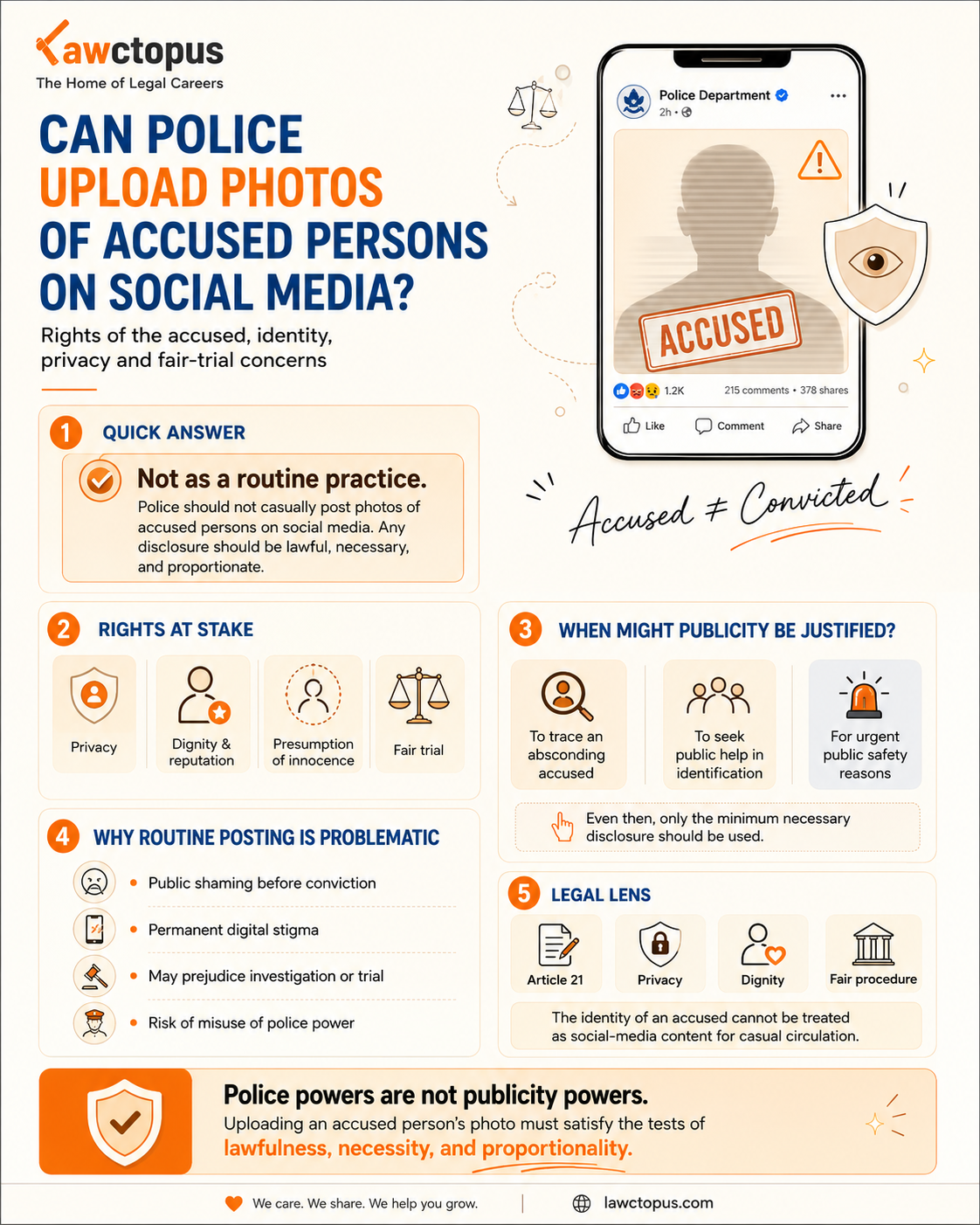
For CLAT PG aspirants, remember: Article 21, presumption of innocence, dignity, privacy and fair trial are the key constitutional principles involved in this developing issue.
Subscribe for updates
Join 10,000+ subscribers.
SH
Shruti chauhan
Contributing author
Have a doubt about this?Ask Doubts
