
Case Brief : Chaya & Ors. v. State of Maharashtra & Anr.
Citation: Chaya & Ors. Etc. v. The State of Maharashtra & Anr. Etc., Civil Appeal Nos. of 2026 (@ SLP(C) Nos. 14517-14539 of 2025), decided on March 23, 2026, by a bench of Justice Pamidighantam Sri Narasimha and Justice Alok Aradhe (opinion authored by Justice Alok Aradhe).
Facts
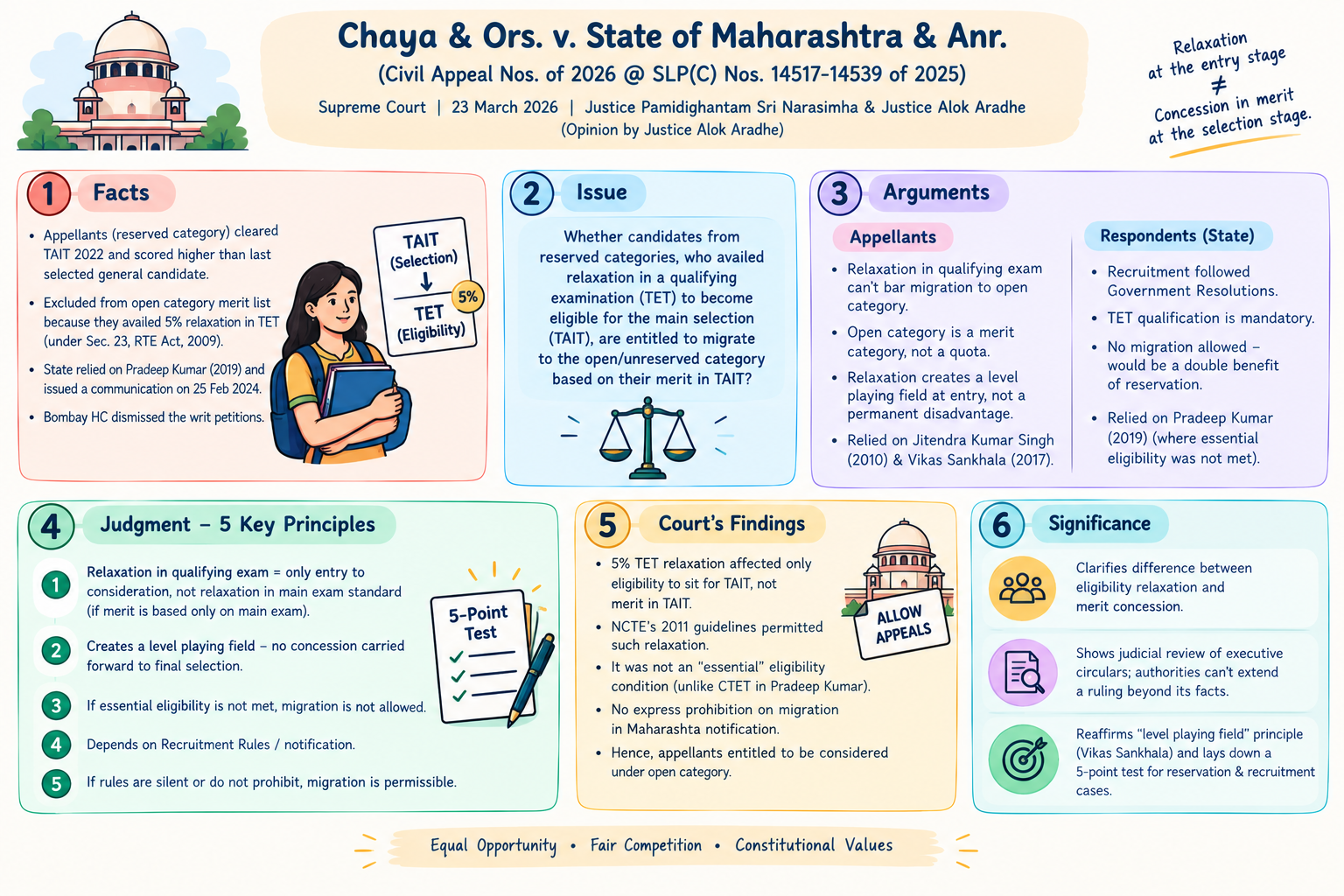
The appellants, candidates belonging to reserved categories, challenged a merit list dated February 25, 2024, prepared following the Teachers Aptitude and Intelligence Test, 2022 (TAIT), conducted by the Maharashtra State Council for Education for teacher recruitment across Zila Parishad, Municipal Corporation, Nagar Parishad, and private management schools.
Although the appellants secured higher marks than the last selected general category candidate, the authorities excluded them from the open category merit list solely because they had availed a 5% relaxation in qualifying marks for the Teacher Eligibility Test (TET), a prerequisite examination under Section 23 of the Right of Children to Free and Compulsory Education Act, 2009.
The Commissioner (Education), Government of Maharashtra issued a communication dated February 25, 2024, the very day the merit list was published, directing that any reserved category candidate who availed TET relaxation must be considered only under their reserved category, relying on the Supreme Court's ruling in Government of NCT of Delhi v. Pradeep Kumar, (2019) 10 SCC 120.
The appellants' representations against this exclusion went unanswered, and they approached the Bombay High Court, which dismissed their writ petitions, holding that relaxation in TET could not be ignored when determining open category eligibility and that permitting migration would confer an unfair advantage over general category candidates.
Issue
The principal question before the Supreme Court was whether candidates belonging to reserved categories, who availed relaxation in a qualifying examination (TET) to become eligible for the main selection process (TAIT), are entitled to migrate to the open or unreserved category based on the merit they secured in that main examination.
Arguments on Behalf of the Appellants
The appellants argued that relaxation in a qualifying examination cannot bar migration to the open category where a candidate's merit in the main selection examination exceeds that of the last selected general candidate.
They contended that the open category represents a merit category rather than a quota reserved exclusively for general candidates, and that the purpose of eligibility relaxation is to create a level playing field at the entry stage, not to permanently penalise meritorious performance at the selection stage.
The appellants relied on Jitendra Kumar Singh v. State of U.P., (2010) 3 SCC 119, and Vikas Sankhala v. Vikas Kumar Agarwal, (2017) 1 SCC 350, arguing that the High Court had mechanically applied Pradeep Kumar without appreciating the distinct factual matrix of their case.
Arguments on Behalf of the Respondents
The State of Maharashtra argued that the recruitment process strictly followed applicable Government Resolutions, and that TET qualification constitutes a mandatory eligibility requirement.
The respondents contended that candidates who qualified TET under relaxed standards could not claim migration to the open category, since permitting such migration would amount to granting a double benefit of reservation.
They placed primary reliance on Pradeep Kumar, where the Court had held that candidates failing to meet essential eligibility criteria cannot migrate to general category vacancies.
Judgment
The Supreme Court allowed the appeals and set aside the High Court's judgment, directing that appellants who secured marks higher than the last selected general category candidate be included in the open category merit list. The Court undertook a detailed review of its own precedents and distilled five governing principles:
- First, a relaxation in a qualifying examination merely enables entry into the zone of consideration and does not count as relaxation in the standard for the main examination, provided it does not affect merit determined solely by main examination performance;
- Second, such relaxation creates a level playing field where no concession carries forward into the ultimate selection;
- Third, a candidate who fails to meet essential eligibility criteria altogether cannot migrate to the open category;
- Fourth, migration eligibility depends on what the specific Recruitment Rules or employment notification provide; and
- Fifth, migration remains permissible where such rules are silent or do not expressly prohibit it.
Applying these principles, the Court held that the 5% TET relaxation granted to reserved category candidates under Maharashtra's Government Resolutions affected only eligibility to sit for TAIT, not the determination of merit within TAIT itself, since TAIT applied uniformly to every candidate regardless of category.
The Court found that the NCTE's own 2011 guidelines expressly permitted such relaxation, meaning the 60% TET threshold was never an "essential" eligibility condition in the way CTET's 60% threshold had been in Pradeep Kumar, where the respondents additionally lacked valid OBC certification altogether.
The Court held that the Commissioner (Education) erred in relying on Pradeep Kumar, since that ruling addressed candidates who failed to meet essential eligibility conditions entirely, a materially different situation from candidates who met eligibility through a validly permitted relaxation and then competed on equal footing in the main examination.
The Court further noted that the Maharashtra recruitment notification contained no express prohibition on migration, which, combined with the absence of any genuine merit concession in TAIT itself, entitled the appellants to be considered under the open category.
This ruling offers a clean illustration of how courts distinguish between eligibility relaxation and merit concession in reservation jurisprudence, a distinction frequently tested through altered fact patterns involving recruitment examinations.
It also demonstrates judicial review of executive circulars and communications, since the Court found the Commissioner's reliance on a factually distinguishable precedent to be an error correctable through appeal, reinforcing that administrative authorities cannot mechanically extend a ruling's holding beyond its actual factual scope.
The case further reaffirms the "level playing field" principle developed in Vikas Sankhala, now synthesised into a structured five-point test that examiners are likely to draw on for reservation and recruitment-law questions.
Get case-law updates weekly
Join 10,000+ subscribers.
HA
Hanspal Bakul
Contributing author
Have a doubt about this judgment?Ask Doubts
