
Company Law Important Cases (Part 1): Separate Legal Entity and Corporate Personality
Introduction
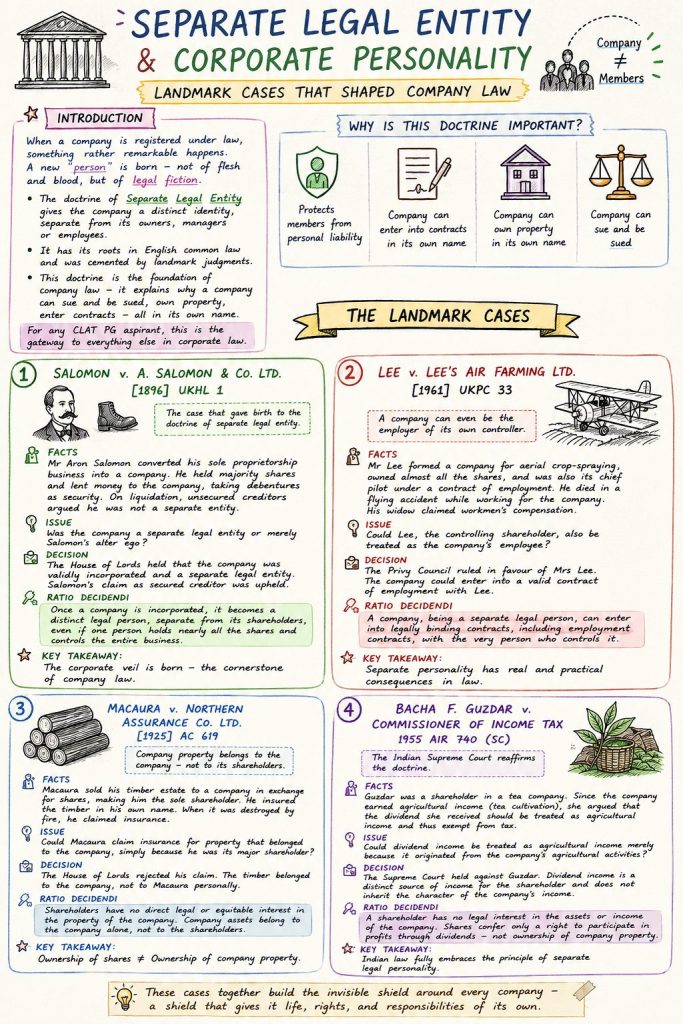
When a company is registered under law, something rather remarkable happens. A new “person” is born – not of flesh and blood, but of legal fiction. This is what we call the doctrine of Separate Legal Entity. It means the company, once incorporated, has its own identity, distinct from the people who own it, manage it, or work for it.
The doctrine has its roots in English common law and was cemented by a landmark House of Lords decision that forever changed the way we understand corporate personality. Before this ruling, courts often blurred the line between a company and its members.
Today, this principle is the very foundation of company law. It explains why a company can sue and be sued, own property, and enter contracts – all in its own name. For any CLAT PG aspirant, understanding this doctrine isn’t optional. It’s the gateway to everything else in corporate law.
Salomon v. A. Salomon & Co. Ltd. [1896] UKHL 1
Facts of the Case
Mr Aron Salomon ran a successful boot and leather business as a sole proprietor. He later converted it into a limited company, following the required legal formalities. He held the majority of shares, while his family members held the rest – just enough to satisfy the minimum membership requirement of the time.
Salomon also lent money to his own company and, in return, secured debentures, making him a secured creditor. When the company eventually ran into financial trouble and was wound up, the unsecured creditors argued that Salomon and the company were essentially the same entity, and that he shouldn’t be allowed to claim priority over them as a secured creditor.
Issue
Whether a company, upon due incorporation, acquires a legal personality distinct and separate from its shareholders, notwithstanding that one individual holds the overwhelming majority of shares and exercises complete control over its affairs.
Judgement
The House of Lords held that the company was validly incorporated. Once incorporation formalities are complete, the company becomes a separate legal entity, regardless of how much control one individual exercises over it. The court upheld Salomon’s status as a secured creditor. A company, once incorporated, is a distinct legal person, separate from its shareholders – even if one person holds nearly all the shares and controls the entire business.
This is the foundational case of company law. Every student must remember it as the origin point of the “corporate veil” – the idea that the company stands as a shield between itself and its members.
Lee v. Lee’s Air Farming Ltd. [1961] UKPC 33
Facts of the Case
Mr Lee formed a company for aerial crop-spraying and held almost all its shares. He was also appointed as the company’s chief pilot and worked under a contract of employment with it. Tragically, he died in a flying accident while carrying out his duties for the company.
His widow sought compensation under workmen’s compensation legislation, claiming her husband had died as an employee of the company. The insurance company opposed this, arguing that Lee, being the company’s controlling shareholder and effectively running the show himself, could not also be treated as its employee.
Issue
Whether a person who is the controlling shareholder and sole governing director of a company can, in law, simultaneously stand in the position of an employee of that company for a workmen’s compensation claim?
Judgement
The Privy Council ruled in favour of Mrs Lee. The company, being a separate legal person, was capable of entering into a valid contract of employment with Lee, despite him being its director and controlling shareholder. A company can enter into legally binding contracts, including employment contracts, with the very person who controls it, because the company exists as a person independent of its controller.
This case extends Salomon’s logic one step further – separate personality isn’t just symbolic, it has real, practical consequences, even in relationships between a company and the individual running it.
Macaura v. Northern Assurance Co. Ltd. [1925] AC 619
Facts of the Case
Macaura owned a timber estate, which he later sold to a company in exchange for shares – making him practically the sole shareholder. He continued to insure the timber, but the insurance policies remained in his own personal name, not the company’s. When a fire destroyed the timber, he filed an insurance claim.
Issue
Whether a shareholder, notwithstanding his status as majority or sole shareholder of a company, possesses an insurable interest in property that is legally owned by the company, such as to sustain a claim under a policy of insurance taken out in his personal name?
Judgement
The House of Lords rejected his claim. Since the timber belonged to the company and not to Macaura personally, he had no insurable interest in it, regardless of his shareholding. Shareholders have no direct legal or equitable interest in the property of the company. Company assets belong to the company alone – shareholders only hold rights against the company, not over its assets.
This case draws a sharp line between ownership of shares and ownership of company property – a distinction that trips up students constantly, and one examiners love to test.
Indian Position: Bacha F. Guzdar v. Commissioner of Income Tax 1955 AIR 740
Facts of the Case
Bacha F. Guzdar was a shareholder in a tea company. Under Rule 24, Income Tax Rules, 1922, 60% of agricultural income was exempt from tax. Since the company derived a portion of its income from agricultural operations (tea cultivation), Guzdar argued that the dividend she received should also be treated as agricultural income and hence be tax-exempt in her hands.
Issue
Whether dividend income received by a shareholder from a company can be characterised, in the shareholder’s hands, as agricultural income by virtue of the fact that a portion of the company’s own income is derived from agricultural operations, so as to attract exemption under Rule 24 of the Income Tax Rules, 1922?
Judgement
The Supreme Court of India held against Guzdar. It ruled that dividend income is a distinct source of income for the shareholder, separate from the company’s agricultural income. The character of income does not pass through to the shareholder simply because of share ownership. A shareholder does not have any legal interest in the assets or income of the company. Shares merely confer a right to participate in profits through dividends – they do not make the shareholder a co-owner of company property or income.
This is the Indian judiciary’s clearest reaffirmation of Macaura’s logic – proof that the doctrine of separate legal personality is deeply embedded in Indian company law too, not just an English import.
Get case-law updates weekly
Join 10,000+ subscribers.
HA
Hanspal Bakul
Contributing author
Have a doubt about this judgment?Ask Doubts
