Sovereignty is a basic idea in jurisprudence and political theory. It explains why the state can make laws, enforce them, punish violations, and represent the political community. A state is not merely a population living in a particular territory. It also requires an authority that is supreme within its territory and independent in relation to other states. This supreme authority is called Sovereignty.
In simple words, sovereignty means the highest and final power of the state. Within the country, no individual, association, or institution can claim a higher legal authority than the state. Outside the country, no foreign state can legally control its decisions.
The older idea of sovereignty as an unlimited power has been changed with expansion of globalisation, democracy, federalism, international law, constitutionalism and fundamental rights. These factors have limited the manner in which state power may be exercised.
What is Sovereignty ?
The word sovereignty is derived from the Latin term superanus meaning ;supreme’. It refers to the state's supreme authority over persons, groups, and institutions within its territory. The state can make binding laws and demand obedience to them. It can also use lawful coercion against those who disobey.
Sovereignty has two aspects-
Internal Sovereignty
External Sovereignty
Internal Sovereignty
It means supremacy within the territory of the state. Parliament, courts, local bodies, private organisations and citizens must function according to the constitution and laws.
External Sovereignty
It means independence from foreign control. A sovereign state is free to decide its foreign policy, enter treaties, maintain diplomatic relations, and protect its territorial integrity. In international law, states are formally equal, whether large or small.
Sovereignty is one of the essential elements of the state. Government is the machinery through which state power is exercised, but sovereignty belongs to the state itself.
Definitions of Sovereignty
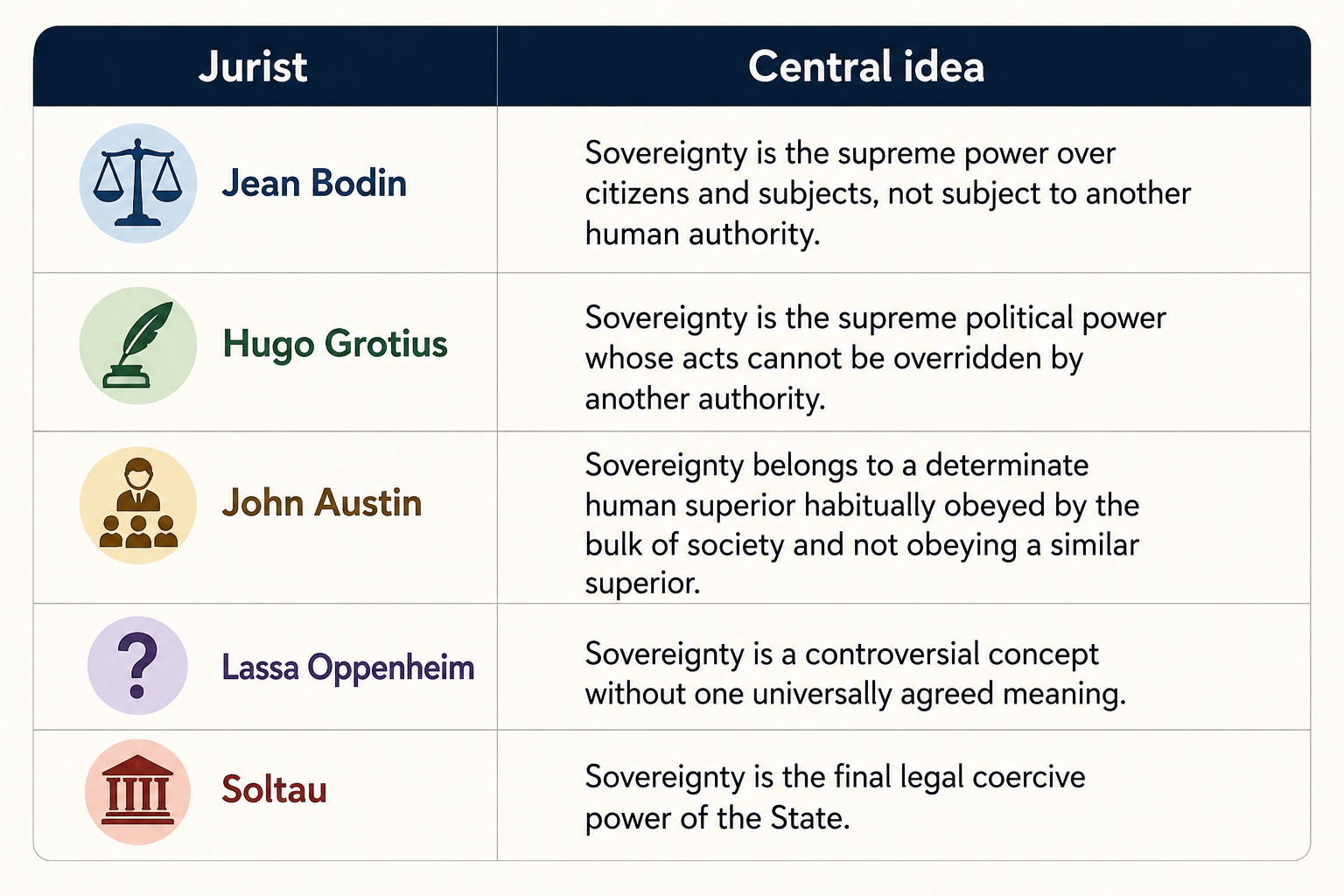
Sovereignty has no single universally accepted definition because it has legal and political aspects. Important definitions include the following.
Austin’s definition is especially important in jurisprudence. He viewed sovereignty as a definite person or body whose commands are often obeyed by the people. For him, law is the command of a sovereign backed by a sanction. This is called the command theory of sovereignty.
A modern constitutional understanding does not identify sovereignty only with a ruler or legislature. In India, the people are the ultimate source of authority, while the constitution distributes and limits governments power. The words “We the People of India” in the preamble express this idea of popular sovereignty.
Essentials of Sovereignty
Traditional jurists identified several features of sovereignty. Some have been changed by modern constitutional practice.
Supremacy - Sovereignty is the highest power within the state. No internal association can legally issue commands superior to those of the sovereign authority. In India, however, the Constitution is supreme and every organ of government is subject to it.
Permanence - Sovereignty continues as long as the state continues. The death of a monarch, resignation of a government, or change of political party does not end the state’s sovereignty.
Universality - Sovereignty extends throughout the territory and normally applies to all persons, groups, and institutions within it.
Indivisibility - Traditional theory considered sovereignty indivisible because two final and conflicting commands cannot exist in the same legal order. Modern federal constitutions distribute governmental functions between the union and the states. They may not divide sovereignty in the strict theoretical sense, but they do distribute constitutional powers.
Inalienability - A state cannot permanently give away its sovereignty and remain fully sovereign. It may enter treaties or accept international obligations, but such commitments are generally accepted through its own authority.
Types of Sovereignty
These classifications describe different aspects of sovereignty.
Legal and political sovereignty
Legal sovereignty is the authority legally competent to make the final laws of the state. In the United Kingdom, the traditional example is the king or queen in parliament. Political sovereignty refers to the body whose will is ultimately followed in political life. The public opinion, political parties, and social movements influence the legal sovereign. A.V. Dicey stated that “behind the legal sovereign stands another political sovereign to whom the legal sovereign must ultimately bow.”
Popular sovereignty
Popular sovereignty means that the people are the ultimate source of political authority. The government derives its legitimacy from the consent and will of the people. Elections, constitutional rights, and public accountability express this principle.
National sovereignty
National sovereignty places sovereignty in the nation. It is understood as a collective political community. It emphasizes national unity, independence, and freedom from foreign control. This was strongly associated with the French Revolution and the rise of the modern states.
Titular and real Sovereignty
A titular sovereign is sovereign in name but not in actual political control. In a parliamentary democracy, the president of India is the formal head of the state, while real executive power is exercised by the council of ministers headed by the prime minister.
De jure and de facto sovereignty
A de jure sovereign has the legal right to rule. A de facto sovereign has actual control, even if that control was obtained through a revolution or force.This distinction is important during civil wars and changes of government. A de facto ruler may later become de jure sovereign through constitutional recognition or popular acceptance.
Theories of Sovereignty
Austinian Theory
The Austinian theory treats sovereignty as a single, supreme, indivisible power of the state. Jean Bodin and Thomas Hobbes supported early forms of this approach. John Austin gave it its most systematic legal form. According to Austin, a determinate human superior is sovereign if the bulk of the society habitually obeys that superior and that superior does not habitually obey any similar authority.
Austin’s theory has three main points-
The sovereign must be determined, so the person or body holding final authority can be identified.
The sovereign is legally unlimited and does not obey another authority of the same kind.
Law is the command of the sovereign and disobedience is followed by punishment.
Pluralist Theory
Pluralism developed as a reaction against the absolute State of the Monists. Thinkers such as Harold Laski, GDH Cole, Otto Von Gierke, and FW Maitland argued that society consists of many real associations, including families, religious bodies, trade unions, professional groups, voluntary organisations. The state is one association among them and should not claim unlimited control over social life.
Marxist View
The Marxist approach connects sovereignty with the economic power and class relation. It argues that the state often protects the economically dominant class and that apparently neutral laws may preserve existing property relations. In a classless society, the state is expected to wither away.
Evaluation of Theories
No single theory completely explains sovereignty in a modern constitutional state. Austin is useful because every legal system needs institutions capable of making final decisions and his distinctions between legal and political sovereignty are helpful.
However Austin’s theory has serious limitations. It does not fit constitutional democracies where the government is bound by a written constitution, judicial review, fundamental rights, and federal arrangement. It is difficult to identify one determinate sovereign in India.
Parliament is not legally above the constitution, and the people express their authority through the constitutional structure. Austin’s definition of law as a command also ignores customary law, judicial precedent, constitutional principles and rules that develop without a direct command.
Pluralism correctly warns against state absolutism and highlights social groups. Yet complete division of sovereignty may create confusion or allow peaceful groups to dominate weaker ones. Pluralism is therefore best seen as a theory of limited and accountable state powers.
Modern sovereignty is also affected by international law, globalisation, technology, human rights and international organisations. States remain sovereign but sovereignty is no longer a licence to act without responsibility.
By entering treaties, states accept certain limits through their own consent. It has therefore moved from absolute command towards constitutional authority, democratic legitimacy, and responsible independence.
Conclusion
Sovereignty is the legal and political foundation of the State. Traditionally, it meant supreme authority within a territory and independence from external control. Its classification helps explain who possesses authority and how it is exercised.
For Jurisprudence, Austin remains important because he explains law and final authority. Yet his theory cannot fully explain constitutional democracy, federalism, popular sovereignty, customary law, or judicial review. Pluralism and Marxism expose limits and power relations that he underemphasised.
The modern position is balanced, the state must possess final legal authority, but it must operate within the constitution, respect rights, remain accountable and act responsibly in an interdependent world..