
Contract of Guarantee and Indemnity : Indian Contract Act
Introduction
There is always a risk involved in transactions, the lender might worry about the debt not being paid and the employer or contractor might fear having to meet financial claims. Indemnity and guarantee serve to distribute these risks.
Chapter VIII of the Indian Contract Act, 1872, covers both types of contracts, particularly Sections 124 to 147. They are connected since each of them can offer protection to a person against financial loss. They function in a different manner i.e. in the case of indemnity one party agrees to protect the other from loss, whereas in the case of a guarantee a third party promises the creditor that the debt or obligation of the principal debtor will be carried out if that debtor fails to do so.
For example, an obligation on A to make good to B for any loss resulting from A’s business is an indemnity, and if B obtains a loan from a bank and C promises to repay it should B fail to do so, then it is a guarantee. The following article sets out the various sections, terms, rights, liabilities, circumstances and differences between the two.
Some Important Terms
| Term | Meaning |
| Promise | When a promise is made, the person to whom it is made receives it. |
| Damages | Money paid as compensation for a loss |
| Liability |
Contract of Indemnity
Meaning and statutory definition
A contract of indemnity is described in Section 124 as one where one party agrees to protect the other against any loss resulting from the actions of the promisor or from the actions of any other person. The party who makes the promise is the indemnifier and the party who is protected is the indemnity-holder or indemnitee.
In simple terms, indemnity means that ‘if you suffer a covered loss, I will compensate you’. For example, a construction company might indemnify an owner against claims or damage resulting from its work.
A contract of indemnity can be an express, i.e. written or clearly stated, or it may be implied from the circumstances and the conduct of the parties. It has to comply with Section 10, which states that an agreement will only constitute a contract when -
- Competent parties give their free consent,
- There is lawful consideration and object, and
- The agreement is not declared void by law.
By consideration is meant something of value given in exchange for the promise.
Main features of indemnity
Usually there are two parties involved, the indemnifier and the indemnity-holder. The purpose of the arrangement is to provide protection against loss or liability, and the promise made by the indemnifier is the primary one. The wording of the agreement determines the extent of the coverage and fraud, illegality and excluded conduct are not included.
Rights of the indemnity-holder - Section 125
If a person is sued in connection with a matter which is within the scope of the indemnity, the indemnity-holder is entitled to recover compensation from the indemnifier. It is for this reason that section 125 is regarded as a remedy provision. It states what the holder may claim -
- Damages that the holder was compelled to pay,
- Legal costs reasonably incurred in defending or bringing the proceedings, provided the holder did not disobey the indemnifier’s instructions and acted prudently, and
- The sum paid as part of a compromise, provided that the compromise was reasonable, not in conflict with the indemnifier’s instructions, and having been authorised by the indemnifier.
The person responsible should act with honesty and reason, they should not use the indemnity as a licence to carelessly increase the loss.
Rights of the indemnifier and commencement of liability
The Act does not clearly specify when the indemnifier’s liability starts, although the traditional position held that actual loss was necessary. Indian courts have since adopted the view that if the holder’s liability is absolute and certain then he can ask the indemnifier to pay without first making the payment himself.
In the case of Gajanan Moreshwar v. Moreshwar Madan Mantri (1942) the Bombay High Court ruled that where an indemnity-holder was liable absolutely he could require the indemnifier to meet that liability. In Lala Shanti Swarup v. Munshi Singh (1967) the Supreme Court looked at an implied indemnity relating to the payment of encumbrances.
Once the payment has been made, the indemnifier can get the remedies or securities that are available against the person who is responsible, on the basis of the contract and equity.
Indemnity bond
A guarantee bond consists of a written commitment to pay for a particular loss and is frequently used in employment situations, tender processes, construction projects, banking operations and government transactions. An experienced employee might make a promise to reimburse reasonable training expenses if he resigns early. This clause must not be unlawful or unconscionable.
Contract of Guarantee
Meaning
A contract of guarantee, as defined in Section 126 of Indian Contract Act, 1872, is one under which a promise is made to carry out the obligations or to discharge the liability of a third party should that party fail to meet them. Put simply, the surety’s promise comes into play only if the debtor defaults.
The one who provides the guarantee is the surety, the person whose default is protected is the principal debtor, and the one to whom payment is owed is the creditor.
For example, A takes a loan of ₹5 lakh from a bank. B then says to the bank, ‘If A fails to repay, I will pay'. In this situation A is the principal debtor, the bank is the creditor and B is the surety. Although Section 126 permits a guarantee to be either oral or in writing, it is usually recorded in writing for the purpose of clarity and as evidence.
Main features of guarantee
A guarantee is an arrangement which consists of the debtor’s promise to the creditor, the surety’s promise to the creditor, and also the debtor’s unexpressed promise to reimburse the surety. There generally has to be a main obligation and the surety then becomes enforceable if default occurs.
The explanation in section 127 regarding consideration for a guarantee is that if anything is done or promised for the advantage of the debtor for example, by lending money, it is adequate, it is not necessary for the creditor to provide a direct benefit to the surety.
Surety’s liability and commencement
According to Section 128, the liability of the surety is equal to that of the principal debtor unless the contract states otherwise. By 'equal' it means that it extends to the same amount and obligations. As a result, the creditor is generally able to go against the surety for the full amount owed, on the condition of the guarantee. It is not necessary for the creditor to use up all the remedies available against the debtor.
In the case of Bank of Bihar v. Damodar Prasad (1969) the Court stated that liability is immediate and the creditor is not obliged to first take action against the debtor. The case of State Bank of India v. Indexport Registered (1992) also established that the creditor need not first use up the remedies available against the borrower or the mortgaged property.
A guarantee can be of a specific nature, applying to a single transaction, or it can be a continuing one, covering a series of transactions. Generally, under Sections 130 and 131, notice or the death of the surety will cancel a continuing guarantee for future transactions, unless the contract states otherwise.
Discharge of surety
A surety can be released in such cases since the rule is that the surety should not have to undertake a substantially different risk:
- According to Section 133, a variance that has not been agreed to i.e., an unauthorized alteration of the terms of the main contract may release the surety from liability for any transactions that occur after the change.
- According to Section 134, the surety may be discharged by the release of the main debtor, provided that the parties have made an agreement.
- If a creditor agrees to allow time, to make a compromise with, or to refrain from suing the main debtor without the surety's consent, then the surety may be released by reason of Section 135. A compromise is a settlement in which the creditor accepts the terms which have been agreed upon rather than insisting on the original claim.
- According to Section 139, if a creditor fails to do something that is relevant the harm caused to the surety's remedy may result in the remedy being discharged.
According to Section 141, the surety's liability could be reduced by the value of the security if the creditor loses it or gives it up without the surety's consent.
Rights of the surety
On payment, Section 140 grants the surety the creditor’s rights over the debtor, this is known as subrogation. The surety then takes the creditor’s place and is able to use the bank’s remedies against the borrower. Section 145 also allows for recovery based on the debtor’s implied promise to indemnify. When there are co-sureties, they are sureties for the same debt. Under Sections 146 to 147 they contribute in accordance with the statutory rules and their maximum obligations.
Important case laws
In the case of State of Maharashtra v. National Construction Co. (2006) the Supreme Court stated that courts should generally respect an unconditional bank guarantee and that interference with it should be exceptional, for example where there is clear fraud or irreparable injustice. The case of National Highway Authority of India v. Gwalior-Jhansi Expressway Ltd. (2018) also emphasised the importance of commercial certainty.
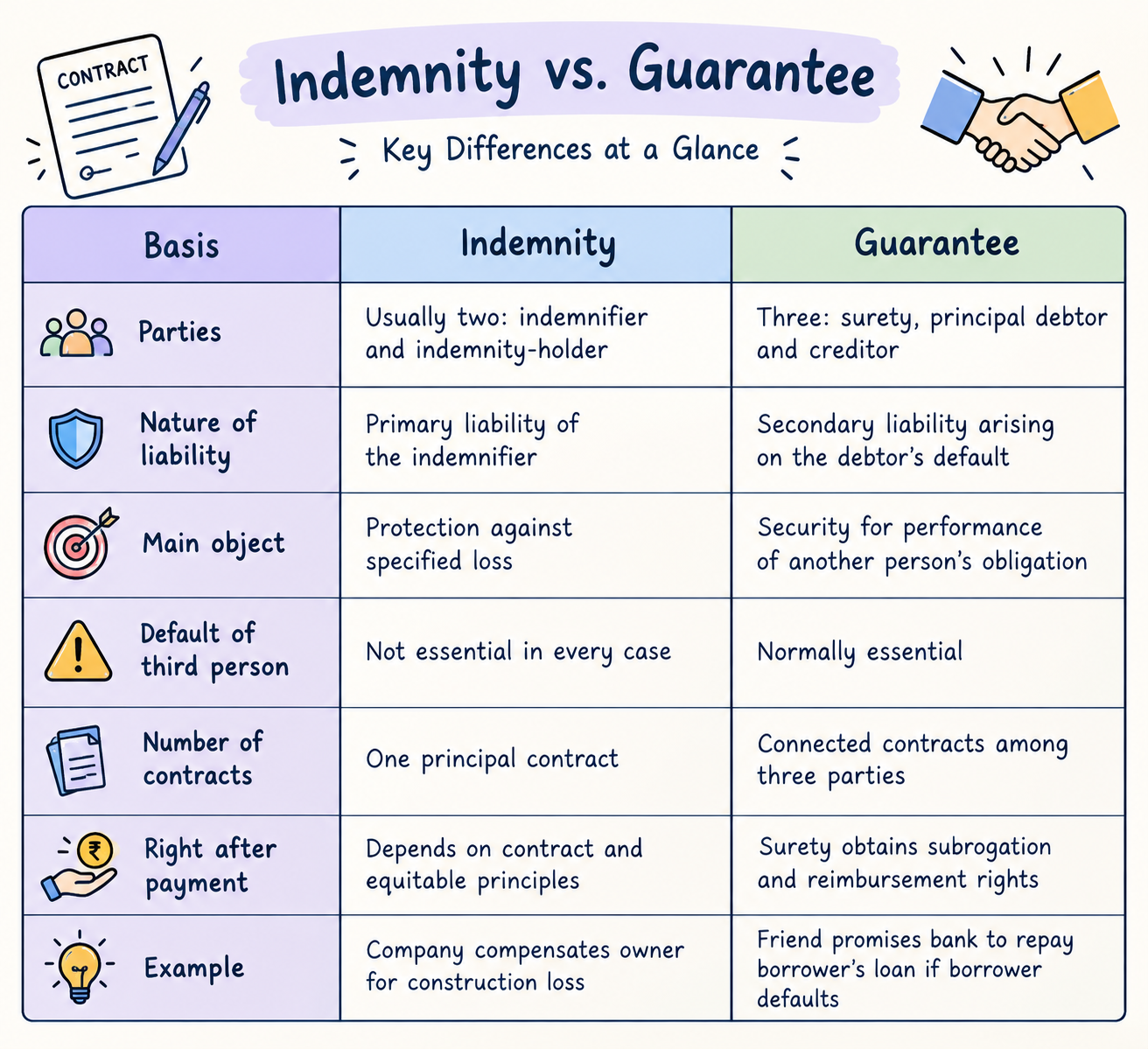
Difference between indemnity and guarantee
Conclusion
Indemnity and guarantee are practical tools for managing risk, but it is important not to confuse the two. With indemnity the risk of loss is passed on, whereas with a guarantee extra security is given in case of the other person’s default. In the case of indemnity the duty of the indemnifier is primary, and in the case of a guarantee the surety usually becomes liable if the principal debtor fails to pay, although the creditor may go directly against the surety.
The key difference in the examination is thus that indemnity offers protection against loss and a guarantee provides security for another person’s obligation.
Subscribe for updates
Join 10,000+ subscribers.
JU
Julie Nigam
Contributing author
Have a doubt about this?Ask Doubts
