
Interpretation of Delegatus Non Potest Delegare
Edit
TABLE OF CONTENTS
Introduction
Principle of Delegatus non potest delegare
Understanding "Delegatus Non-Potest Delegare"
Conclusion
Introduction
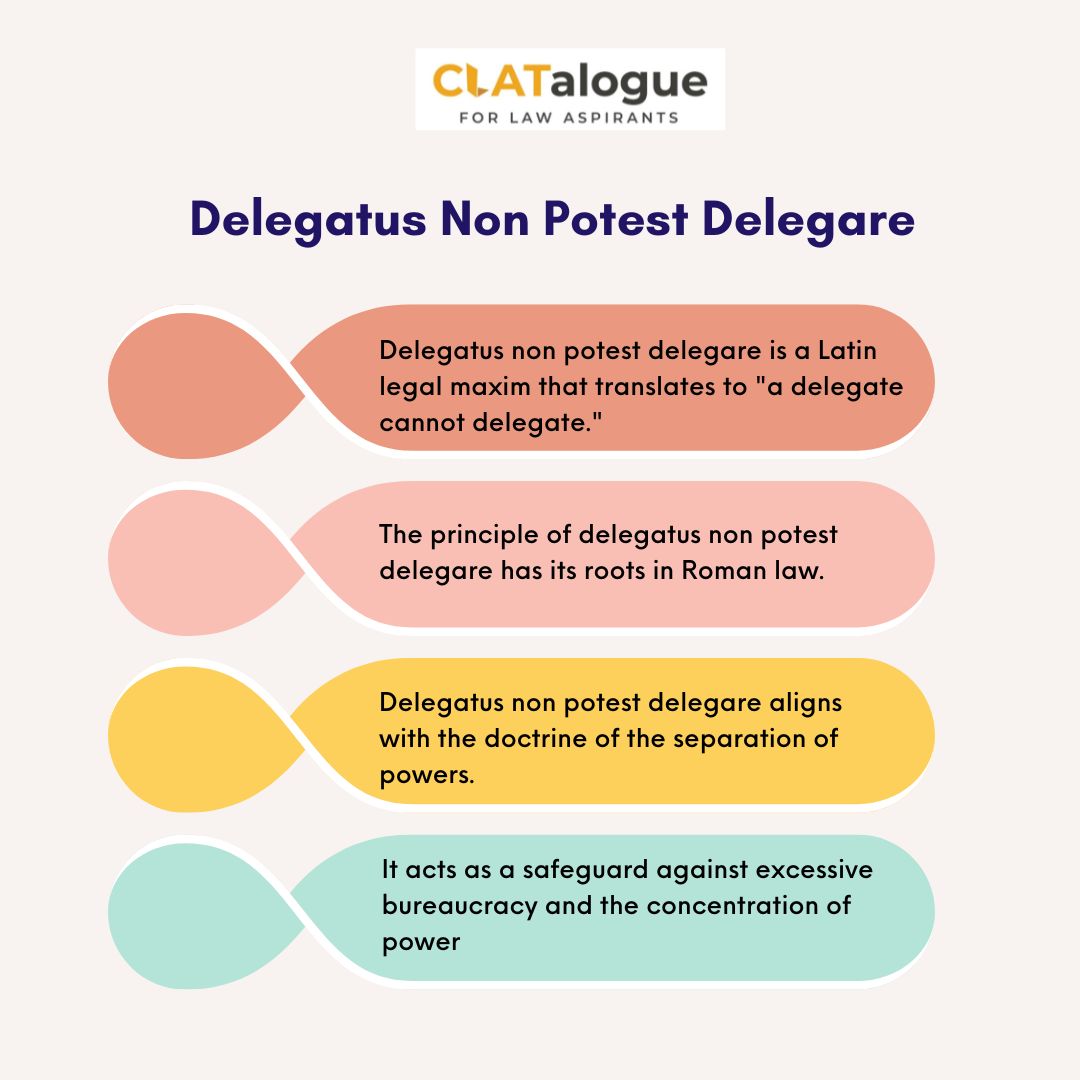
“Delegatus non potest delegare“ is a Latin legal maxim that translates to “a delegate cannot delegate.” It is a principle that generally applies to the delegation of powers or authority by one person or entity to another.
This post will delve into the interpretation and meaning of the definition of the legal maxim and its rules in delegation of powers.
Principle of Delegatus non potest delegare
According to this maxim, if a person or entity has been delegated a specific power or authority, they cannot further delegate that power or authority to someone else unless expressly permitted to do so.
The principle of delegatus non potest delegare is often applied in legal and administrative contexts, particularly in relation to delegated legislation, contractual agreements, and agency relationships. It serves as a safeguard to ensure accountability and prevent the excessive or unauthorized sub-delegation of powers.
Under this principle, the original delegate is responsible for carrying out the delegated task or exercising the delegated authority. They cannot transfer or delegate that responsibility to another person or entity unless there is a clear provision or legal authority permitting such sub-delegation.
However, it’s important to note that the principle is not absolute and can vary depending on the jurisdiction and the specific circumstances of the case. In some cases, statutes or agreements may expressly allow for sub-delegation, while in others, sub-delegation may be implied or permitted by custom or necessity.
Understanding “Delegatus Non-Potest Delegare”
The legal maxim “Delegatus Non-Potest Delegare” is a rule of construction of a statute rather than a rule of law.
Generally, sub-delegation of legislative power is not allowed, unless expressly permitted by the statute or can be inferred from necessary implication. This principle arises from the well-established doctrine of separation of powers, which prohibits one branch or organ of the government from encroaching upon the powers of another.
The doctrine ensures that the authority or entity to whom legislative power is delegated cannot transfer that power to someone else. In administrative law, delegatus non potest delegare acts as a safeguard against excessive bureaucracy and the concentration of power.
It establishes that administrative agencies, while granted certain powers by the legislature, cannot pass those powers onto other entities unless explicitly authorized by statute. This prevents agencies from overstepping their boundaries and maintains the democratic accountability of public decision-making.
This principle is considered a necessary corollary of the separation of powers, as it maintains the integrity and accountability of the delegated powers. The separation of powers divides the functions of governance among the legislative, executive, and judicial branches, ensuring a system of checks and balances.
By prohibiting further delegation, delegatus non potest delegare reinforces the idea that each branch should exercise its powers independently and be held accountable for their actions. It prevents the concentration of power in the hands of a few and ensures that those who exercise delegated authority do so within the limits set by the delegating authority.
Courts play a vital role in interpreting and upholding the principle of delegatus non potest delegare. When confronted with a potential delegation of power, courts analyze the relevant legislation and examine the intended scope of authority. Judicial scrutiny ensures that the delegation is within the permissible limits and that the delegated authority is exercised in accordance with the principles of fairness, reasonableness, and legality.
Conclusion
While the maxim primarily finds application in matters relating to principal and agent relationships, it extends to administrative law and the exercise of discretions conferred by statutes.
Administrative law, which has developed around this Latin maxim, deals with the extent to which an authority can allow another entity to exercise a discretion entrusted to itself by statute. The maxim serves as a guiding principle in interpreting and applying statutes that confer discretionary powers.
However, it is important to note that the maxim does not establish a rigid rule of law. Its application requires considering the language, purposes, and objects of the entire statute in question. The context and intent of the legislation must be examined to determine the permissibility of sub-delegation in each case.
Subscribe for updates
Join 10,000+ subscribers.
SA
Samridhi M
Contributing author
Have a doubt about this?Ask Doubts
