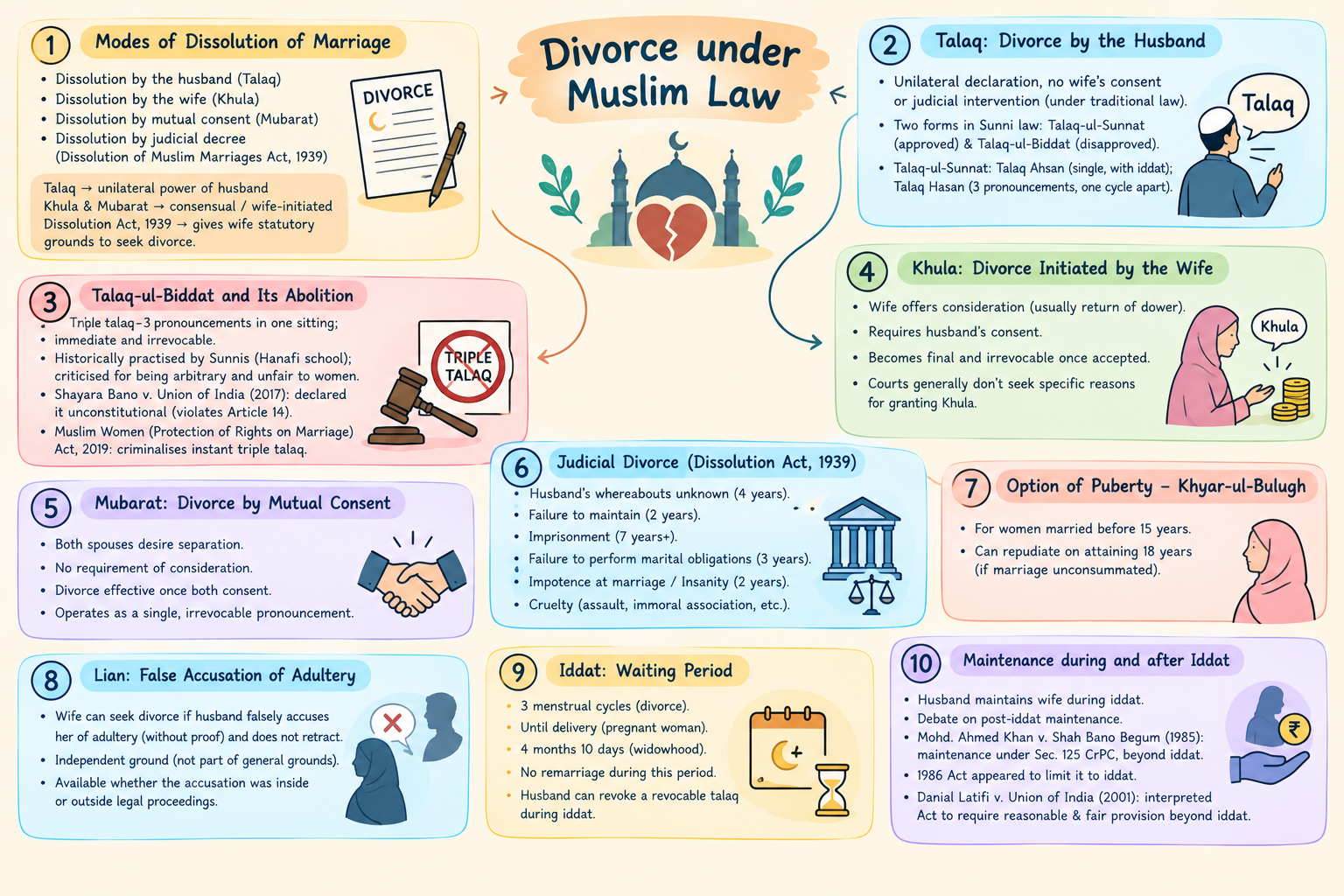
Divorce under Muslim law recognises multiple modes for dissolving a marriage, broadly classified into dissolution by the husband, dissolution by the wife, dissolution by mutual consent, and dissolution by judicial decree.
Talaq represents the husband's unilateral power to repudiate the marriage, while Khula and Mubarat represent consensual or wife-initiated dissolution respectively.
The Dissolution of Muslim Marriages Act, 1939 further introduced statutory grounds enabling a wife to seek judicial divorce independent of her husband's consent, addressing a significant gap that traditional Muslim law otherwise left unaddressed for wives seeking exit from an unwanted marriage.
Talaq: Divorce by the Husband
Talaq refers to the husband's power to repudiate the marriage through a unilateral declaration, without requiring the wife's consent or any judicial intervention under traditional Muslim law. Sunni law recognises two broad forms, namely Talaq-ul-Sunnat, meaning divorce in accordance with approved practice, and Talaq-ul-Biddat, meaning an innovative and disapproved form of divorce.
Talaq-ul-Sunnat further divides into Talaq Ahsan, considered the most approved form, involving a single pronouncement followed by abstinence from sexual intercourse during the wife's iddat period, allowing time for reconciliation.
Talaq Hasan involves three pronouncements made at intervals of one menstrual cycle, becoming irrevocable only upon the third pronouncement, thereby similarly preserving an opportunity for the parties to reconcile before the divorce becomes final.
Talaq-ul-Biddat and Its Abolition
Talaq-ul-Biddat, commonly known as triple talaq or instant talaq, allowed a husband to pronounce divorce three times in a single sitting, rendering it immediately irrevocable without any opportunity for reconciliation or mediation.
This form of divorce, though historically practised among Sunnis following the Hanafi school, attracted sustained criticism for its arbitrary and unilateral character, disproportionately disadvantaging Muslim women.
In Shayara Bano v. Union of India, a five-judge bench of the Supreme Court struck down the practice of instant triple talaq as unconstitutional, holding that it violated Article 14 by permitting an arbitrary form of divorce lacking any scope for reconciliation, and that this practice did not constitute an essential religious practice deserving constitutional protection.
Parliament subsequently enacted the Muslim Women (Protection of Rights on Marriage) Act, 2019, which criminalises the pronouncement of instant triple talaq by a Muslim husband and prescribes imprisonment along with the wife's entitlement to subsistence allowance and custody of minor children.
Khula: Divorce Initiated by the Wife
Khula refers to a form of divorce initiated by the wife, whereby she offers some consideration, typically the return of her dower, in exchange for the husband's consent to release her from the marriage.
The essential feature of Khula lies in the wife's initiative coupled with the husband's acceptance, distinguishing it from Talaq, which requires no reciprocal consideration or consent from the wife.
Once the husband accepts the wife's offer, the divorce becomes final and irrevocable, and courts generally do not require the husband's acceptance to state specific reasons for granting the Khula.
Mubarat: Divorce by Mutual Consent
Mubarat represents dissolution of marriage through the mutual consent and mutual desire of both spouses to separate, distinguishing it from Khula, where the wife alone initiates the process.
Under Mubarat, since both parties equally desire separation, the requirement of consideration flowing from the wife to the husband becomes largely irrelevant, and the divorce becomes effective once both parties express their consent to separate. Both Khula and Mubarat operate as a single irrevocable pronouncement once accepted.
Judicial Divorce under the Dissolution of Muslim Marriages Act, 1939
Section 2 of the Dissolution of Muslim Marriages Act, 1939 lists specific grounds on which a Muslim wife may obtain a decree of divorce from a court, addressing the historical absence of an extrajudicial remedy comparable to Talaq for women under most Sunni schools.
These grounds include the husband's whereabouts being unknown for four years, his failure to provide maintenance for two years, and his imprisonment for seven years or more.
The Act further permits a wife to seek divorce where the husband has failed to perform marital obligations for three years without reasonable cause, where he was impotent at the time of marriage and continues to be so, or where he has been insane for two years or suffers from virulent venereal disease.
Cruelty, defined broadly to include habitual assault, association with women of ill repute, disposal of the wife's property, or obstruction of her religious practice, also constitutes an independent ground under this Section.
Option of Puberty: Khyar-ul-Bulugh
Section 2(vii) of the Dissolution of Muslim Marriages Act, 1939 preserves the wife's option of puberty, allowing a woman married before the age of fifteen years to repudiate the marriage on attaining eighteen years, provided the marriage remained unconsummated.
This provision essentially codifies the traditional doctrine of Khyar-ul-Bulugh, which recognised that a minor girl married off without her consent, typically by a guardian, deserves an opportunity to exit the marriage upon reaching majority.
Lian: Divorce Following False Accusation of Adultery
Lianrefers to a wife's right to seek dissolution of marriage where her husband falsely accuses her of adultery without proof, and this accusation, if unretracted, entitles the wife to approach the court for a decree of divorce.
The husband's failure to substantiate the charge or his refusal to retract it operates as a ground independent of the general grounds listed under the 1939 Act, recognising the wife's right to exit a marriage where her chastity has been unjustly impugned.
Courts treat Lian as available regardless of whether the false accusation was made in or outside legal proceedings, provided the essential elements of an unproven and unretracted charge exist.
Iddat: The Waiting Period after Divorce
Iddat refers to the mandatory waiting period a Muslim woman must observe after divorce or her husband's death, during which she cannot remarry, primarily intended to ascertain whether she is pregnant and to determine the paternity of any child conceived during the marriage.
The iddat period for divorce generally lasts three menstrual cycles, while for a pregnant woman it extends until delivery, and for widowhood it extends to four months and ten days regardless of pregnancy. During the subsistence of iddat, the husband ordinarily retains the right to revoke a revocable Talaq, restoring the marriage without requiring a fresh Nikah.
Maintenance during and after Iddat
The husband generally remains obligated to maintain his wife throughout the iddat period following divorce, and the interpretation of his obligation beyond this period has generated significant judicial controversy.
Following the political controversy this ruling generated, Parliament enacted the Muslim Women (Protection of Rights on Divorce) Act, 1986, which initially appeared to confine the husband's obligation to the iddat period alone.
However, in Danial Latifi v. Union of India, the Supreme Court upheld the 1986 Act's validity while interpreting it to require the husband to make reasonable and fair provision extending beyond the iddat period, effectively preserving the substance of the Shah Bano ruling within the framework of the special statute.