Election Commission of India: Powers and Functions
Edit
TABLE OF CONTENTS
Introduction
Relevant Provisions in the Indian Constitution
History of the Election Commission
Composition of the Election Commission
Powers of the Election Commission
Importance of Election Commission in the Modern Day
Conclusion
Introduction
The Election Commission of India (ECI) is a vital organization that plays a critical role in safeguarding the democratic functioning of the world’s biggest democracy. The Election Commission, established under the provisions of the Indian Constitution, is in charge of ensuring free and fair elections at all levels of government.
This post notes the Election Commission of India’s constitutional foundation, historical history, composition, powers, and modern-day significance, emphasizing its critical role in safeguarding the nation’s democratic values.
Relevant Provisions in the Indian Constitution
The Election Commission of India is founded on many provisions of the Indian Constitution. Articles 324 to 329 are dedicated to the provisions pertaining to the Election Commission. The Election Commission is given superintendence, supervision, and control of elections under Article 324.
The Commission is empowered by the Article to conduct and supervise all parts of the election process, guaranteeing its impartiality and integrity. Furthermore, Article 325 outlaws any discrimination in the exercise of the right to vote based on religion, race, caste, gender, or place of birth, making Indian elections genuinely democratic and inclusive. These constitutional provisions serve as the foundation for the Election Commission’s jurisdiction and duties.
History of the Election Commission
Sukumar Sen, the country’s first Chief Election Commissioner (CEC), led the establishment of the Election Commission of India in 1950. Sen was at the head of ensuring the successful conduct of the country’s initial general elections in 1951-52, which saw an extraordinary voter participation of over 176 million persons choosing MPs to the Lok Sabha.
Following Sukumar Sen’s stint as the first Chief Election Commissioner, the Election Commission of India has been led by a number of remarkable people, each of whom has left their imprint on the institution’s history.
Composition of the Election Commission
Since its creation, the composition of the Election Commission of India has undergone major changes. When the Election Commission was established in 1950, it had only one member: the Chief Election Commissioner (CEC). Sukumar Sen was the country’s first Chief Election Commissioner, in charge of monitoring the electoral process during the country’s first general elections in 1951-52.
However, as India’s democratic framework evolved and the volume and complexity of elections grew, there was a growing realization within the Election Commission of the need for a more participatory decision-making process. As a result, the Election Commission’s composition was redesigned in 1989, and it was made a three-member body.
The CEC and two Election Commissioners (ECs) made up the three-person system. This modification aims to promote more in-depth talks, allow for a broader viewpoint in electoral decision-making, and properly allocate responsibilities among Commission members.
The addition of two Election Commissioners in addition to the Chief Election Commissioner aided in ensuring joint decision-making and improved democratic control of the election process.
The President of India appoints the Chief Election Commissioner and the Election Commissioners. The selection procedure takes into account their qualifications, experience, and fit for the prestigious posts.
The purpose of the Presidential appointment is to guarantee that the persons picked have the highest level of integrity, competency, and impartiality necessary to protect the sanctity of the democratic process.
The Indian Constitution includes provisions on the term and removability of the Election Commission and its members to protect their independence. Article 324 of the Indian Constitution concerns the composition, appointment, and duration of the Election Commission.
Powers of the Election Commission
The Election Commission of India has considerable powers that allow it to conduct elections with impartiality and efficiency, maintaining the democratic process’s integrity. Some of them are listed below:
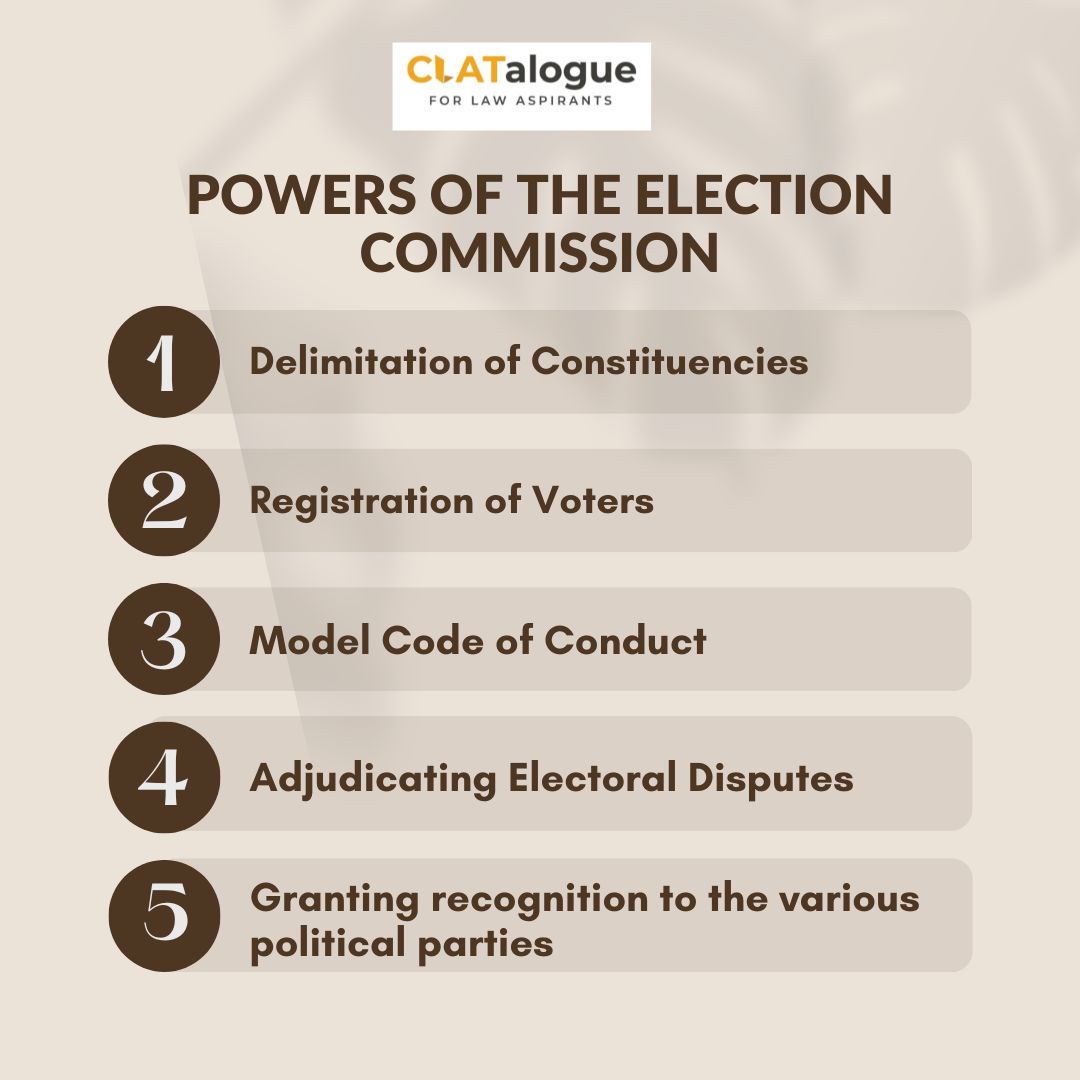
Constituency Delimitation: One of the Election Commission’s primary responsibilities is to carry out constituency delimitation. This entails altering the borders of parliamentary and assembly seats in order to achieve equitable representation and population distribution.
The approach seeks to balance demographic shifts and avoid over- or under-representation in particular locations. Delimitation aids in the preservation of the ideal of “one person, one vote,” guaranteeing that each citizen’s vote has equal weight in the election process.
Voter Registration: The Election Commission is in charge of preparing electoral rolls, which are a list of all eligible voters in each district. The Commission is in charge of constantly updating and maintaining the voter database. It guarantees that all eligible persons can register to vote and participate in the political process.
To assist voter registration, the Commission employs a variety of methods, including door-to-door campaigns, online registration portals, and designated voter registration centres. This procedure aids in the elimination of duplicate or fraudulent entries, hence creating a fair and inclusive election system.
Model Code of Conduct: The Model Code of Conduct (MCC) is a set of rules established by the Election Commission for political parties and candidates to follow throughout the election season. Its goal is to ensure fair play, avoid abuse of power, and preserve the dignity of the election process.
The MCC establishes guidelines for campaign behaviour, the use of public resources, and the avoidance of provocative or divisive speech. The Election Commission ensures a fair playing field for all political parties and candidates by enforcing the MCC, reducing the effect of money and brute force in elections.
Electoral issues: The Election Commission resolves election-related issues in a transparent and neutral manner. The Commission functions as an arbitrator in cases of claims of electoral malpractice, infractions of election regulations, or challenges to election results.
It examines complaints, holds hearings, and guarantees that a fair and reasonable conclusion is reached. The work of the Election Commission in resolving election disputes adds to the confidence and legitimacy of the electoral process, assuring voters of the institution’s commitment to democratic norms.
Importance of Election Commission in the Modern Day
Openness: The Election Commission’s emphasis on openness and accountability in election-related activities encourages trust in the electoral process’s impartiality. It assures that election procedures are carried out transparently and that results are made public, eliminating accusations of electoral fraud and manipulation.
Fair Representation: The Election Commission guarantees that every vote bears equal weight by delimiting constituencies and guaranteeing correct voter registration, resulting in fair representation in legislative bodies. This guarantees that all segments of society’s opinions are heard and represented in decision-making.
Fair Playing Field: The Model Code of Conduct assures that all political parties and candidates have a fair playing field during elections. The Commission reduces the misuse of power and resources by ensuring ethical conduct and fair practices, supporting healthy competition and a more democratic election scene.
Security Concerns: Security and credibility are enhanced by the Election Commission’s attempts to implement current technology and security measures, such as Electronic Voting Machines (EVMs) and Voter-Verified Paper Audit Trail (VVPAT) equipment. These methods aid in the prevention of election fraud and the preservation of the democratic process.
Public Participation and Awareness: The Election Commission regularly participates in voter education efforts to educate residents about the importance of voting and the election process. These efforts promote higher voter turnout and active involvement, resulting in a more engaged and educated electorate.
Conflict Resolution: In places where there are political conflicts or disturbances, the Election Commission’s unbiased approach to administering elections is critical to maintaining peace and resolving political disagreements democratically. It serves as a forum for peaceful conflict settlement and power transition.
Conclusion
The Election Commission of India is a vital institution in the current setting, zealously safeguarding the nation’s democratic principles. Its efforts to maintain election integrity, inclusion, openness, and equitable representation have made a substantial contribution to India’s democratic vigour.
The Election Commission remains the cornerstone of India’s democratic fabric, establishing the foundation of the nation’s governance and determining its democratic future by ensuring free and fair elections and encouraging individuals to exercise their right to vote.
Subscribe for updates
Join 10,000+ subscribers.
SA
Samridhi M
Contributing author
Have a doubt about this?Ask Doubts

