
In Conversation with Faiz Ayat Ansari (Assistant Professor of Law, KIIT Law School) on his Exciting Journey in the Field of Law
In Conversation with Faiz Ayat Ansari (Assistant Professor of Law, KIIT Law School) on his exciting and inspiring journey in the field of Law as well as his Law School Journey.
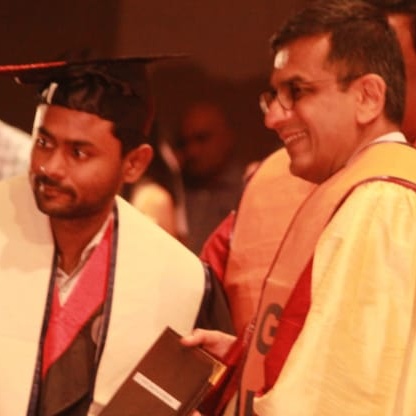
Tell us a bit about yourself.
Hi everyone ! I am Faiz Ayat Ansari. I am an Assistant Professor of Law at KIIT School of Law, KIIT Deemed to be University (Institution of Eminence), Bhubaneswar, India; a PhD Research Scholar at the National Law School of India University, Bengaluru and a Researcher and Collaborator at Mediterranea International Centre for Human Rights Research, Reggio Calabria, Italy.
I previously worked as Assistant Professor and Coordinator, Centre for Constitutional Law and Policy (CCLP) at Parul Institute of Law, Faculty of Law, Parul University, Vadodara. I did my B.A.LL.B. (Hons.) from Baroda School of Legal Studies, Faculty of Law, The Maharaja Sayajirao University of Baroda. I am also an alumnus of Gujarat National Law University, Gandhinagar, where I pursued my LL.M. in Constitutional and Administrative Law.
I have been a member of the Legal Education Awareness Foundation, New Delhi and have been invited to deliver guest lectures at prestigious international institutions like Stanford University, US; the Diplomatic Academy of the Ministry of Foreign Affairs, Russia; State Academic University for the Humanities, Russia; Istanbul Topkapi University, Turkey; University St. Kliment Ohridski, North Macedonia; Barcelona Technological School, Spain; International Group of Artificial Intelligence, UK; the Federal District University Centre (UDF), Brazil, the Mediterranea International Centre for Human Rights Research, Italy and the Tashkent State University of Law, Uzbekistan.
I have a keen interest in bridging the gap between the academia, policy making and the industry in the legal field. My areas of interest include Constitutional law, Comparative Public Law, Media law, etc. I have previously co-authored a book titled ‘Law and Justice in the Era of Globalization’ and co-edited six books on areas like Constitutional law, Comparative Public Law, Media law and International Law.
I am also a recipient of the Dr. J.K. Patel Memorial Award in 2021 and 2022 for my contribution to research and academics. I also received the International Interdisciplinary Eminent Speaker Award by the Peruvian Bar Association in 2022.
How did you start your law school journey?
Well, to be honest, law was not the first career choice which I had initially thought of, nor was it the second! I initially wanted to play cricket for India (I am still a cricketer at heart) and my second career choice was to be a medical professional. Therefore, I opted for the science stream in my 12th standard.
I had taken the AIPMT examination at that point of time for medical entrance. Based on my merit in the general category, I was being offered admission in the dental field. I wasn’t too much interested in that field. So you can say that this was the pre-law period in my life.
Though not expressly as a career choice, I always had a liking for law throughout my school days as well. I was good at public speaking and had a liking to express my views to the public at large. This liking was more or less an implied one and I hadn’t yet realized that I could pursue a career in law.
The credit for making me realize this actually goes to my mother who one fine day, out of the blue, asked me ‘Why don’t you pursue a career in law?’ when I was wondering whether I should give the medical field another try or not. That is what was actually the triggering point of me opting to pursue a career in law.
And I am extremely happy till date that I made the decision at that point of time. In fact, I did not know that there are so many career avenues within law itself and it is such a dynamic career option.
I was probably only aware of the career options which a layman in India knows about law i.e litigation and to an extent judiciary. Once I entered into the field of law, I got to know about the whole lot of career options which one can pursue and the dynamics of law.
How were the initial years of your law school journey?
Well, in one word, exciting. I was always keen to learn more about the law. I was really fascinated with law courses which I learnt in the initial years of my Law School journey like Constitution law, Criminal law, Law of Torts etc. Even though I had a science background, but I absolutely used to love my political science classes as well.
The dynamism which social sciences brings to understanding of the law and society is something which totally caught my mind. I really used to get involved a lot in the class discussions and debates about various topics of law. I was also very much interested in moot courts and was fortunate to represent my institution in two national moot courts in my first three semesters itself at law school.
Even though I had to be quite patient with respect to testing substantial success at the national moot court level (I was a part of a Gold Medal winning team at a National Moot in my fourth year), I absolutely loved mooting.
Apart from being actively involved in academics being regularly amongst the toppers of the batch and moot courts, I was also very much into debating. I particularly had a liking for the Asian style parliamentary debate where I again represented my institution several times in various such national debate competitions. It was a very exciting journey as I also managed to keep my passion for cricket intact during my law school days and was a part of the silver medal winning team in the third year of my law school.
I was also very much interested to carry out various research based activities. However, I only started to pursue research on a serious note perhaps towards the end of my second year and beginning of my third year.
I was also fortunate enough to have certain good teammates in both my moot court and research pursuits. However I believe that the most important qualities which I solidified in myself is discipline and punctuality (not to say that I was undisciplined earlier!).
For the first two years of my law school, I used to commute on train from Godhra to Vadodara where my law school was situated. In order to reach bang on time for the first lecture which used to be at 9:00 a.m., I used to board the Paschim Express around 7 am. from Godhra. The final lecture would be over at 1.30 pm and the train to Godhra (Swaraj Express/ Sarvodaya Express) would depart at 1.45 pm. So I used to have exactly 15 minutes to sprint as fast as I could from the law school to Vadodara railway station.
I had to do this because the next train to Godhra would be after 4 o’clock which would be too late. So this entire experience inculcated a sense of strong discipline and work ethics in me and grew me as a person.
What motivated you to pursue law as a career?
Rather than focusing on the what in this question, I believe that it would be better answer if I answer ‘Who’. As I mentioned earlier, the entire credit in order to trigger my understanding for seriously taking up law as a career goes to my mother. She is the one who identified the qualities in me and imagined that I would be a successful legal professional. I absolutely owe it to her that she understood me bang on and thankfully, by the grace of The Almighty, there has been no looking back since then.
Tell us a bit about your experience while taking the entrance test for admission into LLM courses. How was that experience different from the time you took the entrance test for UG?
So, from the preparation and the strategic point of view for the CLAT PG entrance exam, it was quite simple. In fact, I would opine that one should keep it simple and not unnecessarily complicate things while preparing for CLAT PG entrance exam.
The subjects involved in the CLAT PG entrance test are not alien ones for a law student. All the subjects are core subjects as prescribed by the Bar Council of India and it is not possible for a law student to not have studied any of the subjects at some point of time in their law graduation.
With respect to the preparation, one thing one should always keep in mind is that which are the subjects one is really good at and which are the subjects one is not really good at. I personally believe that the subject in which you are not at all good, you will not be extremely good in that subject in a short span of time.
This ideology leads to my personal strategy that you should maximize your strong points and minimize your weak points. This essentially means that if you are not good in ‘X’ law subject, you should not focus all your energy or most of your energy on ‘X’ subject. Instead, you should just work towards having a decent knowledge of ‘X’ subject in which you are weak and then leave it at that.
Instead, most of your time and energy should be dedicated to the subject in which you are strong and your primary aim should be to absolutely maximize your benefits in that subject. With respect to the second part of your question, I believe there is significant difference in the preparation for CLAT UG and CLAT PG examinations.
There is usually a lot of uncertainty when it comes to CLAT UG examination since people come from all sorts of backgrounds including science, commerce, humanities etc. However when it comes to the CLAT PG examination there is a sense of stability and consistency. It is kind of a straight forward thing where you know what you need to prepare and come up with a strategy which will work for you.
What were your top 3 sources of information while preparing for the law entrance exam? Did you prepare for the exam all by yourself?
I primarily referred to the CLAT LL.M. entrance book by Universal as well as the UGC NET law book by the same publisher. These books comprehensively cover most of the subjects which are required to be studied for CLAT PG entrance examination. The one subject which I believe was not adequately covered in these entrance books is Jurisprudence. So, for jurisprudence I referred V D Mahajan’s book on Jurisprudence and Legal Theory. I did not take any coaching for the same.
What would you say sets apart your story from others?
I believe the diversity of the institutions (both in terms of type of institution and geography) which I have been a part of, both as a student as well as professionally is something which is quite unique.
As someone born in Sultanpur, Uttar Pradesh (North India), I’ve done all my schooling from St. Arnold’s High School, Godhra. I’ve done my B.A.LL.B. (Hons.) from the Maharaja Sayajirao University of Baroda and LL.M. from Gujarat National Law University, Gandhinagar ( all in West India).
I’ve worked at Parul University, Vadodara (West India) for four years and I am pursuing my PhD from the National Law School of India University, Bengaluru (South India). Presently, I’m working as an Assistant Professor (Senior Scale) at KIIT School of Law, KIIT Deemed to be University, Bhubaneswar (East India).
So, I have been part of traditional state universities, national law universities and private universities across the length and breadth of India. This has brought a wide variety of experiences to me which I cherish a lot.
Any advice you’d like to pass on to law school aspirants and law students?
As I have laid down in certain earlier conversations as well, law is as dynamic as a career choice would get. However, in order to reap the maximum benefits, you should first of all respect yourself. You should not get carried away in a negative manner by what ‘people’ have to say.
If you yourself start thinking about what people have to say (negatively) about you, then what will be left for the people to think?! The one person who you need to understand the most in your life is yourself. When you start the implementation of this attitude, unnecessary talks of irrelevant people don’t bother you and you actually figure out the correct people with whom you would like to keep a bond much quicker. I personally call this the ‘Theory of Irrelevance’, where the thing which in no way is important for you finds itself in the irrelevant category de facto.
This may seem to be a fairly simple thing, but it is this thing where students or people in general struggle the most. There are multiple things which go on in a law student’s life. I am not even touching the personal side of things and sticking to simply the law school life. Exams, projects, viva, moots, debates, judgment writing, being part of societies and centres and the urge or pressure to participate in practically everything under the sun.
In this extreme dynamic, competitive and sometimes chaotic scenario, it’s important that one does not lose one’s soul. One should not get lost in the crowd just to satisfy some peer pressure or one’s own expectations. Try to maintain your originality. Identify what incites your passion.
It’s great to carry out co-curricular and even extra-curricular activities, but it should not come at the cost of something which forms and builds your core i.e. academics and class discussions. These co-curricular activities should not be understood as a substitute to academics. I say this with responsibility having tried to always have a balance between academics, co-curriculars and extra-curriculars myself. None of them should come at the cost of each other.
Also, one needs to avoid having a false sense of entitlement and pride. Staying humble is the most important quality for a law student. There is a fine line between being confident and being arrogant.
One should have one’s legs on the ground and head in the sky. Moreover, one also needs to respect one’s body and not play around with the body clock. Even though it’s a subjective thing, but I believe in the good old theory whereby the day is meant for work and the night is for relaxing. So never make it a habit of compromising with your sleep for work or studies.
This interview is a part of our series #MyStory where we interview law students and legal professionals.
Click here to submit your #LawSchoolJourney
Subscribe for updates
Join 10,000+ subscribers.
RU
Ruchika Mohapatra
Contributing author
Have a doubt about this?Ask Doubts
