
How to Remember Sections? Tips and Tricks to Retain and Recall!
Are you finding it difficult to remember sections and various legal provisions? Read this post to learn how to master the art of remembering legal sections and provisions!
Introduction
One of the most challenging aspects of studying law is the sheer volume of sections, provisions, and case laws that one needs to remember. Subjects like Constitutional Law, Criminal Law, and Contract Law are filled with intricate details, each of which can be crucial in the CLAT PG exam or any legal career. However, with the right strategies, remembering these sections and provisions becomes more manageable. This article provides effective techniques to help you retain and recall legal sections and provisions, complete with practical examples.
I. Understanding the Importance of Context
1.1 The Role of Context
Memorisation becomes easier when you understand the context and purpose behind a legal provision. Rather than memorising a section in isolation, try to comprehend the broader legal framework in which it operates. For example:
- Article 21 of the Indian Constitution: Instead of just remembering that it guarantees the “right to life and personal liberty,” understand that this article has been expansively interpreted by the courts to include rights such as the right to privacy, the right to a clean environment, and the right to legal aid. This context makes it easier to recall the provision during exams or in practice.
- Section 300 of the Indian Penal Code (IPC): This section defines murder. By understanding that this section is built on the foundation laid by Section 299 (culpable homicide), it becomes easier to differentiate between the two and remember the specific clauses that distinguish murder from culpable homicide.
1.2 Creating Mental Maps
Creating mental maps is a technique that involves visualising the relationships between different sections and provisions. For instance:
- Constitutional Law: Imagine the Constitution as a tree. The Preamble is the root, fundamental rights are the trunk, directive principles are the branches, and amendments are the leaves. Visualising the Constitution in this way can help you remember where each article fits within the broader legal structure.
- Contract Law: Picture the formation of a contract as a journey. Offer and acceptance are the starting points; consideration is the fuel; and the legal purpose is the destination. Along the way, you encounter various provisions like Section 10 (essential elements of a valid contract) and Section 23 (lawful consideration and objects). This journey metaphor helps in recalling the sections in a logical sequence.
II. Dividing Information
2.1 Breaking Down Complex Sections
Chunking is a powerful memory technique where you break down complex information into smaller, more manageable parts. For legal sections that are lengthy or detailed, this approach can be particularly useful.
- Example: Section 375 of the IPC (Rape): This section is detailed, with numerous clauses defining what constitutes rape. To remember it, break it down into chunks: By breaking down the section into these key elements, you can recall the entire provision more easily.
- Define the basic concept of rape.
- Memorise the specific circumstances that qualify as rape (e.g., without consent, with a minor).
- Note the exceptions provided in the section (e.g., marital rape exception for wives over a certain age).
2.2 Grouping Similar Sections Together
Another effective method is grouping similar sections together to reinforce memory. For instance:
- Constitutional Law: Group all the fundamental rights articles (Article 12-35) together. By studying them as a collective, it becomes easier to remember individual articles. Similarly, group the directive principles (Article 36-51) and fundamental duties (Article 51A).
- Criminal Law: When studying the IPC, group sections related to specific crimes. For example, Sections 299 to 304 deal with homicide-related offenses. By studying these sections as a group, you reinforce your understanding and memory of how they interrelate.
III. Use of Mnemonics
3.1 Creating Mnemonics for Legal Provisions
Mnemonics are memory aids that help you recall information through association. For legal sections, creating acronyms or phrases can be particularly useful.
- Example: Article 19 of the Indian Constitution (Freedom of Speech and Expression): To remember the six freedoms guaranteed under this article, create a mnemonic like “SAMPLE,” where:
- S stands for speech and expression.
- A stands for Assembly,
- M stands for movement.
- P stands for profession.
- L stands for life and liberty (freedom to live anywhere).
3.2 Associative Learning
Associative learning involves linking new information with something familiar. This can be an effective way to remember sections and provisions.
- Example: Section 124A of the IPC (Sedition): Associate this section with a famous case like Kedar Nath Singh v. State of Bihar, which upheld the constitutionality of Section 124A but also laid down safeguards against misuse. By linking the section to a landmark case, you create a mental cue that helps you recall the provision more easily.
- Example: Article 356 of the Indian Constitution (President’s Rule): Associate this article with the 1975 Emergency in India. Remembering the historical context makes it easier to recall the article and its implications.
IV. Regular Revision and Active Recall
4.1 Spaced Repetition
Spaced repetition is a memory technique that involves reviewing information at increasing intervals. This method is particularly effective for long-term retention of legal provisions.
- Example: Weekly Review Sessions: After studying a section, revisit it the next day, then after three days, then after a week, and finally after a month. This spaced repetition helps reinforce the information in your long-term memory.
- Example: Flashcards: Create flashcards with the section number on one side and the content or key points on the other. Regularly test yourself using these flashcards, spacing out your review sessions to reinforce memory.
4.2 Practice Through Application
Applying what you’ve learnt in practical scenarios is one of the best ways to solidify your memory. This could involve solving case studies, participating in moot courts, or discussing hypothetical situations.
- Example: Case Analysis: When reading case judgements, try to identify and recall the relevant sections involved in the case. For instance, while reading the Vishaka v. State of Rajasthan case, remember how the Supreme Court linked the guidelines to Article 21 (Right to Life) and Article 19(1)(g) (Freedom to practice any profession).
- Example: Hypothetical Questions: Create hypothetical legal scenarios and challenge yourself to identify the applicable sections and provisions. This exercise helps in reinforcing the sections in a practical context.
V. Visualisation and Storytelling
5.1 Visualising Legal Scenarios
Visualisation involves creating mental images of how legal principles apply in real life. This technique helps in remembering abstract concepts by making them more concrete.
- Example: Visualising Theft (Section 378, IPC): Picture a scenario where someone takes another person’s wallet without permission. Visualise the act of theft, the intent, and the victim’s reaction. This vivid image helps in recalling the section and its key components.
- Example: Visualising Contracts (Indian Contract Act): Imagine two parties signing a contract. Visualise the negotiation, the exchange of promises, and the formal agreement. Picture what happens if one party breaches the contract. This visualisation aids in remembering the key sections related to contract formation and breach.
5.2 Storytelling
Creating a story around a legal provision can make it more memorable. Stories are easier to remember because they engage your imagination and emotions.
- Example: The Story of Promissory Estoppel (Indian Contract Act): Imagine a scenario where a landlord promises a tenant not to increase the rent for a year. The tenant, relying on this promise, renovates the apartment. The landlord then tries to increase the rent. This story helps in remembering the principle of promissory estoppel and its application under Section 115 of the Indian Evidence Act.
- Example: The Story of Defamation (Section 499, IPC): Picture a journalist writing a false article that damages a celebrity’s reputation. The celebrity sues the journalist for defamation. This narrative helps in recalling the elements of defamation and the defences available under the law.
Conclusion
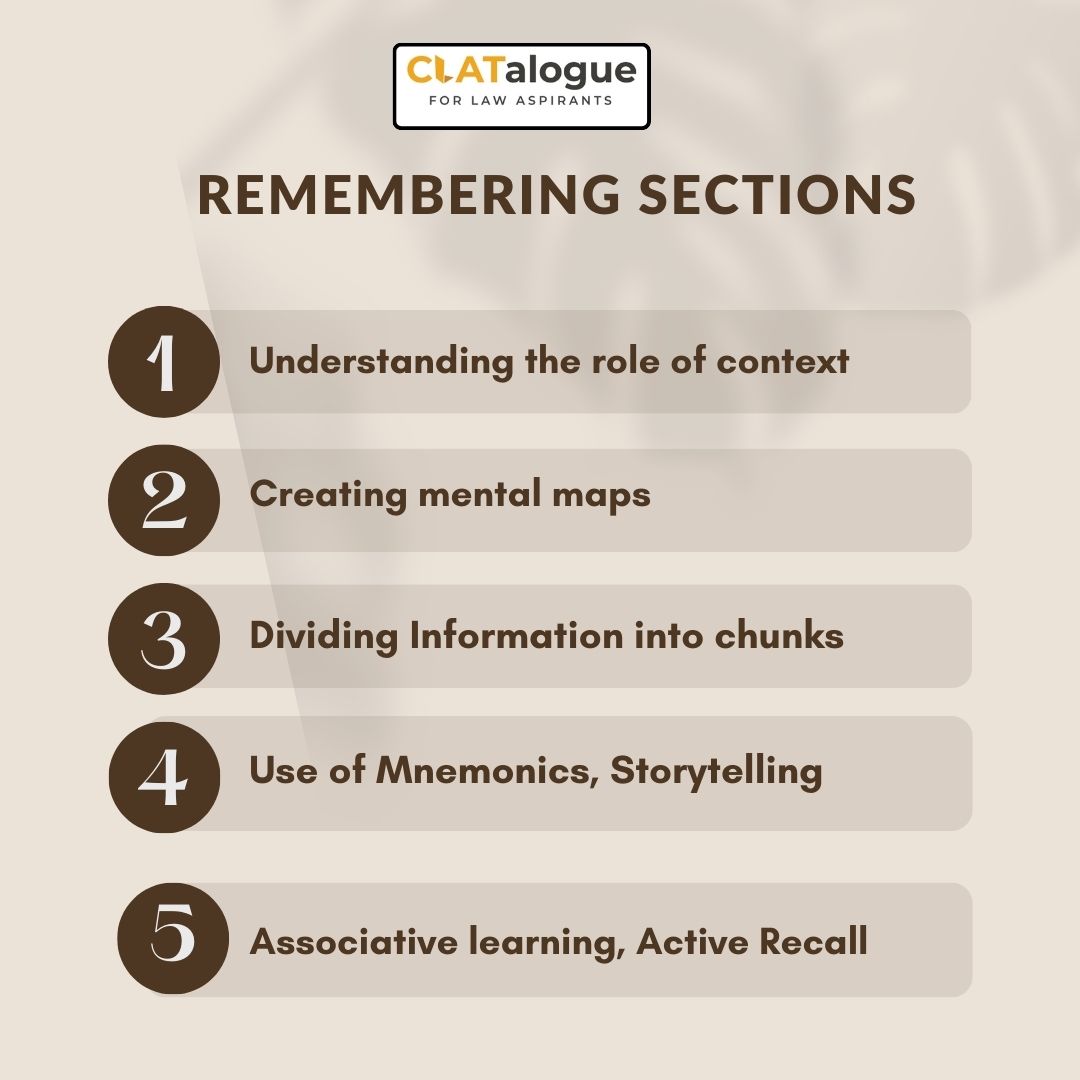
Remembering sections and provisions can be daunting, but with the right techniques, it becomes much more manageable. By understanding the context, using mnemonic devices, chunking information, practicing active recall, and applying visualisation and storytelling, you can enhance your ability to remember complex legal material. Consistency and regular revision are key to making these techniques effective. As you prepare for exams or practice law, these strategies will not only help you memorise sections but also deepen your understanding of the law as a whole.
Subscribe for updates
Join 10,000+ subscribers.
IN
Indrasish Majumder
Contributing author
Have a doubt about this?Ask Doubts
