Important Supreme Court Cases & Decisions: July 2021
As a law school aspirant preparing for CLAT or any other law exam, you are required to stay on top all legal developments that take place in the country. At CLATalogue, we have compiled a list of all important Supreme Court cases and decisions delivered in July 2021. These are important from, both, an examination point of view and for your general knowledge.
Here we go:
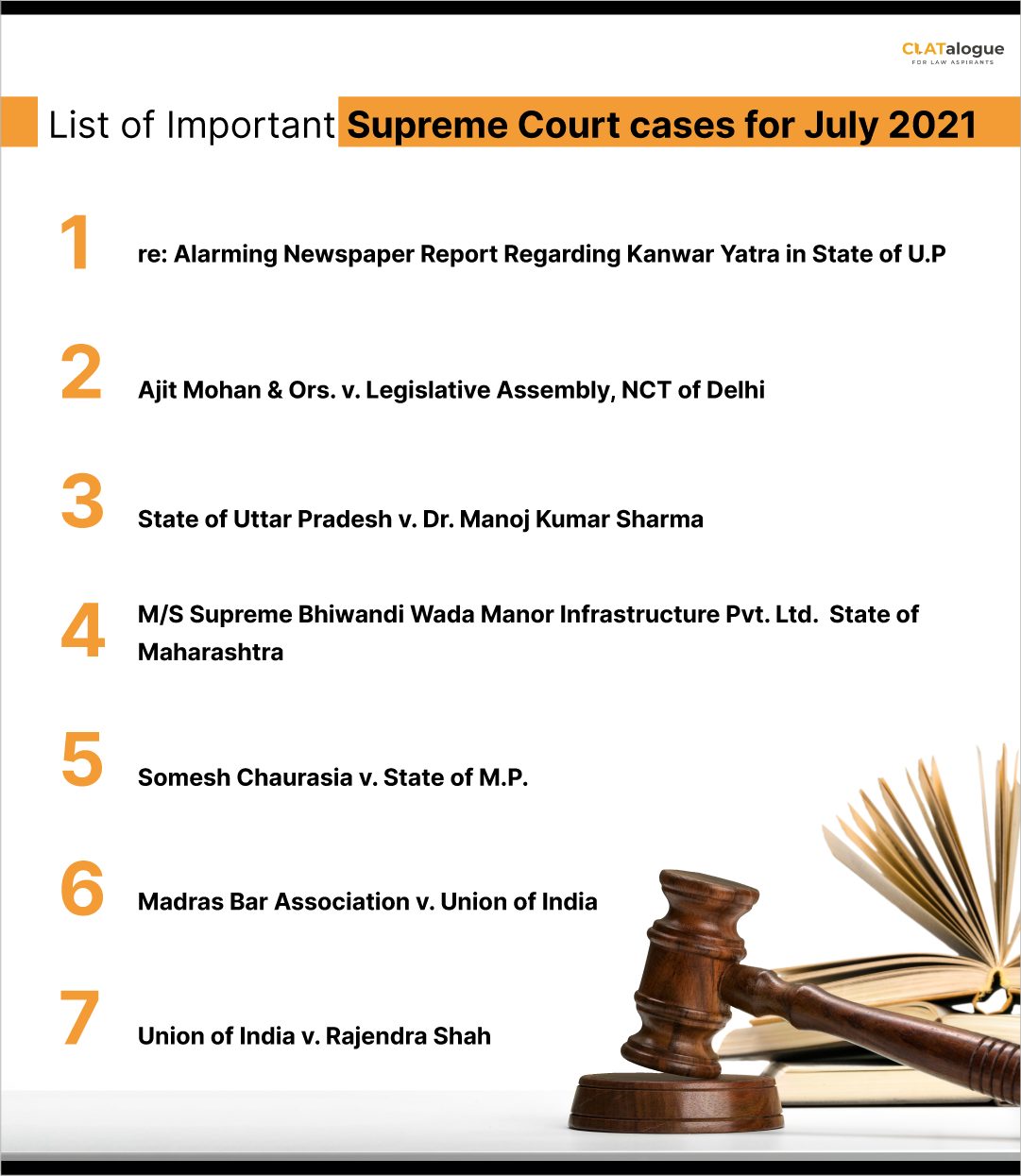
- In re: Alarming Newspaper Report Regarding Kanwar Yatra in State of U.P.[i]
Bench: RF Nariman and BR Gavai, JJ.
- In this case, the Court had taken suo motu cognizance of holding the Kanwar Yatra by the state of Uttar Pradesh, after perusing a report in the Indian Express[ii], because of an anticipated third wave of COVID-19. It is worth noting that the Union was not in favor of holding the Yatra. The Court asked the State Government to reconsider holding the physical form of the pilgrimage, observing that the right to life—that concerned all citizens, was “paramount” and that religious sentiments are subservient to this right. Pursuant to this, the U.P. Government called it off.
- In a related matter[iii], the same Bench of the Court criticized vehemently the decision of Kerela Government to relax lockdown requirements on account of ‘Bakrid’. The Court condemned allowing the opening of shops in areas with highly critical spread (labelled as ‘Category D’), and said that the plea to exercise restraint in the Government Notification doesn’t ensure the citizens’ right to health and safety. In conclusion, the Court said that religious (or otherwise) pressure groups mustn’t interfere with Fundamental Rights. The Court also said that Kerela Government must pay heed to Article 144 of the Constitution and follow the law laid down in the Kanwar Yatra case.
- Ajit Mohan & Ors. v. Legislative Assembly, NCT of Delhi[iv]
Bench: Sanjay Kishan Kaul, Dinesh Maheshwari, Hrishikesh Roy, JJ.
- This case is related to the summons issued to Facebook India Managing Director (who approached the apex Court under Article 32) by the Peace and Harmony Committee, Delhi Assembly Committee about the Delhi Riots Enquiry. Many questions of legal importance were discussed in this case.
- The Court, on responding to a challenge, held that the Legislative Assembly indeed had jurisdiction to conduct the stipulated enquiry, but it did not have the power to prosecute (the enquiry could not reach the “prohibited domains”).
- In the given facts of the case, the Court held that the issue of privileges was premature, and the issue of clash between privilege powers and fundamental rights was also peremptory at that stage.
- Delhi Legislative Assembly invoked the spirit of “cooperative federalism”. The Union, highlighting the role of Facebook in events like these being a global problem, claimed jurisdiction at the Central level.
- Postscript of the judgment highlighted pendency-related issues and solutions in a post-COVID judiciary.
[Discernable ratio decidendi of the case is available at pp.180-81 of the judgment.]
- State of Uttar Pradesh v. Dr. Manoj Kumar Sharma[v]
Bench: Sanjay Kishan Kaul and Hemant Gupta, JJ.
- The Court observed that respect must not be “demanded”, but commanded and that, the repetitive and unnecessary summoning of public officials does not add to the Court’s majesty-as it comes at the cost of their official engagement which must not be interfered with, in public interest. In a related contempt case, the Court observed, “the frequent, causal and lackadaisical summoning of high officials by the Court cannot be appreciated”[vi].
- In K. Janu v. Lakshmi Chandra, the apex Court [same Bench] observed, “The summoning of officers to the court to attend proceedings, impinges upon the functioning of the officers and eventually it is the public at large who suffer on account of their absence from the duties assigned to them.”[vii]
- M/S Supreme Bhiwandi Wada Manor Infrastructure Pvt. Ltd. State of Maharashtra[viii]
Bench: DY Chandrachud and MR Shah, JJ.
- In a case, the Bombay High Court granted anticipatory bail to an accused on the ground that the Magistrate didn’t examine the complainant on oath under Section 200 of the Code of Criminal Procedure, 1973 before directing the registration of F.I.R. under Section 156(3). The Court held that such compliance was not required.
- The Court referred to a number of cases to conclude that the Magistrate was empowered to order investigation under Section 156(3), without examination of the complainant under Section 200 of the Cr.P.C.
- Somesh Chaurasia v. State of M.P.[ix]
Bench: DY Chandrachud and Hrishikesh Roy, JJ.
- While the underlying subject-matter in this case may not catch everyone’s eye, the Court made certain stark observations about the Trial Courts in this case.
- “Independence of the district judiciary is cardinal to the integrity of the entire system (of judiciary)”, the Court said, further observing that Trial Courts are a citizen’s first interface with judiciary and the entire faith on the administration of justice hinges on it.
- The Court also highlighted the colonial mindset and the conditions (infrastructural and administrative) under which district judiciary suffers, which indirectly impact civil liberties of all stakeholders.
- Madras Bar Association v. Union of India[x]
Bench: L. Nageswara Rao, S. Ravindra Bhat, JJ, (majority); Hemant Gupta, J. (dissenting)
- The petitioner challenged the Sections 12 and 13 of the Tribunal Reforms (Rationalisation and Conditions of Service) Ordinance, 2021 and Sections 184 and 186 (2) of the Finance Act, 2017 as amended by the said Ordinance.
- The Court struck down provisions relating to a fixed minimum age-limit, among other provisions that were contrary to the Court’s previous judgments[xi].
- It is worth noting that in an earlier case[xii], the Court struck down rules framed under the Finance Act 2017 on several grounds, including their effect of judicial independence.
- Union of India v. Rajendra Shah[xiii]
Bench: RF Nariman, B.R. Gavai, JJ. (majority); K.M. Joseph, J. (majorly concurring, with one line of dissent)
- In Rajendra N Shah Union of India, the Gujarat High Court struck down parts of the Constitution [97th Amendment] Act 2011, so far as it inserted Part IXB (Articles 243ZH to 243ZT) as ultra vires the Constitution of India. The Supreme Court has upheld this judgment, on the same ground, that non-compliance of Article 368(2) took away the power of the State Legislature illegitimately.
- The majority upheld certain provisions of Part IXB (“so far as it relates to multi-State cooperative societies”) by applying the Doctrine of Severability. Joseph, J. dissented on this issue.
- The entry of “co-operative societies” was an exclusive state subject, and the necessary ratification by States was not done.
Found this post helpful? Stay tuned for the important Supreme Court cases compilation for the month of August.
[i] Suo Motu WP (C) No. 5/2021, Supreme Court order dated 16.07.2021
[ii] As reported by the Indian Express on 14.07.2021 (available at https://indianexpress.com/article/india/uttarakhand-government-cancels-kanwar-yatra-amid-covid-pandemic-7403083/), while the state of Uttarakhand had suspended the Kanwar Yatra, U.P. intended to go ahead with it.
[iii] This order is also titled ‘In re: Alarming Newspaper Report Regarding Kanwar Yatra in State of U.P.’
[iv] WP (C) No.1088/2020, decided by the Supreme Court on July 8, 2021 [Full text available at https://www.google.com/url?sa=t&source=web&rct=j&url=https://main.sci.gov.in/supremecourt/2020/20428/20428_2020_37_1501_28386_Judgement_08-Jul-2021.pdf&ved=2ahUKEwjQx8DSv9vzAhUF73MBHZP4D2EQFnoECAkQAQ&usg=AOvVaw3zCxXzcnO-GS31TL4EKPw7]
[v] Civil Appeal No. 2320/2021, decided by the Supreme Court on July 9, 2021
[vi] Id., Order dated 6 April, 2021
[vii] Civil Appeal No. 3740/2019, decided by the Supreme Court on April 10, 2019
[viii] Criminal Appeal No. 680/2021, decided by the Supreme Court on July 26, 2021
[ix] Criminal Appeal Nos 590-591/2021, decided by the Supreme Court on July 22, 2021
[x] WP (C) 502/2021, decided by the Supreme Court on July 14, 2021
[xi] Madras Bar Association v. Union of India, (2020) SCC Online SC 962
[xii] Rojer Mathew v. South Indian Bank Ltd., 3 (2020) 6 SCC 1
[xiii] Criminal Appeal Nos. 9108-9109 of 2014, decided by the Supreme Court on July 20, 2021
Subscribe for updates
Join 10,000+ subscribers.
AN
ANNA PRIYA
Contributing author
Have a doubt about this?Ask Doubts

