Just Rights for Children Alliance v. S. Harish (2026): Supreme Court Recognizes Children’s Right to Access the Internet
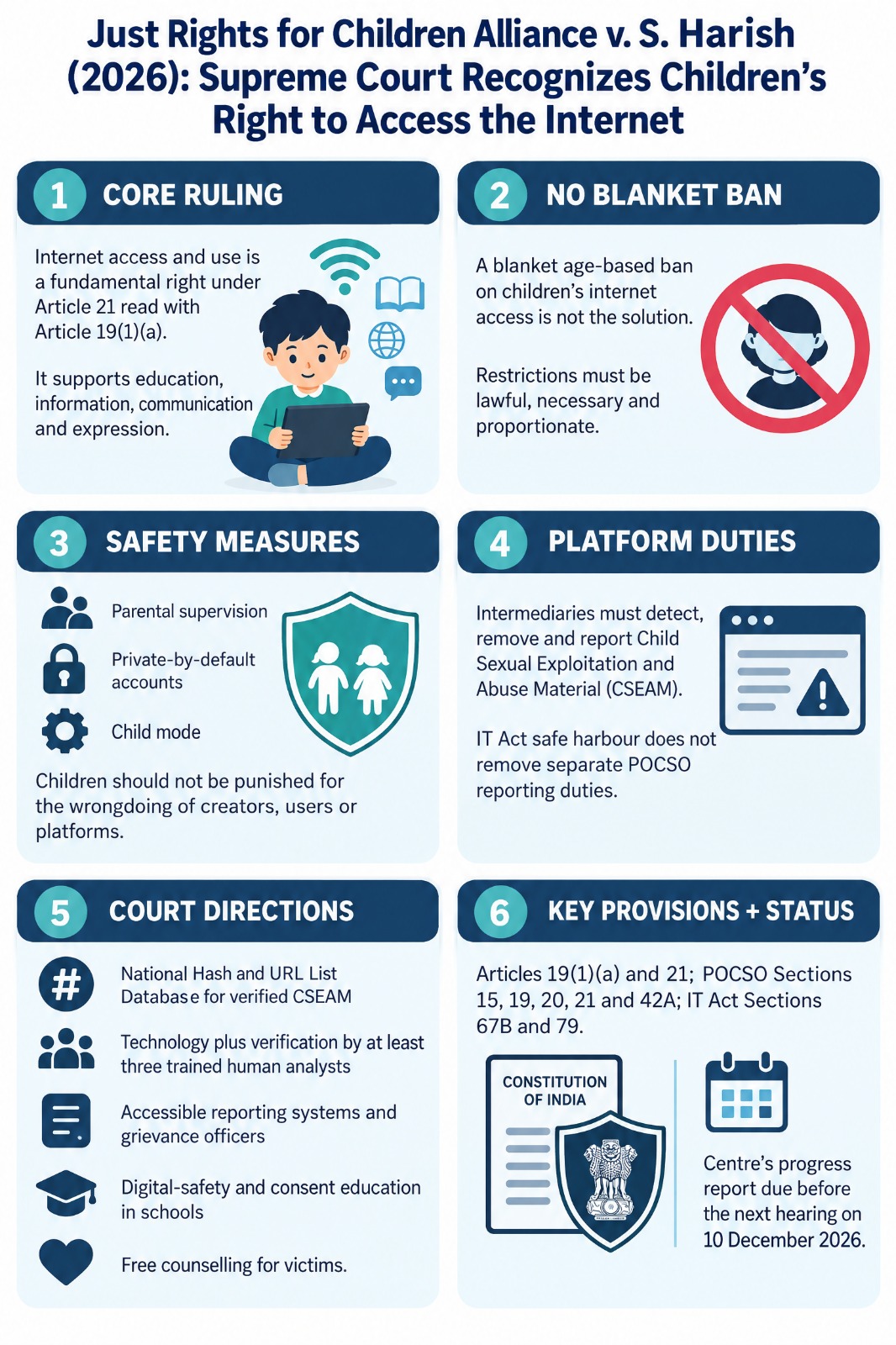
The issue of access to internet and online safety of children was dealt recently by Supreme Court in the case of Just Rights for Children Alliance and Another v. S. Harish and Others, (2026 INSC 1149). The Court held that the right to access and use the internet is a fundamental right of every individual including the children under Article 21 read with Article 19(1)(a) of the Constitution.
The Court rejected a blanket ban on children’s internet access as a solution to online abuse. It supported proportionate safeguards such as parental supervision, private-by-default accounts and a dedicated “child mode”.
Who brought the case and Why?
The matter was brought by the Just Rights for Children Alliance, along with another applicant, through miscellaneous applications in connected criminal appeals. The applicants brought to the Court’s attention reports of serious failures by social media intermediaries in detecting, removing and reporting Child Sexual Exploitation and Abuse Material (CSEAM).
They alleged that some platforms were allowing paid advertisements and redirect links promoting CSEAM. Users were allegedly directed to other websites or platforms where such material was offered for money. The applicants also pointed out that some intermediaries reported such material to the United States-based National Center for Missing & Exploited Children, but did not make the mandatory report to the Special Juvenile Police Unit or local police under Indian law.
Earlier 2024 Judgment in the Same Case
The 2026 order followed the Supreme Court’s important judgment dated 23 September 2024 in the same matter. In that decision, the Court explained the meaning of “possession” and “storage” of child sexual abuse material under Section 15 of the POCSO Act. It said that possession could be constructive or digital possession depending on the facts and the intent of the person.
The Court also clarified that apart from the Information Technology Act, 2000, intermediaries must also comply with their duties under the POCSO Act. Compliance with the IT Act’s safe-harbour provision does not automatically protect an intermediary from liability under POCSO. Intermediaries must report suspected offences to the authorities specified under Section 19 of POCSO and Rule 11 of the POCSO Rules.
The 2026 proceedings arose from the applicants’ claim that these duties were still not being followed.
Issues before the Supreme Court
The Court considered two connected questions:
- Whether children can be completely denied access to the internet to protect them from online exploitation.
- What legal and technological mechanisms are required to detect, remove and report CSEAM effectively.
The broader issue was whether internet access is a fundamental right and whether restrictions must satisfy legality, necessity and proportionality.
What did the Supreme Court hold?
- The Court clearly held that access to and use of the internet is a fundamental right under Article 21 read with Article 19(1)(a). Freedom of speech and expression includes the right to receive information and ideas. The internet is now an important medium for education, communication, creative expression and participation in public life.
- The Court also noted its importance for children in remote areas and children with special needs, for whom it may be the only practical source of learning and connection.
- The Court did not create a right to any website or service as a free-for-all. It agreed to accept reasonable and proportionate limits on harmful content, including adult websites. The ruling is against a blanket age-based ban, not every safety measure.
- The Court reasoned that removing children from the internet would punish victims instead of wrongdoers. Those who create, circulate, sell or seek CSEAM, and intermediaries that fail to remove it, must be held accountable.
Relevant legal provisions
Article 21 protects life and personal liberty. The Court connected digital access with dignity, education and communication.
Article 19(1)(a) protects speech and expression, including receiving and imparting information over the Internet. Article 19(1)(g) provides protection for trade and business through the internet subject to restrictions.
Section 15 of the POCSO Act deals with storage or possession of child pornographic material in specified circumstances. Sections 19, 20 and 21 create duties relating to reporting offences and consequences for failure to report. Section 42A gives POCSO overriding effect in case of inconsistency with another law.
An intermediary can also get the safe-harbour protection for third party content, if it exercises due diligence under Section 79 of the IT Act. But such protection does not oust the separate reporting and child protection obligations imposed by the POCSO.
The Court also referred to Section 67B of the IT Act dealing with electronic sexually explicit material involving children and the IT Rules on intermediary due diligence.
Other Important judgments referred to
In Anuradha Bhasin v. Union of India, the Supreme Court held that freedom of speech and expression and the freedom to carry on trade or business through the internet are constitutionally protected under Articles 19(1)(a) and 19(1)(g). That judgment left open whether access to the internet itself was an independent fundamental right.
In Pragya Prasun v. Union of India, the Court recognised digital access as an intrinsic part of Article 21 and directed the State to build inclusive digital systems that do not exclude persons with disabilities or other marginalised groups.
The Court referred to its own judgment in Just Rights for Children Alliance v. S. Harish dated 2024 for the duties of intermediaries, reporting requirements and interpretation of Section 15 of POCSO.Together, these cases show the gradual development of digital rights under Articles 19 and 21.
Directions Issued by the Court
The Court issued detailed directions, including:
- The Union Government must provide information about technological tools used by intermediaries to detect and remove CSEAM.
- The Government must frame guidelines for significant social media intermediaries on perceptual hash-matching, URL listing and other detection tools.
- A National Hash and URL List Database must be created exclusively for identifying and removing verified CSEAM.
- Material must pass several verification stages, with the final assessment by at least three trained human analysts.
- Entries must be encrypted, audited and capable of correction. Wrongly listed content must be promptly removed from the database and restored on platforms.
- Platforms should have accessible reporting systems and dedicated officers to receive grievances for CSEAM complaints.
The Court directed the Centre to file a progress affidavit before the next hearing, fixed for 10 December 2026.
Importance of the judgment
The judgment balances children’s safety and freedom. It recognizes that in today's digital world, education and information are not luxuries, but it also calls for more regulation of platforms and protection from exploitation.
The fundamental principle for the CLAT-PG students is that a fundamental right can be regulated but restrictions must be lawful, i.e. necessary and proportionate. You can’t solve online harm by taking the victim out of the digital world. It should focus on tackling harmful content, better reporting systems and intermediary accountability.
Get case-law updates weekly
Join 10,000+ subscribers.
JU
Julie Nigam
Contributing author
Have a doubt about this judgment?Ask Doubts