
Top 6 Landmark Cases on Muslim Law
Let's read top 6 landmark cases on muslim law which are frequently asked in the exams and have the jurisprudence of muslim law in india.
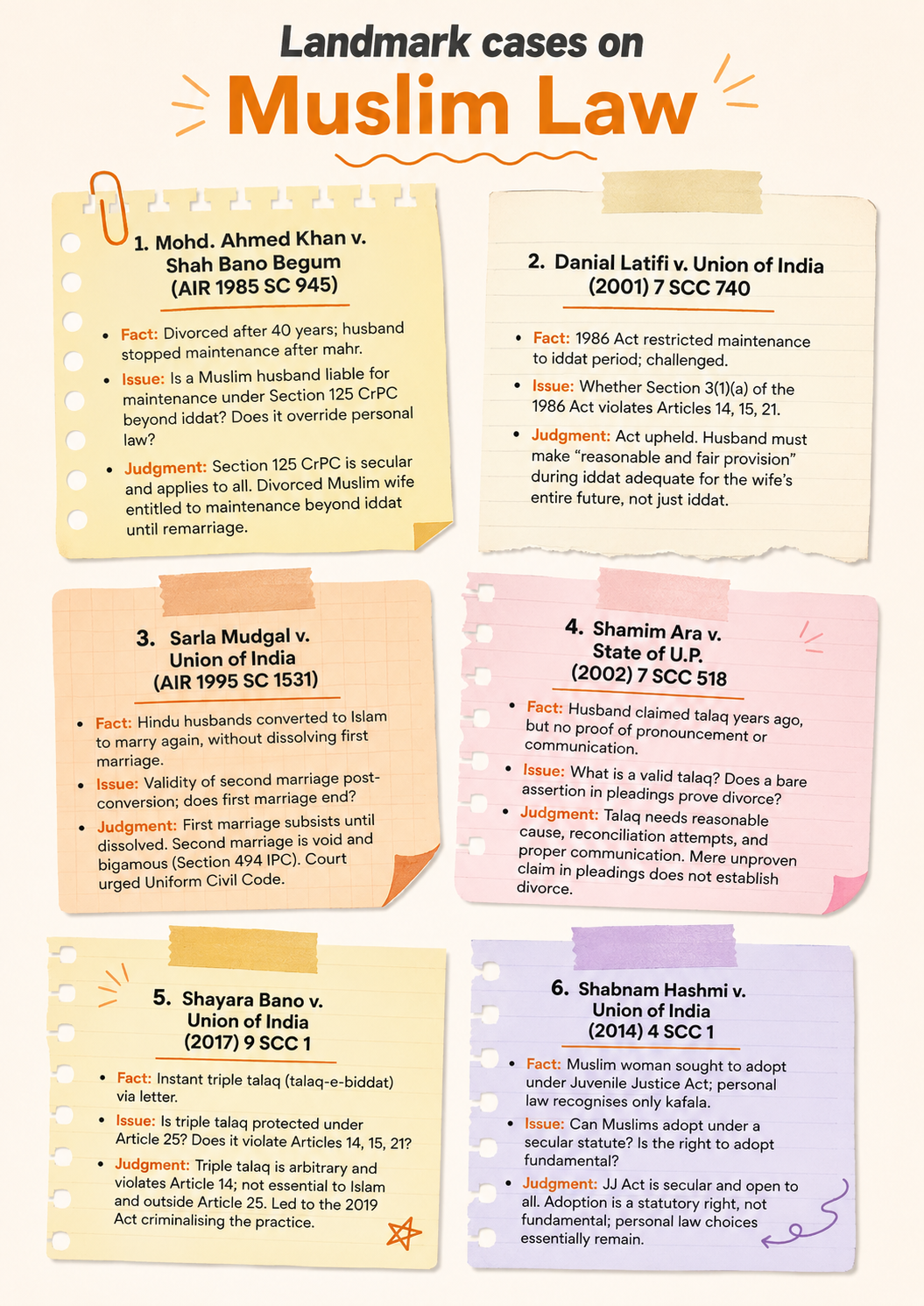
Mohd. Ahmed Khan v. Shah Bano Begum, AIR 1985 SC 945
Facts: Shah Bano was married to Mohd. Ahmed Khan for over 40 years. He divorced her by talaq and stopped paying maintenance once her mahr amount was exhausted. She approached the court under Section 125 CrPC seeking maintenance.
Issues:
- Whether a Muslim husband is liable to pay maintenance to his divorced wife under Section 125 CrPC beyond the iddat period
- Whether this secular provision overrides Muslim Personal Law.
Judgment: The Supreme Court held that Section 125 CrPC is a secular provision applicable to all citizens regardless of religion. A divorced Muslim wife unable to maintain herself is entitled to maintenance beyond iddat, until remarriage.
It also established that personal law cannot override a beneficial, secular statutory remedy. This ruling triggered political backlash, leading to the 1986 Act discussed next.
Danial Latifi v. Union of India, (2001) 7 SCC 740
Facts: After the Shah Bano controversy, Parliament passed the Muslim Women (Protection of Rights on Divorce) Act, 1986, seemingly restricting maintenance to the iddat period. This provision was challenged as unconstitutional.
Issues: Whether Section 3(1)(a) of the 1986 Act, limiting maintenance to iddat, violated Articles 14, 15, and 21 of the Constitution.
Judgment: The Court upheld the Act's validity but interpreted it harmoniously - the husband must make "reasonable and fair provision" during iddat that is adequate to sustain the wife for her entire future, not just the iddat period.
Sarla Mudgal v. Union of India, AIR 1995 SC 1531
Facts: Several Hindu husbands converted to Islam solely to contract a second marriage without dissolving their first marriage under the Hindu Marriage Act, relying on polygamy permitted under Muslim law.
Issues: Whether such conversion and remarriage was legally valid, and whether the first marriage survived despite the husband's conversion.
Judgment: The Supreme Court held the first marriage subsists until formally dissolved; conversion alone does not automatically end it.
The second marriage post-conversion was declared void and bigamous, attracting prosecution under Section 494 IPC. The Court also urged consideration of a Uniform Civil Code.
Shamim Ara v. State of U.P., (2002) 7 SCC 518
Facts: The wife filed for maintenance; the husband claimed he had already divorced her years earlier through unilateral talaq, but produced no proof of pronouncement or communication to her.
Issues:
- What constitutes a valid talaq
- whether a bare assertion in a written statement amounts to proof of divorce.
Judgment: The Court held that talaq must be pronounced for a reasonable cause, preceded by attempts at reconciliation, and properly communicated to the wife. A mere unproven claim in pleadings does not establish divorce. This ratio significantly curtailed arbitrary, undocumented unilateral talaq and became a key safeguard for Muslim women.
Shayara Bano v. Union of India, (2017) 9 SCC 1
Facts: The petitioner's husband divorced her instantly through talaq-e-biddat (triple talaq pronounced in one sitting), via a letter. She challenged this practice as unconstitutional.
Issues:
- Whether instant triple talaq is protected under the freedom of religion in Article 25
- whether it violates Articles 14, 15, and 21
Judgment: By a 3:2 majority, the Court struck down talaq-e-biddat as manifestly arbitrary and violative of Article 14, holding it not essential to Islamic religious practice and therefore outside Article 25's protection. This ratio directly led to the Muslim Women (Protection of Rights on Marriage) Act, 2019, which criminalised the practice.
Shabnam Hashmi v. Union of India, (2014) 4 SCC 1
Facts: A Muslim woman sought to adopt a child under the Juvenile Justice Act, though Muslim personal law does not recognise formal adoption (only kafala, a guardianship arrangement).
Issues:
- Whether Muslims can adopt under a secular statute despite personal law silence
- whether the right to adopt is a fundamental right.
Judgment: The Court held the JJ Act is a secular, enabling law open to all citizens irrespective of religion; adoption under it is optional, so personal law is not overridden, only supplemented. The right to adopt was recognised as a statutory right, not elevated to fundamental right status, leaving personal law choices intact for those who prefer kafala.
Get case-law updates weekly
Join 10,000+ subscribers.
HA
Hanspal Bakul
Contributing author
Have a doubt about this judgment?Ask Doubts
