
Landmark Cases on the Indian Contract Act (Part 1): Formation of Contract, Capacity and Free Consent
Contract law on paper looks deceptively simple until courts start interpreting it. For CLAT PG, these eight judgments matter less for their facts and more for the reasoning that followed them. Here's a breakdown that sticks to what actually gets tested.
1. Carlill v. Carbolic Smoke Ball Co. (1893) 1 QB 256
Facts: A pharmaceutical company promised £100 to anyone who caught influenza despite using their smoke ball as instructed. Mrs Carlill did exactly that, fell ill anyway, and asked for the money. The company refused, claiming there was never a proper contract between two specific parties.
- Can an advertisement addressed to the whole world create a binding offer?
- Does acting on the offer's terms count as acceptance even without informing the offeror beforehand?
Judgment: The court sided with Mrs Carlill. A general offer, once acted upon by someone meeting its conditions, becomes enforceable against the offeror. The company had even deposited money with a bank to show sincerity, which killed their "no real intention" defence. Performance itself served as acceptance here, no separate communication needed.
2. Lalman Shukla v. Gauri Dutt (1913) 40 All 489
Facts: A servant was sent out to find his employer's missing nephew. While he was still searching, the employer announced a cash reward for information leading to the boy's recovery. The servant found the child first and only heard about the reward afterward, then tried claiming it.
Judgment: The Allahabad High Court said no. Acceptance presupposes knowledge of the offer at the moment the act is done. Since Lalman had no idea about the reward when he traced the boy, there was nothing for him to "accept."
3. Bhagwandas Kedia v. Girdharilal Parshottamdas & Co. AIR 1966 SC 543
Facts: A telephone conversation between parties in two different cities led to a contract, but a dispute broke out over where exactly it was formed. This mattered because the answer decided which court had jurisdiction to hear the case.
Issues: Should telephone communication be treated like postal communication, where the contract forms the moment a letter is posted? Or does it need actual, real-time receipt of acceptance?
Judgment: The Supreme Court reasoned that a phone call is closer to a face-to-face conversation than a letter. So the contract is complete only where the acceptance is actually heard by the offeror, not where the acceptor spoke it. The postal rule, in other words, doesn't extend to instant communication.
4. Chinnaya v. Ramaya (1882) ILR 4 Mad 137
Facts: A mother gifted land to her daughter on the condition that the daughter pay an annual sum to the mother's sister. The daughter agreed in writing but stopped paying later. The sister, who technically gave nothing in the transaction, sued to enforce the promise anyway.
Judgment: The Madras High Court allowed the suit, pointing to Section 2(d), which permits consideration to move from "the promisee or any other person." The consideration had flowed from the mother, not the sister, but that was enough under Indian law. This case is why Indian contract law is often said to be more liberal than English law on privity of consideration.
Section 2(d) - “When, at the desire of the promisor, the promisee or any other person has done or abstained from doing, or does or abstains from doing, or promises to do or to abstain from doing, something, such act or abstinence or promise is called a consideration for the promise;”
5. Mohori Bibee v. Dharmodas Ghose (1903) 30 IA 114
Facts: A minor mortgaged his property to obtain a loan, and the lender's own agent was aware he was dealing with a minor. When the lender tried to recover the money by enforcing the mortgage, the minor's side argued the entire agreement was invalid from the start.
Judgment: The Privy Council settled this firmly - a minor's agreement is void ab initio in India, not voidable. Section 11 makes majority a precondition for contractual capacity, so no contract ever technically existed. The lender lost both the mortgage and the chance to recover the money advanced.
Section 11- Who is competent to contract? - “Every person is competent to contract who is of the age of majority according to the law to which he is subject , and who is of sound mind, and is not disqualified from contracting by any law to which he is subject.”
6. Ranganayakamma v. Alwar Setti (1889) ILR 13 Mad 214
Judgment: The court held that preventing cremation was indeed an unlawful act, which brought it within the definition of coercion. The adoption was declared voidable because consent had been extracted through this pressure.
7. Raghunath Prasad v. Sarju Prasad AIR 1924 PC 60
- When does a lender's financial advantage over a borrower cross into "dominant position" under Section 16?
- Does a harsh interest rate alone prove undue influence?
8. Gherulal Parakh v. Mahadeodas Maiya AIR 1959 SC 781
- Does forming a partnership for wagering purposes make the partnership itself illegal, or just the underlying wager unenforceable?
- Can something collateral to a void agreement still survive under Section 23?
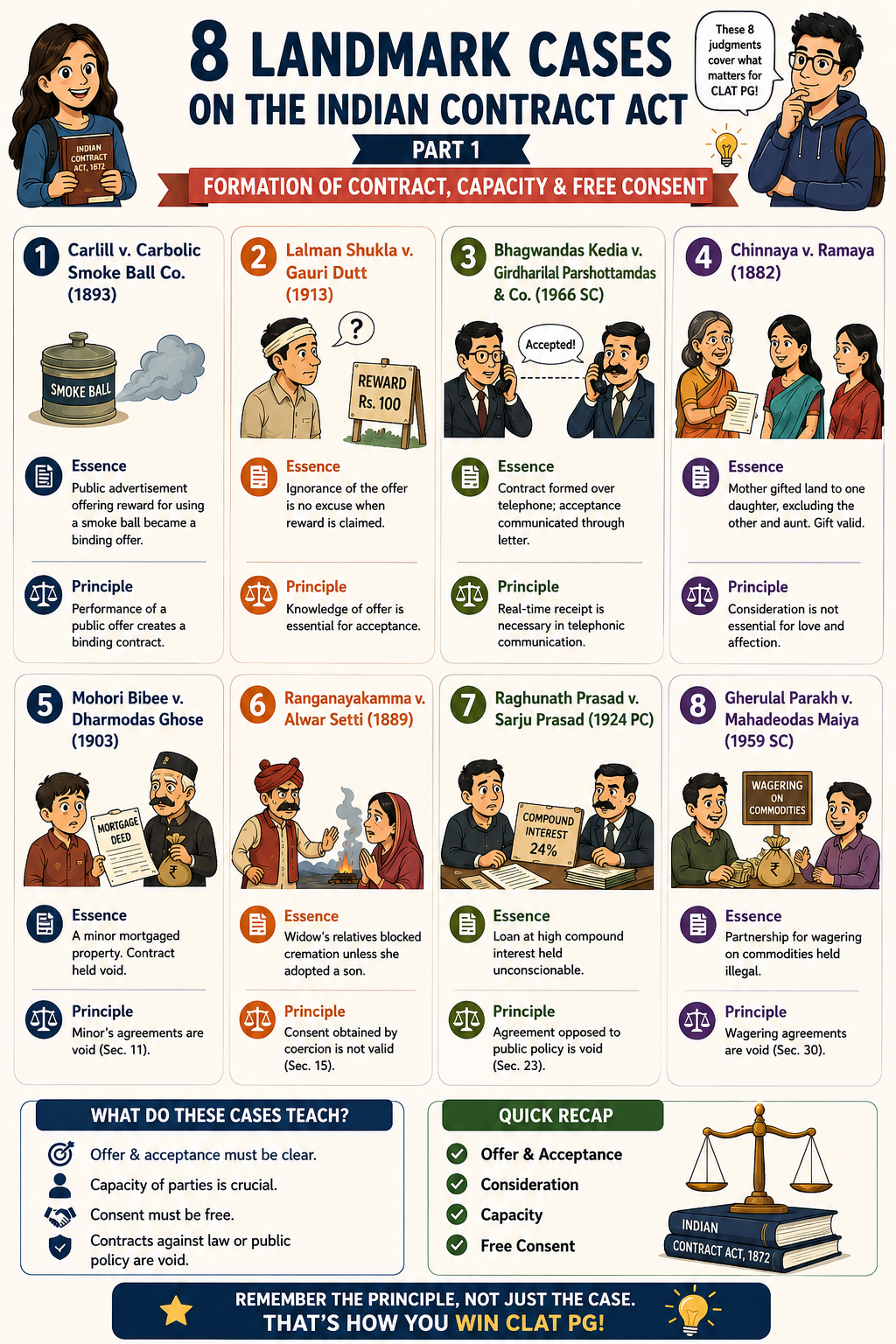
For CLAT PG, knowing the ratio in each case matters far more than memorising facts, since that's usually where the actual question is hiding.
