
Landmark Cases on the Indian Contract Act (Part 2 ): Void Agreements, Frustration and Discharge of Contracts
Contracts don't always end the way parties intend. Sometimes performance becomes impossible, sometimes the very purpose of the agreement disappears overnight. The doctrine of frustration exists precisely for these situations, and Indian courts have borrowed heavily from English precedent while carving their own path under Section 56.
This piece walks through eight cases that CLAT PG candidates must know, covering how frustration, force majeure and discharge actually work in practice.
1. Satyabrata Ghose v. Mugneeram Bangur & Co. AIR 1954 SC 44
Facts: A company sold plots of land and promised to build roads before handing over possession. During World War II, the government requisitioned part of the land for military use, delaying the road construction significantly. The buyer sued, claiming the contract had become impossible to perform and should be treated as frustrated.
Issues: Does temporary requisition of land amount to frustration under Section 56, or does it merely delay performance without destroying the contract's foundation?
Judgment: The Supreme Court held that frustration in India isn't tied to the English idea of an "implied term" but flows directly from Section 56. Since the requisition was temporary and the contract didn't specify a fixed timeline for road building, the delay didn't defeat the contract's core purpose. The Court also clarified that impossibility under Section 56 covers practical impossibility, not just literal physical impossibility.
2. Naihati Jute Mills Ltd. v. Khyaliram Jagannath AIR 1968 SC 522
Facts: A jute mill contracted to purchase raw jute, requiring an import licence from what was then East Pakistan. When obtaining the licence became difficult due to changed government policy, the buyer refused to perform, arguing the contract stood frustrated.
Issues: Can a party invoke frustration merely because performance has become more difficult or commercially inconvenient, without it being truly impossible?
Judgment: The Supreme Court rejected the frustration argument. Difficulty in obtaining a licence isn't the same as impossibility, and the buyer had voluntarily undertaken the risk of securing it.
3. Boothalinga Agencies v. V.T.C. Poriaswami Nadar AIR 1969 SC 110
Facts: The appellant entered into a contract to sell imported chicory to the respondent. The chicory was imported under an "actual user's licence," which strictly prohibited resale to third parties. Subsequently, the Import Control Order, 1955 came into force, making the resale of such goods a statutory offence.
The appellant failed to deliver the goods and claimed the contract was void due to illegality and supervening impossibility.
Issues:
Issues:
- Does a contract to sell goods in breach of an administrative licence condition render the agreement void under Section 23 of the Contract Act?
- Can a party plead frustration if they voluntarily accepted a restrictive licence, or does this amount to self-induced frustration?
Judgment: The Supreme Court held that a mere breach of an administrative licence condition does not automatically make the contract illegal. However, the subsequent Import Control Order created an absolute statutory prohibition against the sale.
Because this legal intervention left the seller with no alternative or choice, the court ruled that the frustration was not self-induced. The contract was held completely void under Section 56 due to supervening illegality.
4. Taylor v. Caldwell (1863) 3 B&S 826
Facts: The parties agreed to hire out a music hall for a series of concerts. Before the event could take place, the hall burned down due to an accidental fire, with neither party at fault. The hall owner was sued for breach when the concerts couldn't happen.
Issues: When the very subject matter of a contract is destroyed without either party's fault, does the contract survive or does it automatically come to an end?
Judgment: The English court held that the contract was discharged because its performance depended on the continued existence of the hall. This case is regarded as the origin point of the modern doctrine of frustration in common law. It moved English law away from rigid absolute liability toward recognising that some events genuinely excuse performance.
5. Krell v. Henry [1903] 2 KB 740
Facts: A room was rented specifically to view the coronation procession of King Edward VII. The procession was cancelled due to the king's illness, though the room itself remained perfectly usable for other purposes. The owner sued for the rent, and the tenant refused to pay.
Issues: Can a contract be frustrated when its literal performance is still possible, but its entire underlying purpose has vanished?
Judgment: The court held that the contract's foundation was the procession itself, not merely the room, so its cancellation frustrated the agreement. This introduced the "frustration of purpose" doctrine, distinct from physical impossibility. It's frequently contrasted with Taylor v. Caldwell to show two different routes to the same frustration outcome.
6. Energy Watchdog v. CERC (2017) 14 SCC 80
Facts: Power generating companies had entered long-term supply agreements at fixed tariffs, relying on coal imported from Indonesia. When Indonesia changed its export regulations, coal prices rose sharply, and the companies sought to invoke force majeure to revise the tariffs.
Issues: Does a rise in the cost of performance, caused by a foreign regulatory change, amount to frustration or force majeure under Indian contract law?
Judgment: The Supreme Court held that mere increase in cost, however steep, doesn't frustrate a contract unless performance becomes genuinely impossible. Since the agreements didn't specifically cover this exact regulatory risk, and coal could still be sourced, the doctrine of frustration didn't apply. The Court reaffirmed that commercial hardship alone can never substitute for actual impossibility.
7. Sushila Devi v. Hari Singh AIR 1971 SC 1756
Facts: Parties entered into an agreement concerning property located in a region that later became part of Pakistan after Partition. Performance of the agreement became impossible because the property fell outside Indian jurisdiction entirely.
Issues: Where a contract's subject matter becomes legally and practically inaccessible due to territorial changes beyond anyone's control, is the agreement frustrated?
Judgment: The Supreme Court held that the contract stood frustrated since performance had become genuinely impossible due to circumstances no party could have anticipated or controlled. Partition-related impossibility was treated as a valid supervening event under Section 56. This case shows how frustration doctrine adapted to India's unique post-independence legal landscape.
8. Welspun Specialty Solutions Ltd. v. ONGC Ltd. (2021) SCC OnLine SC 891
Facts: ONGC floated a tender for seamless steel casing pipes, and Remi Metals, later renamed Welspun, won the contract across four purchase orders with a 40-week delivery timeline. The contract stated that time was of the essence and included a liquidated damages clause capped at 5% of contract value. Deliveries were delayed, yet ONGC granted extensions, waiving liquidated damages for the first two extensions before deducting them for later ones.
Issues:
- Can a party still treat time as the essence of a contract after repeatedly granting extensions and waiving penalties for delay?
- Once liquidated damages are waived for earlier delays, can they be revived for subsequent extensions of the same obligation?
Judgment: The Supreme Court upheld the arbitral tribunal's award in favour of Welspun, holding that ONGC's conduct in granting extensions showed it never truly treated time as essential to the contract. Liquidated damages already waived for earlier periods couldn't be resurrected for later delays, and only actual proven loss remained recoverable going forward. The Court also stressed that arbitral awards shouldn't be disturbed under Sections 34 and 37 when the tribunal's interpretation is reasonable and plausible, even if courts might have read the contract differently.
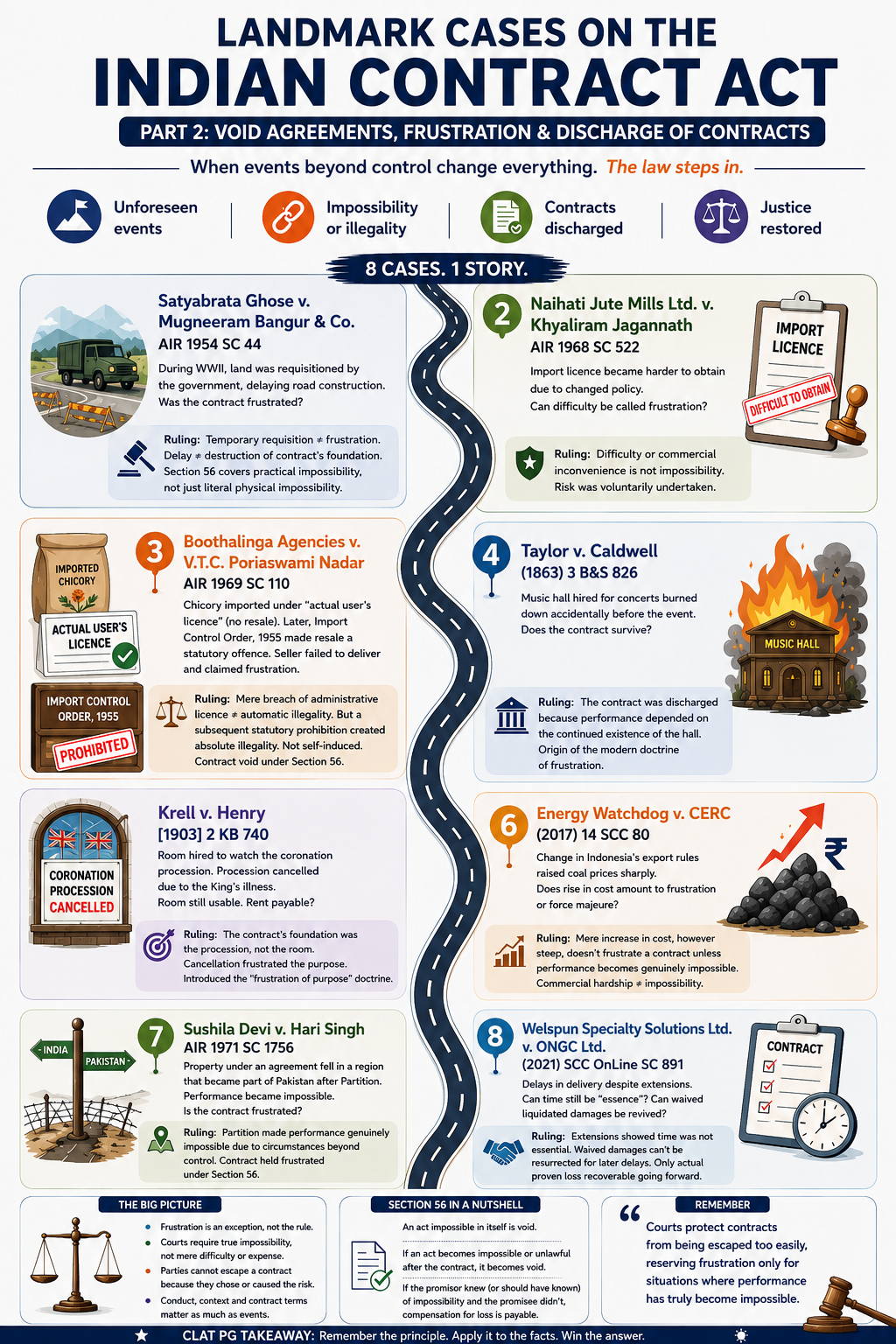
For CLAT PG, the recurring theme worth remembering is this: courts protect contracts from being escaped too easily, reserving frustration only for situations where performance has truly become impossible.
Get case-law updates weekly
Join 10,000+ subscribers.
HA
Hanspal Bakul
Contributing author
Have a doubt about this judgment?Ask Doubts
