
Landmark Cases on the Right to Die for CLAT 2022
The right to life is the most important fundamental right, not only in India but all around the globe. Its sanctity emerges from the most basic foundation of existence- life itself. The right to life is held by the highest regards under Article 21 of the Indian Constitution. So when the question relating to the right to die arose, a lot of eyebrows were raised, both inside and outside the courtrooms. This article discusses various landmark cases on the right to die for CLAT 2022.
1. Maruti Shripati Dubal v. State Of Maharashtra, (1986) 88 BOMLR 589
The question on the right to die was raised for the first time in 1986. The High Court of Bombay observed that Section 309 of the IPC which criminalises attempt to commit suicide is unconstitutional as the right to die forms an inherent part of right to life under Article 21 of the Constitution.
2. P. Rathinam v. Union of India, 1994 AIR 1844
In this case, the Supreme Court observed that any criminal punishment for an attempt to suicide amounts to double punishment as it violates the constitutional right to life under Article 21. A corollary was also drawn with other fundamental rights.
For instance, Article 19 while bestowing the freedom and the right to speak also includes the right to not speak. Similarly, Article 21 which guarantees the right to live, also includes the right to not live, i.e., the right to die. Section 309 of the IPC was, thus, held to be unconstitutional.
3. Gian Kaur v. State of Punjab, 1996 AIR 946
The five judge bench in this case overruled the decision in the P. Rathinam case. Petitioners who were sentenced to imprisonment and fine for abetting a suicide argued that their act was in furtherance of the right to not live under Article 21.
However, the court held that while Article 19 and other FRs which give the ‘right not to’ are on omission, the right to not live is an act and thus, punishable. The constitutionality of Sections 306 and 309 was upheld.
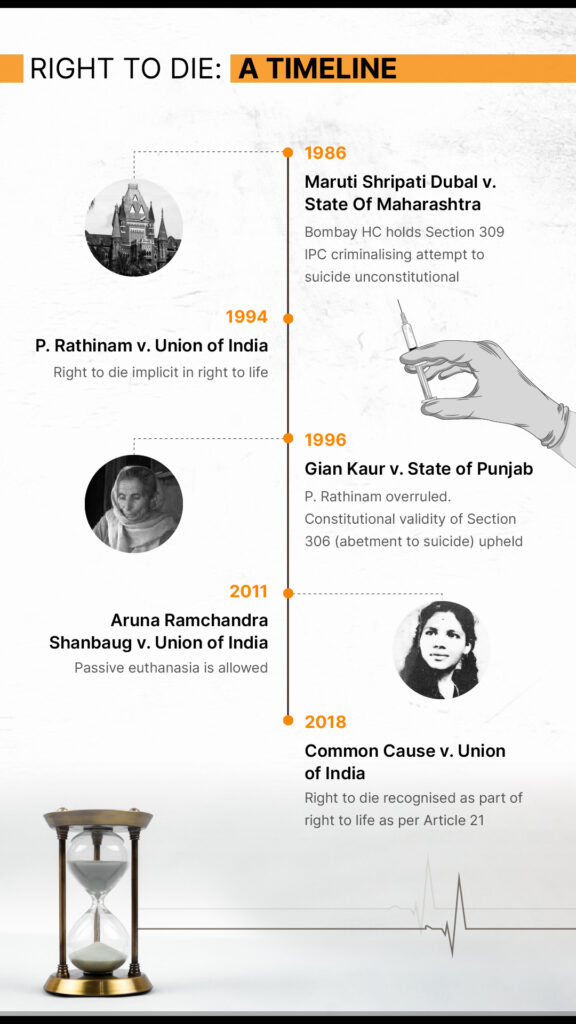
An overview of the landmark judgements on the Right to Die.
The Conversation on Euthanasia and the Right to Die
The term Euthanasia has been derived from the Greek word “euthanatos”, which means “good death”. Euthanasia can broadly be categorised into two parts- active euthanasia and passive euthanasia.
In active euthanasia, an act is done by a medical professional to fasten the death process of an individual. While in passive euthanasia, essential medical treatment is withdrawn. Thus, in active euthanasia, a deliberate act is done while in passive euthanasia, an omission is made.
In India, active euthanasia is illegal while the history of passive euthanasia, is discussed as follows:
4. Aruna Ramachandra Shanbaug v. Union of India, (2011) 4 SCC 454
A ‘friend’ of Aruna Shanbaug who had been in a Persistent Vegetative State (PVS) ever since she had been sexually assaulted in 1973 had filed a request for passive euthanasia. A medical team was appointed to review her physical and mental condition. While the court did not allow the request, it did pass orders to allow passive euthanasia.
The doctrine of Parens Patriae (The State is the parent) was invoked and it was held that upon the informed opinion of a medical board of doctors, the Supreme Court (and the High Courts) may allow passive euthanasia on a case to case basis.
Passive euthanasia was discussed at length in this case and was defined as the deliberate act of withdrawing medical support of the patient, with the intention of causing their death.
5. Common Cause v. Union of India, (2017) 10 SCC 1
In this case, the petitioners, an NGO prayed for the right to die with dignity to be declared a fundamental right. It further asked the court to issue directions on the concept of “living wills”. This would allow individuals, who are of sound mind, to issue an advanced medical directive which could include the right to refuse life support system in situations wherein they cannot be kept alive without the aid of such systems.
The judgement allows terminally ill patients to seek death with dignity by exercising their living will.
Subscribe for updates
Join 10,000+ subscribers.
MR
Mrinaal Datt
Contributing author
Have a doubt about this?Ask Doubts
