
Landmark Supreme Court Judgments of April 2025
Introduction
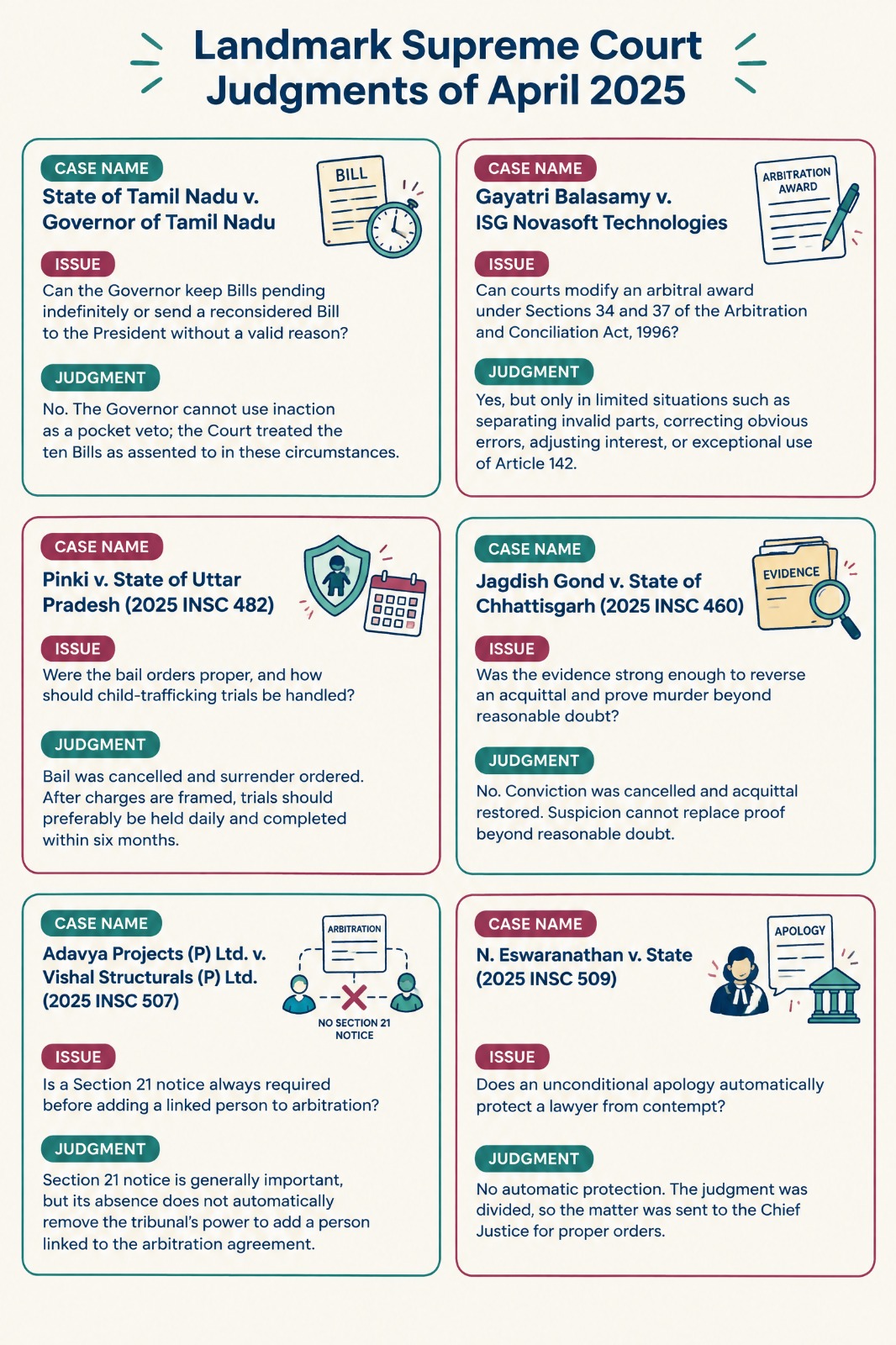
The Supreme Court is involved in settling individual disputes as well as in explaining how the Constitution, the statutes, and public institutions should function. In April 2025 it considered questions concerning the Governor’s duties, arbitration, child trafficking, criminal appeals and judicial accountability.
The article looks at six significant decisions from April 2025. The decisions relate to constitutional law, criminal law, arbitration, child protection and contempt.
State of Tamil Nadu v. Governor of Tamil Nadu
Facts
Several Bills which had been passed by the Tamil Nadu Legislative Assembly were forwarded to the Governor and remained pending for a long time. Following the Supreme Court’s previous ruling in the Tamil Nadu Governor case, the Governor returned some of the Bills, but the Assembly then passed them once again, after which the Governor reserved them for the President rather than acting upon them in the normal constitutional way.
Issue
Could the Governor hold Bills indefinitely? And if a Bill had been reconsidered and then passed once more by the Assembly, could the Governor send it to the President without providing a valid constitutional reason?
Judgment
On 8 April 2025 the Supreme Court ruled that the Governor could not treat inaction as a ‘pocket veto'. Since Articles 200 and 201 of the Constitution set out the proper procedure for handling Bills, the Governor is required to act in accordance with that procedure and cannot therefore delay a Bill indefinitely. Furthermore, the Court decided that, in the particular circumstances of the case, the ten Bills should be regarded as having received assent and it invoked Article 142 in order to achieve complete justice.
The decision is significant in the context of federalism since a constitutional head cannot, by means of an unexplained delay, frustrate an elected state legislature. It also brings into question the issue of judicial timelines and Article 142.
Gayatri Balasamy v. ISG Novasoft Technologies
Facts
The disagreement stemmed from an arbitration concerning employment-related claims and the payment of a sum of money. It was only after that the matter came before a five-judge Constitution Bench, since courts had on certain occasions modified, rather than simply setting aside, the arbitral awards. Since arbitration is meant to offer a faster alternative to regular litigation, too much interference by the courts can undermine its object.
Issue
Can the courts alter an arbitral award under Sections 34 and 37 of the Arbitration and Conciliation Act, 1996, or are they limited to upholding it or setting it aside?
Judgment
On 30 April 2025, the Supreme Court, by a vote of 4:1, ruled that courts have a limited authority to alter an arbitral award in certain cases. This could involve separating an invalid section from a valid one, correcting obvious clerical or computational errors, adjusting interest after the award has been made if it is the proper course to do so, and, in exceptional circumstances, making use of Article 142. The Court made it clear that this is not a general power of review and should not be applied routinely.
Justice K.V. Viswanathan gave his dissenting opinion. He cautioned that the Arbitration Act is intended to minimise judicial intervention and that permitting modification might blur the line between setting aside an award and hearing an appeal. The case is therefore significant not only in view of the ruling of the majority but also because of the clear discussion concerning judicial restraint.
Pinki v. State of Uttar Pradesh (2025 INSC 482)
Facts
The case was about alleged child trafficking and the decision to grant bail to the accused. The families of the children affected by the case objected to the bail rulings on the grounds that the trials had been proceeding slowly. Such child trafficking cases are particularly serious since delays can damage the victims, cause evidence to be weakened and give the accused people an opportunity to influence witnesses.
Issue
Were the bail orders appropriate and, if so, what measures were needed to make sure that trials in cases of child trafficking were held quickly and with sensitivity?
Judgment
In April 2025 the Supreme Court cancelled the bail orders and ordered the accused to surrender. It also ordered that, once the charges had been framed, the trials should preferably take place daily and be finished within six months. The Court requested the State Governments to carry out the Bharatiya Institute of Research and Development's recommendations concerning the prevention and investigation of child trafficking.
The ruling indicates that when deciding on bail it is necessary to take into account child safety, the seriousness of the offence and the possibility of interference with the Trial. In the case of child-protection matters active case management is required.
Jagdish Gond v. State of Chhattisgarh (2025 INSC 460)
Facts
The husband who had been found guilty of his wife's death was acquitted by the trial court, a decision which the High Court overturned and convicted him in accordance with Section 302 of the Indian Penal Code. The case was then appealed to the Supreme Court.
Issue
Was the evidence sufficient to lead to a reversal of an acquittal and to prove that the act was murder beyond any reasonable doubt?
Judgment
The Supreme Court cancelled the conviction and reinstated the acquittal. It pointed out that there was no reliable evidence to show that the death was the result of homicide and that the defendant had a reasonable explanation for his absence.
The Court also reasserted a fundamental principle of criminal law: where two reasonable interpretations are possible, the one which is more favourable to the accused should generally be adopted. An appellate court should hesitate to set aside an acquittal unless the view of the lower court is unreasonable or clearly incorrect.
This case serves as a good reminder of the presumption of innocence and the obligation placed on the prosecution. However strong the suspicion may be, it cannot take the place of proof beyond reasonable doubt.
Adavya Projects (P) Ltd. v. Vishal Structurals (P) Ltd. (2025 INSC 507)
Facts
The case concerned arbitration proceedings and the question of adding New parties; some people who were linked to the arbitration agreement had not at first been given notice of the invocation of arbitration under section 21 of the Arbitration and Conciliation Act, 1996, and the issue was whether this meant that the arbitral tribunal could not later add them to the proceedings.
Issue
Is it an absolute condition for the arbitral tribunal to bring in that person during the arbitration that it serves a Section 21 notice to that person?
Judgment
The Supreme Court considered it important that a Section 21 notice should be given since it signifies the start of the arbitration and has an effect on the limitation period and the rules that apply. It is generally necessary to serve such a notice before making an application under Section 11 for the appointment of an arbitrator.
Yet the fact that notice has not been served on a person who is part of the arbitration agreement does not automatically take away the tribunal’s power to add that person later on.
The judgment strikes a balance between procedural fairness and the practicality of arbitration; a technical objection should not result in the tribunal losing its jurisdiction if the person is otherwise properly linked to the arbitration agreement.
N. Eswaranathan v. State (2025 INSC 509)
Facts
The case was about lawyers who were said to have abused the court procedure. They subsequently gave an unconditional apology. The issue then was whether or not the Court should accept the apology and bring the contempt proceedings to an end.
Issue
Does offering an unconditional apology automatically secure an advocate against being charged with contempt?
Judgment
- With regard to whether the apology should be accepted, the Supreme Court gave a divided judgment. Since the judges had not reached agreement, the case was sent before the Chief Justice for the proper orders to be made.
- The situation shows that an apology does not automatically constitute a complete defence in cases where a lawyer has misused the court process. While the courts have to protect their dignity, they also need to consider whether the apology is genuine and whether it would be appropriate to accept it.
- The case is useful for understanding contempt jurisdiction and professional responsibility.
Conclusion
In April 2025, a number of judgments were delivered in various areas of the law. There is a link between legal procedure and justice, constitutional authorities have to act in a responsible manner, courts must ensure a fair trial, arbitration should remain efficient, and lawyers should protect the integrity of the judiciary. It is because of these principles that the decisions are useful for examination purposes and for gaining an understanding of constitutional democracy.
Get case-law updates weekly
Join 10,000+ subscribers.
JU
Julie Nigam
Contributing author
Have a doubt about this judgment?Ask Doubts
