
Landmark Cases on Law of Torts (Part 3): Defamation, Vicarious Liability and Product Liability
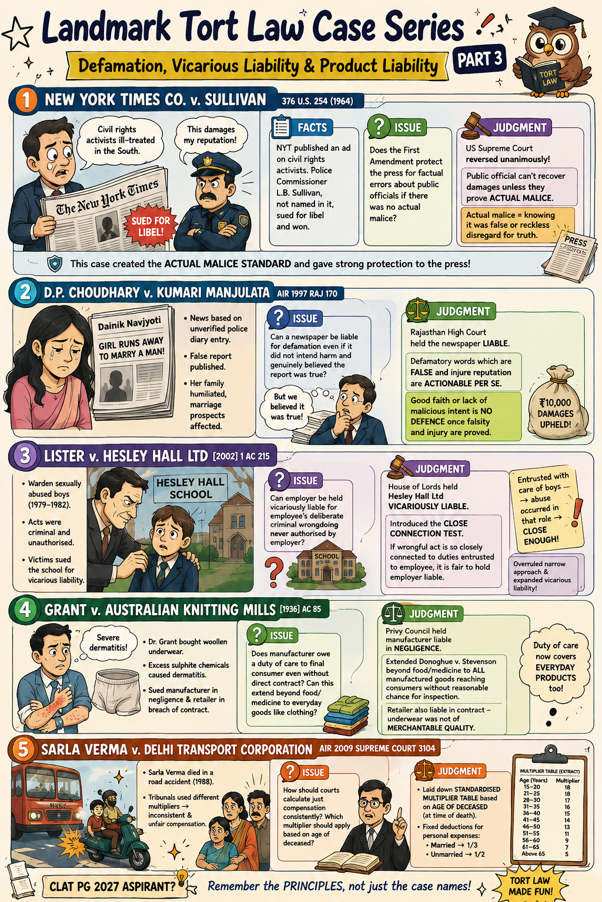
New York Times Co. v. Sullivan 376 U.S. 254 (1964)
Facts: In March 1960, the New York Times published a full-page advertisement describing the mistreatment of Black civil rights activists in the American South. L.B. Sullivan, a police commissioner, claimed the advertisement contained factual errors that damaged his reputation, even though it did not name him directly.
He sued for libel in an Alabama court and won a large damages award, which the Alabama Supreme Court upheld.
Issue: Does the First Amendment protect the press when it publishes statements about public officials that later turn out to contain factual errors, if there was no actual malice involved?
Judgment: The US Supreme Court reversed the Alabama ruling unanimously. It held that a public official cannot recover damages for a defamatory statement about their official conduct unless they prove actual malice.
Actual malice means the statement was made knowing it was false or with reckless disregard for the truth. This case created the actual malice standard and gave the press strong protection while criticising public officials.
D.P. Choudhary v. Kumari Manjulata AIR1997RAJ170
Facts: Manjulata was a young, educated woman from a respected Jodhpur family. In December 1977, the newspaper Dainik Navjyoti published a news item claiming she had run away from home to marry a man, based on an unverified police diary entry. The report turned out to be false.
Because of the publication, her family faced humiliation and her marriage prospects suffered.
Issue: Can a newspaper be held liable for defamation even when it did not intend to harm the plaintiff and genuinely believed the report was accurate?
Judgment: The Rajasthan High Court held the newspaper liable. It ruled that defamatory words which are false and injure reputation are actionable per se, meaning the plaintiff does not need to prove actual damage separately.
Good faith or lack of malicious intent does not excuse the publisher once the statement is shown to be false and damaging. The court upheld the damages of Rs 10,000 awarded to Manjulata.
Lister v. Hesley Hall Ltd [2002] 1 AC 215
Facts: Hesley Hall Ltd ran a boarding school and employed a warden to manage a residential annex, supervise the boys and handle discipline. Between 1979 and 1982, the warden sexually abused several boys under his care.
The victims later sued the school, arguing it should be held vicariously liable for the warden's actions even though the abuse was clearly outside his authorised duties.
Issue: Can an employer be held vicariously liable for an employee's deliberate criminal wrongdoing when that wrongdoing was never authorised by the employer?
Judgment: The House of Lords held Hesley Hall Ltd vicariously liable. It introduced the close connection test, which asks whether the wrongful act is so closely connected to the employee's duties that it would be fair to hold the employer liable.
Since the school had entrusted the warden with the boys' care, and the abuse occurred through that entrusted role, the connection was close enough. This case overruled the earlier narrow approach and expanded vicarious liability significantly.
Grant v. Australian Knitting Mills [1936] AC 85
Facts: Dr. Richard Grant, a physician in Adelaide, bought woollen underwear manufactured by Australian Knitting Mills and sold through a retailer. After wearing the garments, he developed severe dermatitis caused by excess sulphite chemicals left in the wool during manufacturing.
He sued the manufacturer in negligence and the retailer for breach of contract.
Issue: Does a manufacturer owe a duty of care to the final consumer of a product, even though there is no direct contract between them, and can this duty extend beyond food or medicine to everyday goods like clothing?
Judgment: The Privy Council held the manufacturer liable in negligence. It extended the principle from Donoghue v. Stevenson beyond food and medicine to all manufactured goods that reach consumers without a reasonable chance for inspection. The court also held the retailer liable in contract, since the underwear was not of merchantable quality.
Sarla Verma v. Delhi Transport Corporation AIR 2009 SUPREME COURT 3104
Facts: Sarla Verma died in a road accident in 1988 while riding pillion on a scooter driven by her husband, after a Delhi Transport Corporation bus hit them. Her family filed a claim under the Motor Vehicles Act. Different tribunals across India were applying wildly inconsistent multipliers to calculate compensation for such deaths, leading to unpredictable outcomes for similar cases.
Issue: How should courts calculate just compensation in motor accident death claims consistently and predictably, and which multiplier should apply based on the age of the deceased?
Judgment: The Supreme Court laid down a standardised multiplier table linked directly to the age of the deceased at the time of death, not the years left in their service. It also fixed deductions for personal expenses at one-third for married persons and one-half for unmarried persons, etc. This judgment brought uniformity to motor accident compensation.
Get case-law updates weekly
Join 10,000+ subscribers.
HA
Hanspal Bakul
Contributing author
Have a doubt about this judgment?Ask Doubts
