
Landmark Tort Law Cases (Part 4 ): False Imprisonment, Trespass & Remoteness of Damage
Bhim Singh v. State of Jammu & Kashmir, AIR 1986 SC 494
Facts
Bhim Singh was an MLA who was arrested by the police while on his way to attend a state assembly session. The arrest was carried out with mala fide intent to prevent him from exercising his constitutional right to attend the assembly and vote.
Bhim Singh was an MLA who was arrested by the police while on his way to attend a state assembly session. The arrest was carried out with mala fide intent to prevent him from exercising his constitutional right to attend the assembly and vote.
He was deliberately not produced before a magistrate within the required time, and his detention continued despite there being no lawful justification for it.
Issues
- Whether such wrongful detention, motivated by political vendetta and executed in violation of procedural safeguards under Article 22, amounted to false imprisonment attracting exemplary damages.
- Whether public law remedies could be granted for a private law wrong when fundamental rights were violated.
Judgement
The Supreme Court held that the arrest and detention were wholly illegal and violated Bhim Singh's rights under Articles 21 and 22. It awarded exemplary damages of Rs 50,000, marking one of the earliest instances of monetary compensation being granted directly by a court for false imprisonment.
The Supreme Court held that the arrest and detention were wholly illegal and violated Bhim Singh's rights under Articles 21 and 22. It awarded exemplary damages of Rs 50,000, marking one of the earliest instances of monetary compensation being granted directly by a court for false imprisonment.
The ratio established that mala fide detention by state authorities, especially aimed at silencing a public representative, cannot escape liability merely because it wears the garb of official action.
Wilkinson v. Downton, [1897] 2 QB 57
Facts
The defendant played a practical joke on the plaintiff by falsely telling her that her husband had met with a serious accident and had both his legs broken. Believing this to be true, the plaintiff suffered a violent shock to her nervous system, resulting in weeks of physical illness. She sued for damages arising from this psychiatric and physical harm.
The defendant played a practical joke on the plaintiff by falsely telling her that her husband had met with a serious accident and had both his legs broken. Believing this to be true, the plaintiff suffered a violent shock to her nervous system, resulting in weeks of physical illness. She sued for damages arising from this psychiatric and physical harm.
Issues
Whether a false statement, made without any physical contact, could give rise to liability in tort when it caused genuine physical and nervous harm.
Judgement
Wright J held the defendant liable, reasoning that a person who wilfully does an act calculated to cause physical harm, and does in fact cause such harm, commits a wrong for which damages are recoverable.
Wright J held the defendant liable, reasoning that a person who wilfully does an act calculated to cause physical harm, and does in fact cause such harm, commits a wrong for which damages are recoverable.
This case laid the foundation for what later became known as the tort of intentional infliction of emotional distress, independent of both assault and negligence.
Overseas Tankship (UK) Ltd. v. Morts Dock & Engineering Co. (Wagon Mound No. 1), [1961] AC 388
Facts
The defendant's ship, the Wagon Mound, negligently discharged furnace oil into Sydney Harbour while docked for refuelling. This oil drifted towards the plaintiff's wharf, where welding work was underway. Although the plaintiff initially stopped work fearing fire, they resumed after being wrongly assured the oil would not ignite on water. Molten metal later fell into the water, igniting cotton waste floating in the oil, and the resulting fire destroyed the wharf.
The defendant's ship, the Wagon Mound, negligently discharged furnace oil into Sydney Harbour while docked for refuelling. This oil drifted towards the plaintiff's wharf, where welding work was underway. Although the plaintiff initially stopped work fearing fire, they resumed after being wrongly assured the oil would not ignite on water. Molten metal later fell into the water, igniting cotton waste floating in the oil, and the resulting fire destroyed the wharf.
Issues
Whether the defendant could be held liable for damage that was not reasonably foreseeable, even though it was a direct consequence of their negligent act.
Whether the defendant could be held liable for damage that was not reasonably foreseeable, even though it was a direct consequence of their negligent act.
The previous English law under the Re Polemis rule had held defendants liable for all direct consequences of negligence, regardless of foreseeability.
Judgement
The Privy Council rejected the Polemis approach and held that a defendant is liable only for damage that was reasonably foreseeable at the time of the negligent act. Since fire damage from oil on water was not foreseeable in the circumstances known at the time, the defendants were not liable for the destruction of the wharf.
The Privy Council rejected the Polemis approach and held that a defendant is liable only for damage that was reasonably foreseeable at the time of the negligent act. Since fire damage from oil on water was not foreseeable in the circumstances known at the time, the defendants were not liable for the destruction of the wharf.
This case fundamentally reshaped the law on remoteness of damage, replacing directness with reasonable foreseeability as the governing test.
Smith v. Leech Brain & Co. Ltd., [1962] 2 QB 405
Facts
The plaintiff's husband worked at the defendant's factory, where due to the defendant's negligence, a splash of molten metal burnt his lip. The burn occurred at a spot with pre-malignant tissue, and this triggered cancer, from which he eventually died. His widow sued the employer for damages arising from the death.
The plaintiff's husband worked at the defendant's factory, where due to the defendant's negligence, a splash of molten metal burnt his lip. The burn occurred at a spot with pre-malignant tissue, and this triggered cancer, from which he eventually died. His widow sued the employer for damages arising from the death.
Issues
Whether the defendant could be held liable for the full extent of harm, including death from cancer, when the initial injury was a minor burn, and the cancer resulted from the claimant's own pre-existing vulnerability, which was unknown to the defendant.
Whether the defendant could be held liable for the full extent of harm, including death from cancer, when the initial injury was a minor burn, and the cancer resulted from the claimant's own pre-existing vulnerability, which was unknown to the defendant.
Judgement
The court held the defendant fully liable, applying what is known as the thin skull rule or the "eggshell skull" principle. Once some physical harm to the claimant is reasonably foreseeable, the defendant must take the victim as they find them and is liable for the full extent of injury, even if it is unusually severe due to a pre-existing condition.
The court held the defendant fully liable, applying what is known as the thin skull rule or the "eggshell skull" principle. Once some physical harm to the claimant is reasonably foreseeable, the defendant must take the victim as they find them and is liable for the full extent of injury, even if it is unusually severe due to a pre-existing condition.
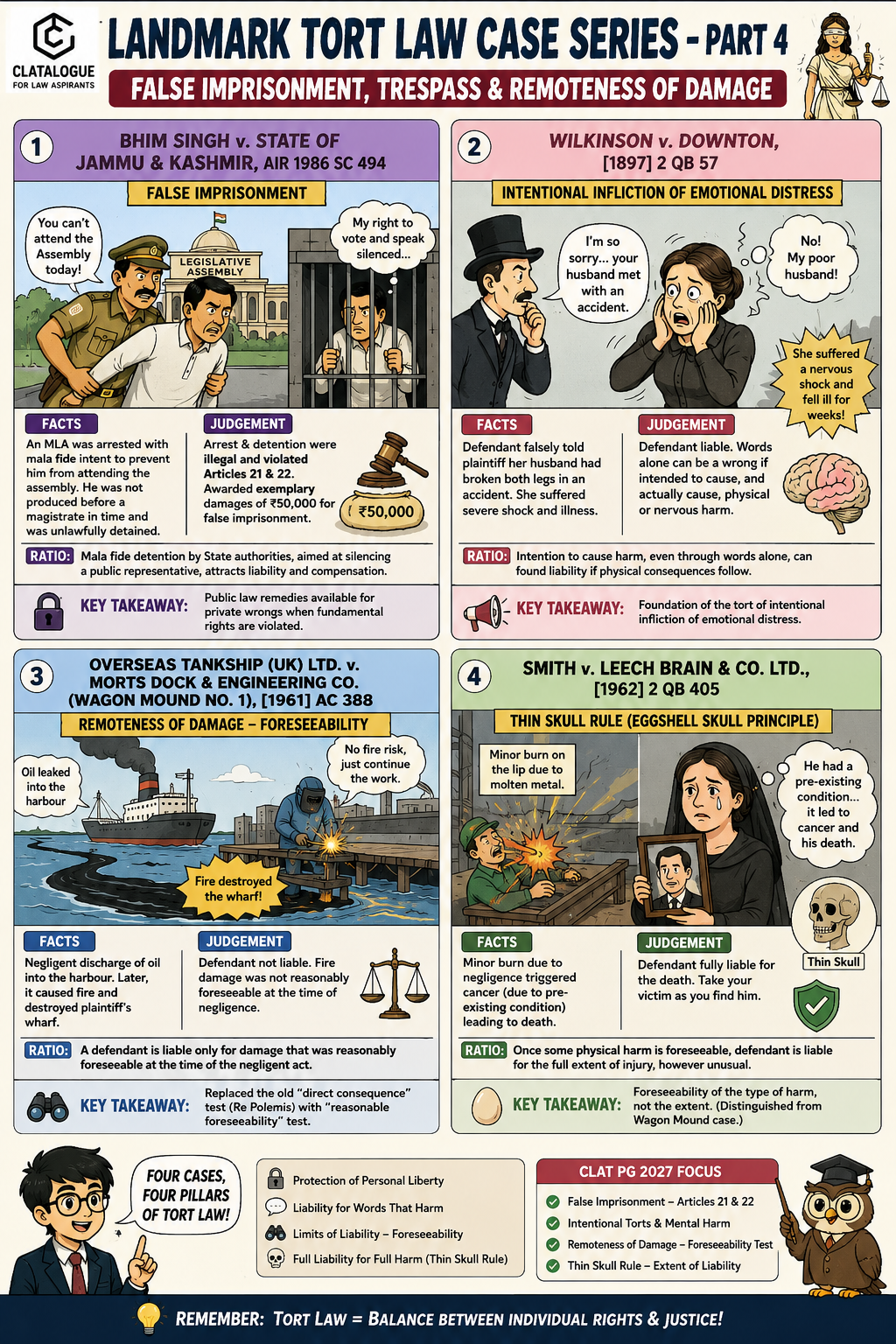
Together, these four cases trace the evolution of tort liability from direct interference with personal liberty to the outer limits of causation and foreseeability, a progression that CLAT PG aspirants should track carefully given how frequently remoteness and false imprisonment are tested in combination.
Get case-law updates weekly
Join 10,000+ subscribers.
HA
Hanspal Bakul
Contributing author
Have a doubt about this judgment?Ask Doubts
