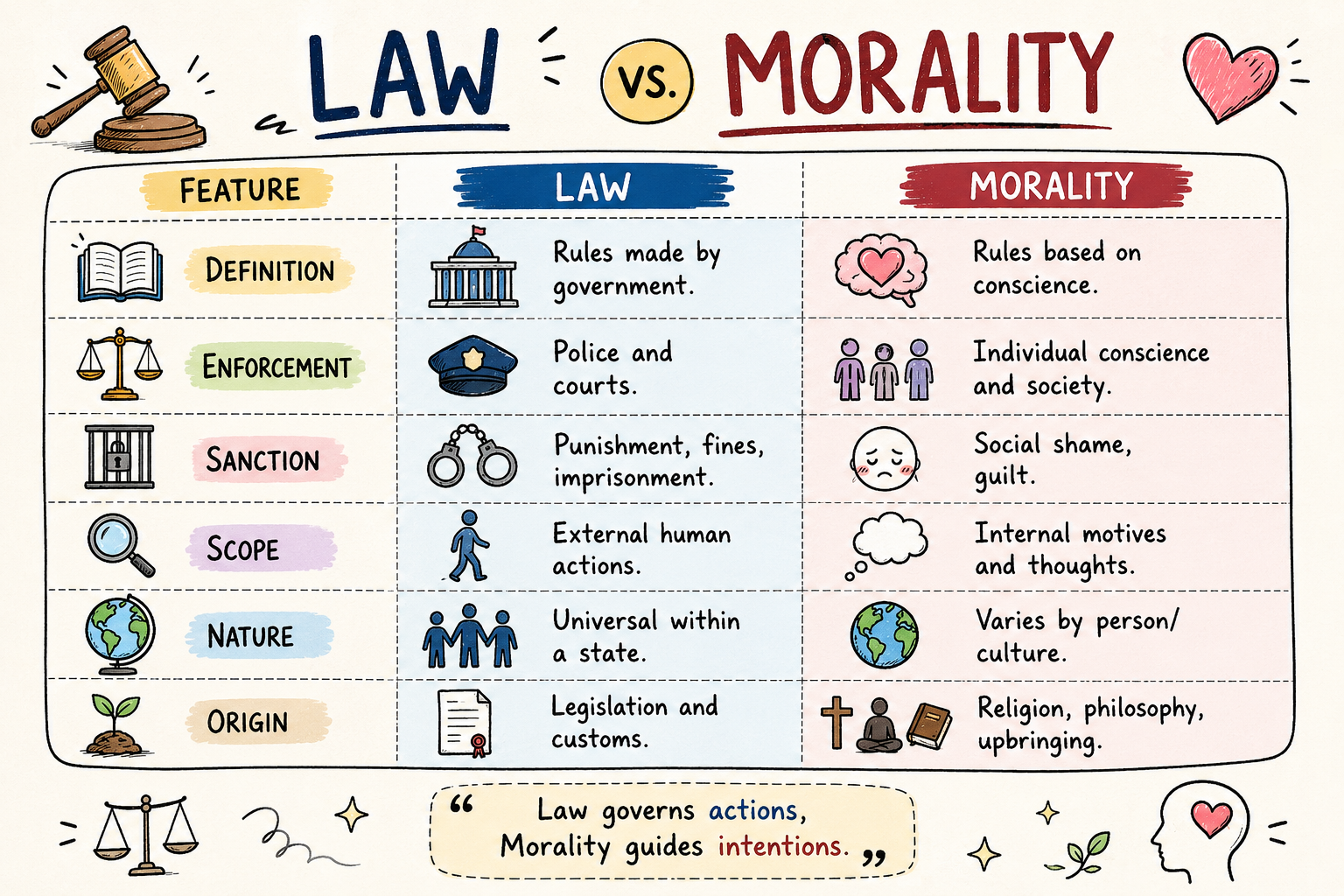
For every law student preparing for the CLAT exam or any other law exams, mastering the core principles of jurisprudence is necessary. Among the various concepts, ideologies, schools of jurisprudence, the interplay between the law and morality is of utmost importance. From ancient Greek philosophers to modern legal positivists, questioning whether an immoral law can truly be called as ‘law’ remains the main point of discussion.
This article breaks down what law and morality are, explores the difference between the law and morality, how different schools of jurisprudence view their intersection and the heated Hart-Fuller debate of 1958.
Defining Law & Morality
To understand where law and morality meet and where they dissents, we must first understand what they are.
What is Law?
Law is a set of rules, norms and regulations enacted, recognised and enforced by a sovereign political authority in order to provide justice and maintain social order. Austin defines law as “a command of the sovereign backed by sanction.” If an individual breaches a legal norm, the state imposes formal sanctions, such as imprisonment, fines, or damages.
What is Morality?
Morality is the basic human values, ethics which operate within the society by humans. It refers to society’s shared beliefs about what is right and wrong. In jurisprudence, morality is examined in relation to the law. Legal scholars debate whether a rule must be moral to be considered valid law or not.
This debate leads to the creation of two different schools with two different ideologies i.e. Natural Law Theory & Legal Positivism.
Natural Law Theory
Natural law theorists like Aristotle, Thomas Aquinas, Lon Fuller and John Finnis argue that law and morality are interconnected. According to this tradition, human positive law derives its validity and binding force from universal moral principles and human reasons.
Natural theory is based on the foundational maxim lex iniusta non est lex which means an unjust law is no law at all. From this perspective, a law made by a sovereign authority that violates fundamental moral principles such as human dignity, equality, or basic justice is no law at all. Such law lacks true legal validity and creates no genuine moral obligations.
Legal Positivism
Legal positivists such as Jeremy Bentham, John Asutin, Hans Kelsen, H.L.A. Hart insists upon the separateness of law and morality. They argue that the existence of law is one thing, its merits and demerit is another. Whether the law is legally valid depends on how it was created rather than its moral content.
In Austin’s famous work, ‘The Province of Jurisprudence Determined’ he quoted, “the existence of law is one thing, its merit or demerit is another.” It means that a rule can be a valid law even if it is morally bad or unfair. He emphasized on ‘what law is’ rather than ‘what law ought to be’.
Positivists believe that mixing morality with law leads to confusion. It may also allow judges to impose their personal moral biasness while adjudicating.
Hart-Fuller Debate (1958)
The debate was sparked by a real-world legal dilemma which originated after World War II. The question emerged regarding how the west german courts should punish the people who used oppressive nazi laws to imprison their personal enemies. If nazi statutes were treated valid, the people had committed no wrong. But if courts declare those statutes void ab initio as they were immoral, courts apply retroactive justice.
This led to a landmark debate which happened as the written exchange of academic papers initiated by the live lectures. It was published in the pages of the Harvard Law Review in 1958.
It opposed Oxford philosopher H.L.A. Hart against Harvard philosopher Lon L. Fuller over the fundamental question: Is there a necessary connection between law and morality?
H.L.A. Hart’s Perspective
In ‘Positivism and the Separation of Law and Morals’, Hart argued that while nazi laws were morally wrong, they were legally valid because they satisfy the procedural requirements of the legal system. He further argued that courts should not pretend nazi laws never existed. Instead, the state should pass an explicit, retroactive criminal statute to punish informers.
Hart defended legal positivism and argued for the strict separation of law and morality.
Lon L. Fuller Perspective
Fuller in his counter essay "Positivism and Fidelity to Law,” rejected Hart’s ideology. Fuller argued that a legal system requires some morality to even qualify as law. He stated that Nazi regime completely ignored basic legal principles. Therefore, it was not a legal system at all, and its laws were completely void from the start.
Fuller argued that the German courts were right to invalidate nazi laws directly. To him, informers were never acting under valid law, so no new laws were necessary.
Fuller’s 8 Principles of Legal Morality
Fuller argued that the system fails to be a legal system, it lacks any of these eight procedural requirements. He introduced the concept of Internal Morality of Law, comprising eight procedural requirements that a legal system must satisfy-
Law must apply generally rather than case by case.
Laws must be published so people know them.
Laws must look forward, not punish past actions.
Rules must be clear and easy to understand.
Rules cannot contradict each other within the system.
Laws must never demand the impossible from citizens.
Comparison between the Two Ideologies
Feature
H.L.A. Hart (Postivism)
Lon L. Fuller (Natural law)
Primary focus
Focused on what law is.
Focused on how law connects to what law ought to be
Connection
How law and Morality differ in Modern Jurisprudence
Law and morality do not always agree. Basic crimes like murder, theft, fraud represent areas where law and morality both are violated. Modern legal areas show how they differ-
Regulatory rules like speeding or parking in a restricted area may violate a law but it's not morally wrong.
Rules on abortion vary globally on different moral beliefs. Some prioritize fetal life while other persons right over their own body.
Similarly with euthanasia. Some countries legalize it and allow it under strict medical guidelines while others completely ban it in moral and religious traditions.
The Supreme court ruling in Navtej Singh Johar case shows how the law can change through societal needs. It shows how constitutional morality can override the outdated moral orthodoxies.
Conclusion
The debate between Hart and Fuller did not end in the victory of either side. Instead it established the structure that continues to transform the state depending upon the modern societal needs. The legacy of debate lies in its practical application to modern governance. From decriminalizing consensual same-sex relations, evolving reproductive autonomy, enforcing strict liabilities, we have been actively applying the interplay between Hart’s ‘law as it is’ and Fuller’s ‘law as it ought to be.’
Modern jurisprudence requires both perspectives to successfully solve the complexities arising out of dynamic society.