
CLATalogue
Notes
PYQs
Case Law Updates
Mocks
Ask a Doubt
Blogs
CLATAILETLegal UpdatesLawctopus Law School
Life at Law School
Contribute
Sign in
HomeNotes

Mortgage under the Transfer of Property Act, 1882

JU
Julie Nigam
5 October 20269 min read

Introduction

Suppose A borrows ₹10 lakh from a bank to buy a house and transfers a limited interest in the house as security. On repayment, A gets the property free and on default, the bank may use legal remedies. This arrangement is a mortgage.

Mortgages are studied under Chapter IV of the Transfer of Property Act, 1882 (TPA), mainly Sections 58 to 104. The chapter balances two interests i.e. the lender must have effective security, but the borrower must not permanently lose ownership merely because a loan was taken. The TPA, therefore recognises the borrower’s right of redemption and regulates the rights and duties of both parties.

Meaning and Essentials of mortgage : Section 58

Section 58(a) defines a mortgage as the transfer of an interest in specific immovable property to secure payment of money advanced or to be advanced, an existing or future debt, or performance of an engagement creating pecuniary liability.

The transferor is the mortgagor. The transferee is the mortgagee. The mortgage-money is the secured principal and interest money. If any transfer is made, it is created by the mortgage deed.

The essentials are -
  • a debt or pecuniary obligation,
  • specific immovable property,
  • transfer of an interest and
  • compliance with the required legal form.

A mortgage is not an outright sale. In K.J. Nathan v. S.V. Maruty Reddy (1964), the Supreme Court held that equitable mortgage is created by delivery of title deeds with the intention of creating security.

How a mortgage is made: Section 59

Where the principal money secured is ₹100 or more, a mortgage, other than a deposit of title deeds, generally requires a registered instrument signed by the mortgagor and attested by two witnesses. Registration, stamp duty and local requirements must also be checked.
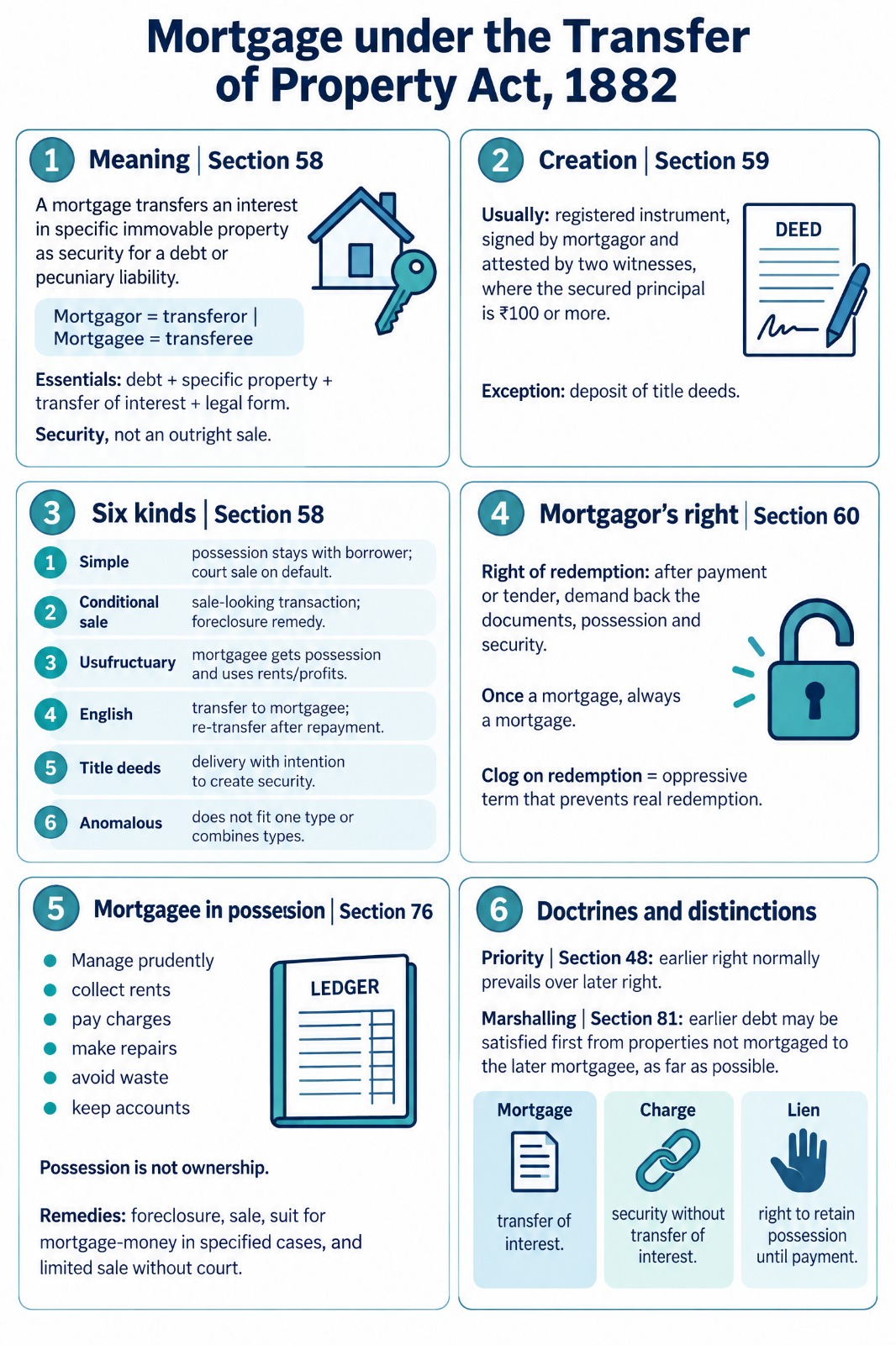
Mortgage under the Transfer of Property Act, 1882

Kinds of Mortgage under Section 58

1. Simple Mortgage under Section 58(b)

The mortgagor stays in possession and undertakes individual repayment. The mortgagee may pursue sale through the court and may have a personal remedy on default.
In simple words a simple mortgage is a legal agreement where a mortgagor (borrower) uses their property as security for a loan without giving up physical possession or control of it.
The mortgagor (borrower) takes on personal liability to repay the debt. It gives the lender the legal right to have the property sold through a court-ordered auction if the loan defaults.

2. Mortgage by conditional sale: Section 58(c)

The transaction appears to be a sale, but it contains a condition that the sale becomes absolute on default, becomes void on repayment, or requires re-transfer on repayment. The condition must be embodied in the same document that affects or purports to affect the sale. The mortgagee’s usual remedy is foreclosure.
In Pandit Chunchun Jha v. Sheikh Ebadat Ali (1954), the Supreme Court held in order to figure out if a deal is mortgage or a sale where a buyer agrees to sell it back later, you must look the actual intent of the parties

3. Usufructuary Mortgage: Section 58(d)

Possession is delivered or promised to the mortgagee, who may retain it and receive rents and profits. The income may be adjusted towards interest, principal or both. There is normally no personal covenant to repay and the mortgagee recovers through enjoyment of the property.
In simple terms, Usufructuary mortgage is a legal agreement where the mortgagor hands over the legal possession of the property to the mortgagee in exchange of loan.
Instead of paying back the loan in cash installments, the lender is allowed to look after the property, rent it out, or cultivate it, and keep all the income, rent, or crops (profits) generated by it to pay off the interest or the loan amount itself.

4. English mortgage: Section 58(e)

The mortgagor commits to repaying the loan by a specified date and transfers the property outright to the mortgagee, who is obliged to return it after full payment is made. The presence of a personal covenant to repay, along with the requirement to re-transfer the property, clearly differentiates this arrangement from a mortgage by conditional sale.
In simple words, English mortgage is the legal agreement where the mortgagor transfers the ownership to the mortgagee, as a security for loan. Mortgagee promises to transfer the ownership back to the mortgagor as soon as the loan is fully paid on the specific date.

5. Mortgage by deposit of title deeds: Section 58(f)

Mortgage by deposit of title deeds, is a legal document where a mortgagor secures a loan simply by handing over the documents or title deeds. It is commonly called an equitable mortgage. Mere physical delivery is not enough, the intention to create security must exist, as recognised in K.J. Nathan.

6. Anomalous mortgage: Section 58(g)

An anomalous mortgage is a mortgage which does not fall under any of the five categories, or which contains features of more than one of the categories. The rights and obligations which attach to such a mortgage are governed mainly by the mortgage deed, having regard where necessary to local usage.

Rights of the mortgagor

Right of redemption: Section 60

After the mortgage-money becomes due, the mortgagor can pay or tender the amount and require the mortgagee to return the documents, possession and security. This is the most important right of the mortgagor. The principle is popularly expressed as “once a mortgage, always a mortgage.” 

Redemption is the absolute legal right of a borrower (mortgagor) to reclaim their property free from all liabilities once they have fully paid back the loan amount, interest, and any associated costs to the lender (mortgagee). A term that unfairly prevents redemption is a clog on redemption. In Ganga Dhar v. Shankar Lal (1958) and Pomal Kanji Govindji v. Vrajlal Karsandas (1989), the Supreme Court held that courts must scrutinise oppressive terms that make redemption unreal. In Narandas Karsondas v. S.A. Kamtam (1977), the Court stressed that the right of redemption continues until it is legally extinguished by act of parties or a court decree.

Sections 60A and 60B allow the mortgagor, in appropriate circumstances, to direct transfer to a third party instead of re-transfer and to inspect or obtain copies of title documents.

Sections 63 and 63A protect the mortgagor’s benefit in accessions and improvements. Section 64 concerns renewal of a mortgaged lease. Under Section 65A, a mortgagor in lawful possession may grant a lease binding on the mortgagee if local law is followed, no premium is paid in advance, there is no renewal covenant and the term remains limited.

Liabilities of the mortgagor

Section 65 implies covenants that title is valid and transferable, the title will be defended, public charges and lease rent will be paid, and prior mortgages will be discharged where required.

A mortgagor in possession in breach of
section 66 is guilty of waste, that is destructive conduct which diminishes the value or security of the property permanently. Removing fixtures, demolishing a building or damaging valuable timber may amount to waste. Ordinary use consistent with the property’s nature is not automatically wasted.

Rights of the mortgagee

A mortgagee may resort to foreclosure or sale as provided in Section 67, depending on the type of mortgage. Foreclosure bars redemption, sale turns the property into money. Section 68 permits Suit for mortgage-money in certain cases such as personal covenant, destruction of security by mortgagor’s fault or failure to deliver possession.
Section 69 provides for a power of sale without the intervention of the courts only in limited statutory situations, such as some English mortgages or cases directly provided for by the section. The power must be exercised strictly and in good faith. Section 69A permits appointment of a receiver in appropriate cases.
Under Sections 70 to 73, a mortgagee may claim accessions, renewals, necessary expenditure and proceeds from revenue sale or government acquisition. Section 72 permits a mortgagee in possession to spend money to preserve the property, protect title, prevent forfeiture or insure it; properly incurred amounts may be added to the security.

Mortgagee in Possession: Duties under Section 76

A mortgagee in possession must manage the property prudently, collect rents and profits, pay public charges, make necessary repairs, avoid destructive acts, use insurance money properly, keep accounts and apply receipts correctly. Possession is not ownership.
These duties are important in a usufructuary mortgage. If the mortgagee's negligence results in failure to collect rent or damage to the property, the loss can be set off against the mortgage account. The mortgagee also has to take into account income received from the property.

Important Doctrines

Doctrine of Priority: Section 48

Where the same owner creates successive rights over the same property, the earlier right normally prevails over the later one. It is based on the latin maxim ‘qui prior est tempore potior est jure’ i.e. first in time, stronger in right. A later mortgagee is subject to the earlier mortgage, unless a statutory or equitable exception applies. Section 78 may postpone a prior mortgagee who has fraudulently or through gross neglect induced another person to advance money.

Doctrine of marshalling: Section 81

If the owner mortgages two or more properties to one mortgagee and later mortgages one or more of those properties to another mortgagee, the subsequent mortgagee may ask that the prior debt be satisfied first from properties not mortgaged to them, as far as possible.\

This cannot prejudice the prior mortgagee or another person with rights in the property. The doctrine creates an equitable relation among the securities and does not mean the automatic cancellation of the first mortgage.

Charge under Section 100

A charge exists when immovable property is made security for payment of money by act of parties or operation of law, but the transaction does not amount to a mortgage. A charge therefore creates security without transferring an interest in the property in the mortgage sense. A statutory charge for unpaid public dues is an example.

A mortgage is based on transfer of an interest in specific immovable property, a charge is only a security over property. A mortgage usually arises from a contract, while a charge may arise by operation of law. A mortgagee has the remedies given by the mortgage, whereas a charge-holder’s remedies depend on Section 100 and the underlying law.

A charge created by act of parties may generally be enforced like a simple mortgage, so far as applicable, but a transferee for value without notice is protected by Section 100.

A lien is usually a right to retain possession until payment. It does not necessarily create an interest in the property and generally gives no power of sale unless law or contract provides it. In
Syndicate Bank v. Vijay Kumar (1992), the Supreme Court explained the banker’s general lien as a right of retention, showing why lien is conceptually different from a mortgage or charge.

Conclusion

A mortgage is a security transaction, not an ordinary sale. Section 58 defines its essential structure and six kinds. Sections 60 to 76 balance the mortgagor’s right to redeem with the mortgagee’s right to recover money. Sections 78 and 81 deal with priority and marshalling, while Section 100 explains the charge.

For CLAT PG, remember the principle that , the lender receives security, not an unfair opportunity to defeat the borrower’s right of redemption

Subscribe for updates
Join 10,000+ subscribers.
JU
Julie Nigam
Contributing author
Have a doubt about this?Ask Doubts
On this page
IntroductionMeaning and Essentials of mortgage : Section 58How a mortgage is made: Section 59Kinds of Mortgage under Section 581. Simple Mortgage under Section 58(b)2. Mortgage by conditional sale: Section 58(c)3. Usufructuary Mortgage: Section 58(d)4. English mortgage: Section 58(e)5. Mortgage by deposit of title deeds: Section 58(f)6. Anomalous mortgage: Section 58(g)Rights of the mortgagorRight of redemption: Section 60Liabilities of the mortgagorRights of the mortgageeMortgagee in Possession: Duties under Section 76Important DoctrinesDoctrine of Priority: Section 48Doctrine of marshalling: Section 81Charge under Section 100Conclusion
Related reading
NotesThe Factories Act, 1948: Part 2 - Welfare, Working Hours, and EnforcementNotesThe Factories Act, 1948: Part 1 - Foundational ProvisionsBlogsCase Brief: Vasanta Sampat Dupare v. Union of India 
JU
Written by
Julie Nigam
AdvertisementsPrism AI
CLATalogue
For submitting a Postshruti.chauhan@lawctopus.com
For banner ads & admission campaignsrohit.bhutani@lawctopus.com
Office hours: 10.30 AM – 7 PM
Useful LinksAbout UsAdvertiseContact UsAsk a QuestionMoot Suite
We are Hiring
Lawctopus Law School

The law school you always wanted! Learn practical legal skills.

For LLS Coursescourses@lawctopus.comVisit site
Connect
© 2026 CLATalogue. All rights reserved.|Privacy Policy|Terms of Service
Subscribe to our newsletter