
Definition of of "Industry" Revisited by 9-Judges Bench of Supreme Court
Every worker's right to raise an industrial dispute depends on one question: does their workplace qualify as an "industry"? Section 2(j) of the Industrial Disputes Act, 1947 defines industry through a long list of terms, including business, trade, undertaking, manufacture, and calling. Yet this definition never explained where ordinary employment ends and industry begins. Recently, nine-judges bench revisited definition of 'industry' and gave it an interpretation.
Parliament left this gap deliberately open, expecting courts to fill it through interpretation. For decades, cases involving hospitals, clubs, cooperative societies, and government departments reached the Supreme Court, each testing whether the term "industry" covered them. This uncertainty needed a workable, uniform framework applicable across radically different institutions.
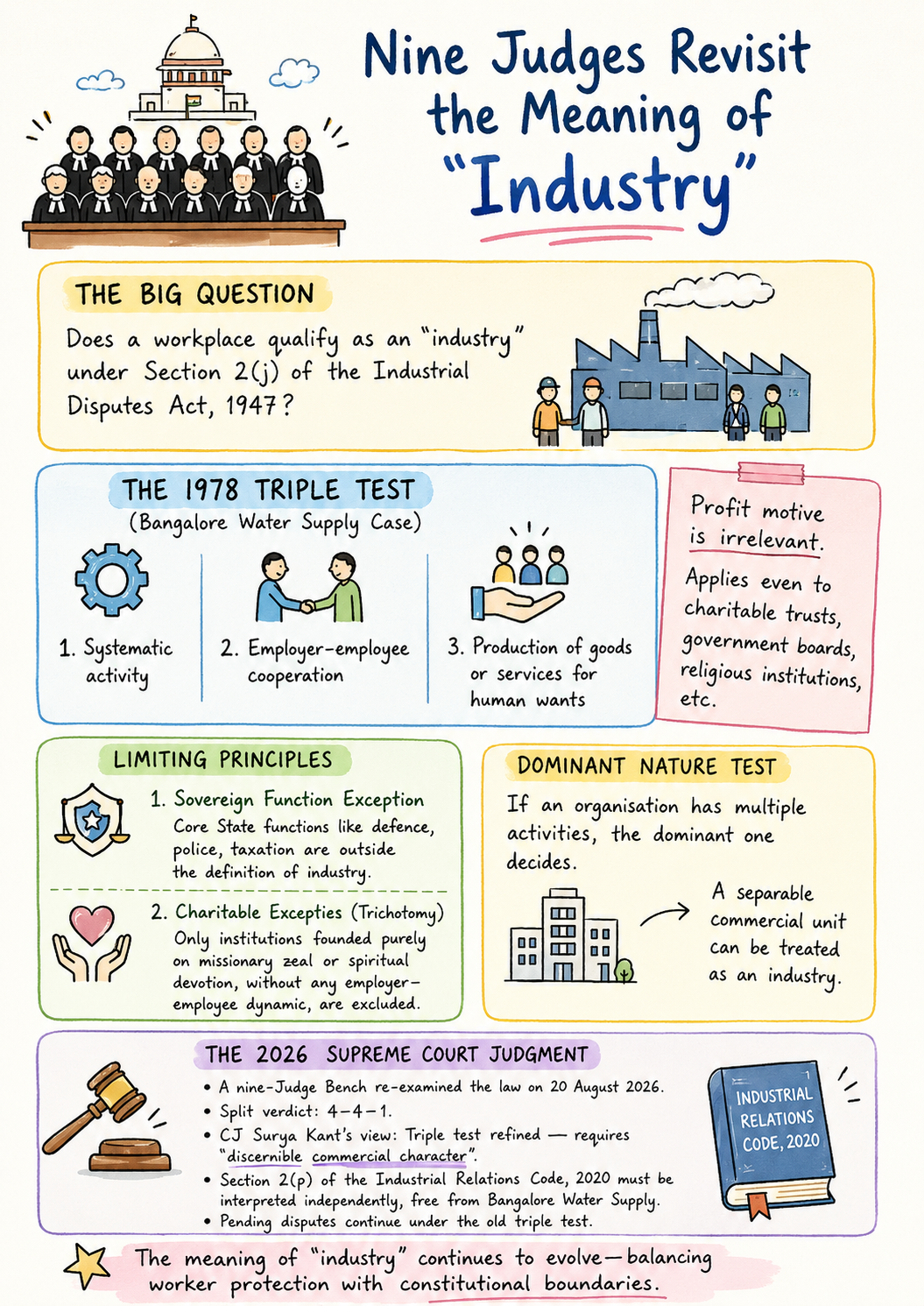
On 20 August 2026, a nine-Judge Bench led by Chief Justice Surya Kant ruled on the meaning of "industry" under Section 2(j) of the Industrial Disputes Act, 1947. The Bench reconsidered the triple test from Bangalore Water Supply & Sewerage Board v A. Rajappa (1978).
The Court framed the following issues:
- Whether Justice Krishna Iyer's triple test correctly read Section 2(j).
- Whether government welfare schemes count as industrial activity.
- What qualifies as a sovereign function.
A seven-Judge Bench, led by Justice Krishna Iyer, formulated the celebrated triple test. This test asked whether an activity was
- systematic
- Involved employer-employee cooperation,
- Produced goods or services satisfying human wants.
Crucially, the triple test made profit motive completely irrelevant. A charitable trust, a government welfare board, or a religious institution could all qualify as industries, provided their internal structure matched the three conditions. This protective philosophy reflected the statute's underlying purpose: safeguarding workmen regardless of their employer's ultimate objective.
The breadth of this test, however, created its own difficulties. Nearly every organised activity involving paid labour began resembling an industry under this formula. Universities, hospitals, and even certain government functions found themselves swept into a definition originally meant for factories and commercial establishments.
To manage this overreach, Justice Iyer carved out a narrow exception for genuinely charitable work. He created what is often called a "trichotomy," dividing philanthropic institutions into three categories. Only those founded purely on missionary zeal or spiritual devotion, without any conventional employer-employee dynamic, escaped the definition entirely.
This exception, though narrow, generated fresh confusion in later cases. Courts had to distinguish between institutions that merely included charitable objectives and those that existed solely for philanthropic devotion. The line between these categories often turned on facts specific to each organisation, making outcomes difficult to predict.
A parallel debate emerged around the idea of "commercial character." Some judges within the 1978 Bench, notably Justice Jaswant Singh, argued that industry should be confined to activities conducted on commercHe restricted it to inalienable functions that only the State can perform, using its sovereign power. Welfare schemes, hospitals, and public services run by government departments remained outside this narrow protective umbrella.
ial lines by private entrepreneurs. This narrower view would have excluded most government and charitable functions altogether.
The majority in Bangalore Water Supply rejected this restrictive reading. They held that commercial character was not essential, since even non-commercial welfare activity could satisfy the triple test. This majority position held the field for the next forty-eight years, shaping how tribunals across India decided industrial disputes.
Alongside charitable institutions, the sovereign function exception developed as another crucial limiting principle. Courts recognised that certain core State functions, such as defence, law enforcement, and taxation, could never be treated as industry. These functions belong to the State's inherent authority and cannot be equated with ordinary employment relationships.
Justice Krishna Iyer's opinion, however, interpreted this sovereign exception very narrowly. This narrow sovereign exception meant that government bodies performing welfare or economic activities faced the same triple test as private employers. The identity of the employer, whether private or governmental, became legally irrelevant to the inquiry. What mattered instead was the actual nature of the activity being performed.
Applying these tests to complex organisations required yet another interpretive tool: the dominant nature test. Large establishments often perform multiple functions simultaneously, some industrial and some not. Courts developed this test to identify which activity predominates, treating the establishment accordingly for the purposes of the Act.
Under this approach, a substantially severable unit within a larger organisation could be treated separately. Even if a government department primarily performed sovereign functions, a distinct commercial wing within it might independently qualify as an industry. This nuanced approach prevented both over-inclusion and unfair exclusion of workers.
Despite its sophistication, the triple test attracted persistent criticism over the following decades. Legislators attempted to narrow the definition through the Industrial Disputes (Amendment) Act, 1982, which sought to exclude several categories of institutions. This amendment, however, was never actually brought into force by the government.
Since the 1982 amendment remained unnotified, Bangalore Water Supply continued governing industrial disputes without any legislative modification. Meanwhile, Parliament eventually replaced the entire framework through the Industrial Relations Code, 2020. This new Code introduced Section 2(p), offering a fresh statutory definition of industry altogether.
The relationship between old judicial interpretation and new legislative text raises an important conceptual question. When a repealed provision is replaced by a differently worded provision, should courts automatically carry forward the earlier judicial gloss? Legal principle suggests that new statutory language deserves independent interpretation, free from old precedent.
This exact question reached a nine-Judge Bench in 2026, following a reference originally made in Jai Bir Singh v State of Uttar Pradesh. The Supreme Court examined whether the triple test still represented sound law, and whether the new Code should inherit its framework. This reconsideration tested nearly every doctrine discussed above.
The resulting judgement, delivered on 20 August 2026, produced a fractured 4-4-1 split that left the formal reformulation of the test in limbo. While Chief Justice Surya Kant authored an opinion attempting to refine the elements by requiring a "discernible commercial character," only three other judges backed this text, failing to secure a clear majority.
It also confirmed that Section 2(p) of the new Code must be interpreted independently, free from Bangalore Water Supply's historical baggage. Pending disputes, meanwhile, continue under the older triple test.
Subscribe for updates
Join 10,000+ subscribers.
HA
Hanspal Bakul
Contributing author
Have a doubt about this?Ask Doubts
