
Notes on Tort Law: Absolute Liability
In the previous article, we looked at strict liability and its elements as well as defences available against it. This article will talk about absolute liability in Tort Law.
Absolute Liability
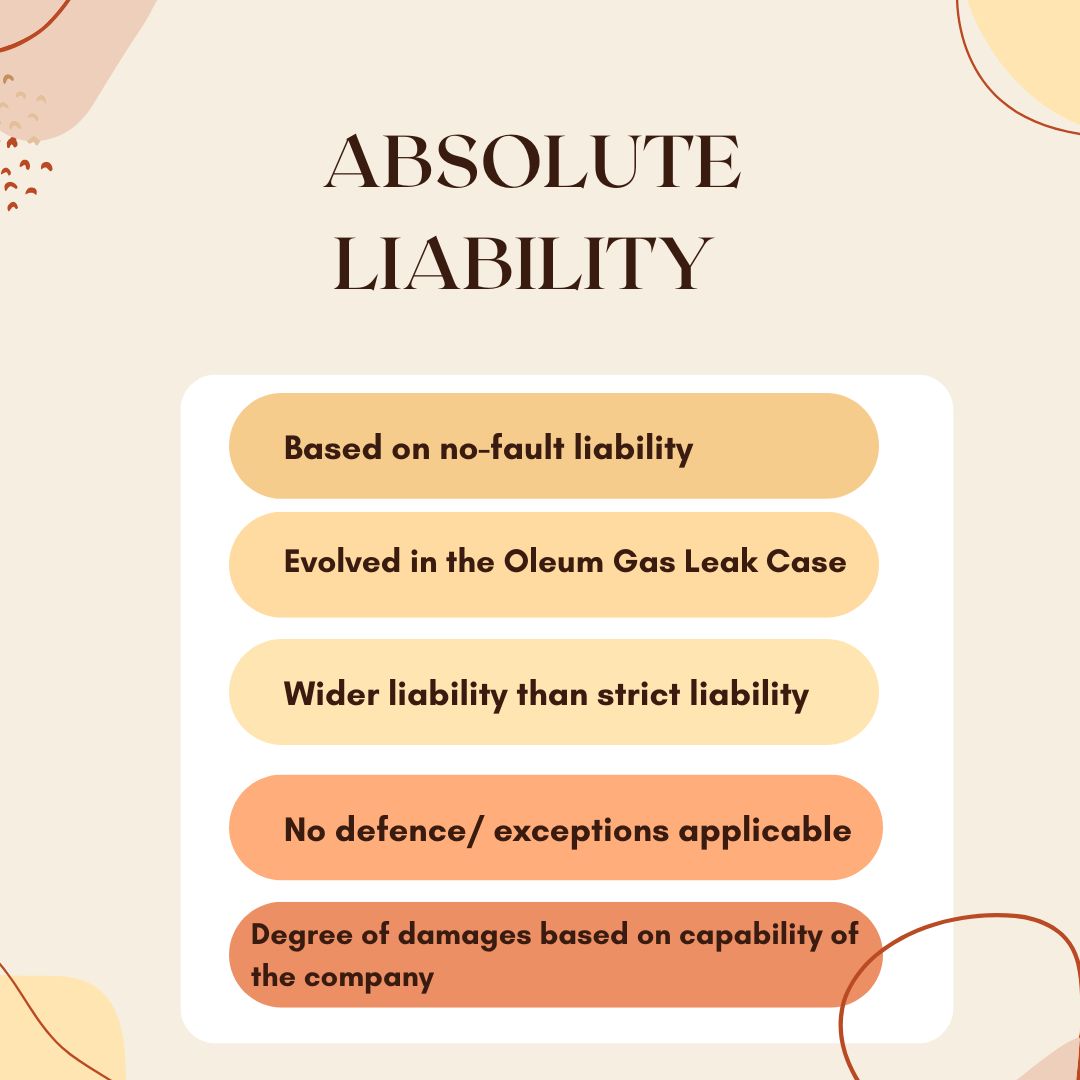
Absolute Liability (based on no-fault liability )evolved in India in the MC Mehta v. UoI Case which is also known as the Oleum Gas Leak Case. The judgement of the case came at a time when the country was coming to terms with the Bhopal Gas Tragedy.
The judgement in this case can be said to be influenced by the tragedy in a way that it decided to hold big corporations liable for their actions and consequential accidents. In this case, SC was dealing with the leak of oleum gas from an unit of Shri Ram Foods and Fertilizer. The leakage was caused by bursting of a tank that was storing the gas and its escape resulted in a lot of damages. Within a period of 1 year, this was the 2nd case of large scale leakage of deadly gas. Supreme Court did not follow strict liability in this case and evolved absolute liability which is not subject to any exceptions at all.
The Supreme Court considered strict liability insufficient to protect citizens’ rights in a developed economy such as India thereby substituting it with the ‘absolute liability principle’. The Supreme Court also designated itself as the protector of the environment and added under Article 21 the right to a pollution-free and safe life.
Essential elements of Absolute Liability
Absolute Liability is just Strict Liability without any exceptions.
- Dangerous thing: The substance must be dangerous or have the power to be potentially destructive and be under the control of someone to hold them liable.
- Escape of dangerous thing from land: The dangerous material must escape to endanger a victim and establish absolute liability.
- Non-natural use of land: Use of land in a manner that is not natural. For example, use of land to grow trees is natural, growing poisonous trees is not.
- Mischief: The plaintiff must demonstrate that dangerous material has escaped and caused damages.
Defences available against Absolute Liability
No defences are available against Absolute Liability. No exceptions of Strict Liability apply in this case either. Therefore, the people who cause damage in this situation have unlimited liability to compensate victims adequately. In the case of Strict Liability, the wrongdoer has to pay compensation per the damage that has been caused while in Absolute Liability the quantum of damages is dependent on the capability of the wrongdoer.
Preparing for CLAT? Go through our notes on Tort Law.
- Introduction to Torts
- Types of Torts
- General Defences in Tort Law
- Negligence in Tort Law
- Strict Liability in Tort Law
Subscribe for updates
Join 10,000+ subscribers.
RU
Ruchika Mohapatra
Contributing author
Have a doubt about this?Ask Doubts
