
Nuclear Liability and the SHANTI Act: Can Parliament Limit Compensation?
India's nuclear energy framework has undergone a major change with the Sustainable Harnessing and Advancement of Nuclear Energy for Transforming India Act, 2025 (SHANTI Act). The Act replaces the earlier civil liability framework under the Civil Liability for Nuclear Damage Act, 2010 and permits greater private sector participation in nuclear activities.
However, the Act's liability framework has raised an important constitutional question: Can Parliament limit the liability payable by nuclear operators when a nuclear accident causes extensive damage to life, property and the environment?
The Supreme Court is currently examining this question in E.A.S. Sarma & Ors. v. Union of India & Anr., W.P. (C) No. 240 of 2026. The petition challenges several provisions of the SHANTI Act, including Sections 11, 12, 13, 14 and 16 on constitutional grounds.
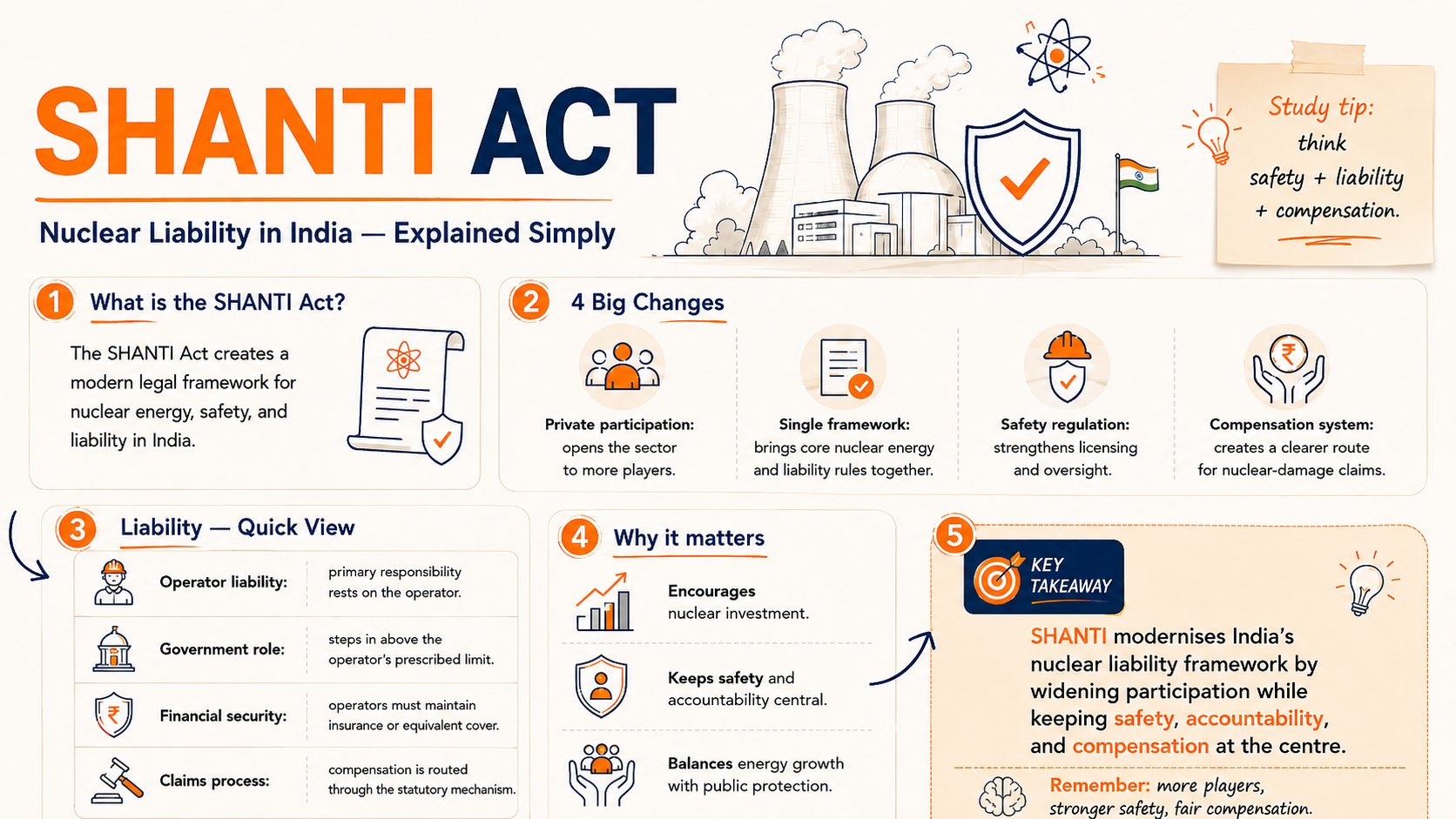
What Is Nuclear Liability?
Nuclear liability refers to the legal responsibility to compensate victims for damage caused by a nuclear incident.
The SHANTI Act follows a no-fault liability framework. This means that a person claiming compensation for nuclear damage does not ordinarily have to prove negligence or wrongful conduct on the part of the operator.
The framework covers damage arising from a nuclear incident, subject to the exclusions and limitations provided under the Act.
The important point is that the Act places the primary liability on the operator of the nuclear installation, rather than requiring victims to establish fault.
What Does Section 11 of the SHANTI Act Provide?
Section 11 deals with the liability of the operator.
The operator is liable for nuclear damage resulting from a nuclear incident involving the nuclear installation or, in specified circumstances, nuclear material coming from or sent to the installation.
Thus, the starting point under the Act is straightforward:
Nuclear incident → nuclear damage → operator's statutory liability.
However, this liability is subject to the limits prescribed by the Act.
What Does Section 12 Provide?
Section 12 specifies circumstances in which the operator will not be liable for nuclear damage.
The provision covers certain exceptional events, including damage caused by extraordinary natural disasters of an exceptional character and certain acts connected with armed conflict, hostilities, civil war, insurrection or terrorism, subject to the statutory conditions.
This means that operator liability under the SHANTI Act is not absolute in the same sense as the judicial doctrine of absolute liability developed by the Supreme Court for hazardous industries.
How Much Is the Operator Liable For?
This is where Section 13 and the Second Schedule become important.
Section 13 provides that the maximum amount of liability in respect of each nuclear incident is the rupee equivalent of 300 million Special Drawing Rights (SDRs), or such higher amount as the Central Government may specify.
However, the operator's own liability is separately determined according to the categories prescribed in the Second Schedule.
The Second Schedule adopts a graded system based on the nuclear installation's capacity:
| Category of nuclear installation | Maximum operator liability |
| Above 3,600 MW thermal power | ₹3,000 crore |
| Above 1,500 MW and up to 3,600 MW | ₹1,500 crore |
| Above 750 MW and up to 1,500 MW |
The Government has also officially described the SHANTI Act as providing a graded liability framework ranging from ₹100 crore to ₹3,000 crore, depending on the category of nuclear facility.
Is ₹3,000 Crore the Maximum Compensation a Victim Can Receive?
No. This distinction is crucial.
₹3,000 crore is the maximum operator liability prescribed for the largest category of nuclear installation under the Second Schedule.
It should not be described as a blanket ceiling on every amount that could potentially be available for nuclear damage.
The Act separately provides for Central Government liability under Section 14.
What Does Section 14 Provide?
Section 14 deals with the liability of the Central Government.
Where the nuclear damage exceeds the operator's liability prescribed under the Second Schedule, the Central Government bears liability for the excess amount, subject to the framework and overall limits prescribed by the Act.
The provision therefore creates a two-level structure:
First level: Operator's liability under the Second Schedule.
Second level: Central Government liability for amounts beyond the operator's prescribed liability, within the statutory framework.
The Act also provides for a Nuclear Liability Fund to meet the Central Government's liability in specified circumstances.
Therefore, saying that the SHANTI Act simply "caps compensation at ₹3,000 crore" would be legally inaccurate.
The more precise statement is:
The SHANTI Act caps the statutory liability of the operator at the amount applicable to the relevant category of nuclear installation, while Section 14 provides for Central Government liability beyond that amount within the statutory framework.
What About Insurance?
The SHANTI Act also deals with the financial security required to meet nuclear liability.
Under Section 15, an operator is required, before commencing operation of a nuclear installation, to obtain an insurance policy or other financial security, or a combination of both, covering its liability for nuclear damage.
The requirement is intended to ensure that funds are available to meet the operator's statutory liability.
The provision is particularly relevant because nuclear accidents can involve claims of enormous magnitude and may have long-term consequences.
What Happened to Supplier Liability?
One of the significant changes introduced by the SHANTI Act concerns the operator's right of recourse against suppliers.
Under the earlier Civil Liability for Nuclear Damage Act, 2010, Section 17(b) allowed an operator to seek recourse against a supplier in specified circumstances, including where an accident resulted from defective equipment or material or substandard services.
The SHANTI Act takes a narrower approach.
Under Section 16, the operator may exercise a right of recourse after paying compensation where:
- the right is expressly provided for in a written contract; or
- the nuclear incident resulted from an act or omission of an individual done with the intention of causing nuclear damage.
Therefore, defective equipment or a manufacturing defect does not automatically create a statutory right of recourse against the supplier under Section 16. Contractual arrangements become particularly important.
This change has become one of the major points of criticism of the new framework.
Why Is the Supreme Court Examining the SHANTI Act?
The constitutional challenge has been filed in E.A.S. Sarma & Ors. v. Union of India & Anr., W.P. (C) No. 240 of 2026.
The petitioners challenge several provisions of the SHANTI Act on the ground that they violate fundamental rights under Articles 14, 19 and 21. Among other issues, the petition challenges the statutory liability framework and the reduced role of supplier liability.
During the hearing on 19 May 2026, the Supreme Court described the matter as involving a sensitive legislative policy issue. At the same time, the Court raised concerns about whether the statutory framework provides a sufficiently robust mechanism for compensating persons affected by a nuclear accident.
The Court also indicated that it would consider the petitioners' concerns regarding the ability of courts to determine appropriate compensation.
Importantly, the Supreme Court has not struck down the SHANTI Act or declared its liability provisions unconstitutional. The challenge remains pending.
Can Parliament Limit Compensation?
This is the central constitutional question.
Parliament can certainly create a statutory framework governing liability. The SHANTI Act demonstrates this by prescribing operator liability according to the category of the nuclear installation and by providing for Central Government liability.
However, a separate question arises when a nuclear accident results in serious violations of fundamental rights.
The Supreme Court has recognised the power of constitutional courts to award compensation as a public law remedy in appropriate cases involving violation of fundamental rights.
In Nilabati Behera v. State of Orissa, (1993) 2 SCC 746, the Supreme Court recognised compensation as an appropriate public law remedy for violation of the right to life and personal liberty under Article 21.
Similarly, in M.C. Mehta v. Union of India, (1987) 1 SCC 395, the Supreme Court developed the doctrine of absolute liability for enterprises engaged in hazardous or inherently dangerous activities.
The Court held that such an enterprise has an absolute and non-delegable duty to the community and cannot escape liability by relying on the exceptions available under the traditional rule of strict liability.
However, the SHANTI Act is a specific statutory framework governing nuclear damage. The question before the Supreme Court is therefore not simply whether the doctrine of absolute liability exists.
The issue involves a difficult balance between victim protection and nuclear development.
A major nuclear accident can result in extensive damage to human life, health, property and the environment. Radiation-related harm may also have consequences that continue for years or generations.
At the same time, the Government argues that India needs a predictable liability framework to encourage investment and facilitate private participation in nuclear energy.
The SHANTI Act therefore attempts to create a system in which:
Operators bear liability up to a prescribed amount, while the Central Government provides the statutory backstop beyond the operator's liability.
The constitutional challenge asks whether this framework provides an adequate remedy for victims of a catastrophic nuclear accident.
Conclusion
The question "Can Parliament limit compensation under the SHANTI Act?" requires a careful answer.
Parliament has prescribed limits on the operator's statutory liability and created a separate mechanism for Central Government liability. Therefore, it would be incorrect to say that the Act simply limits every possible claim for nuclear damage to ₹3,000 crore.
The more difficult constitutional question is whether a statutory liability framework can restrict the power of constitutional courts to provide an effective remedy where a nuclear accident causes serious harm, including violations of fundamental rights.
The Supreme Court's ongoing consideration of E.A.S. Sarma & Ors. v. Union of India & Anr. may provide important guidance on this issue.
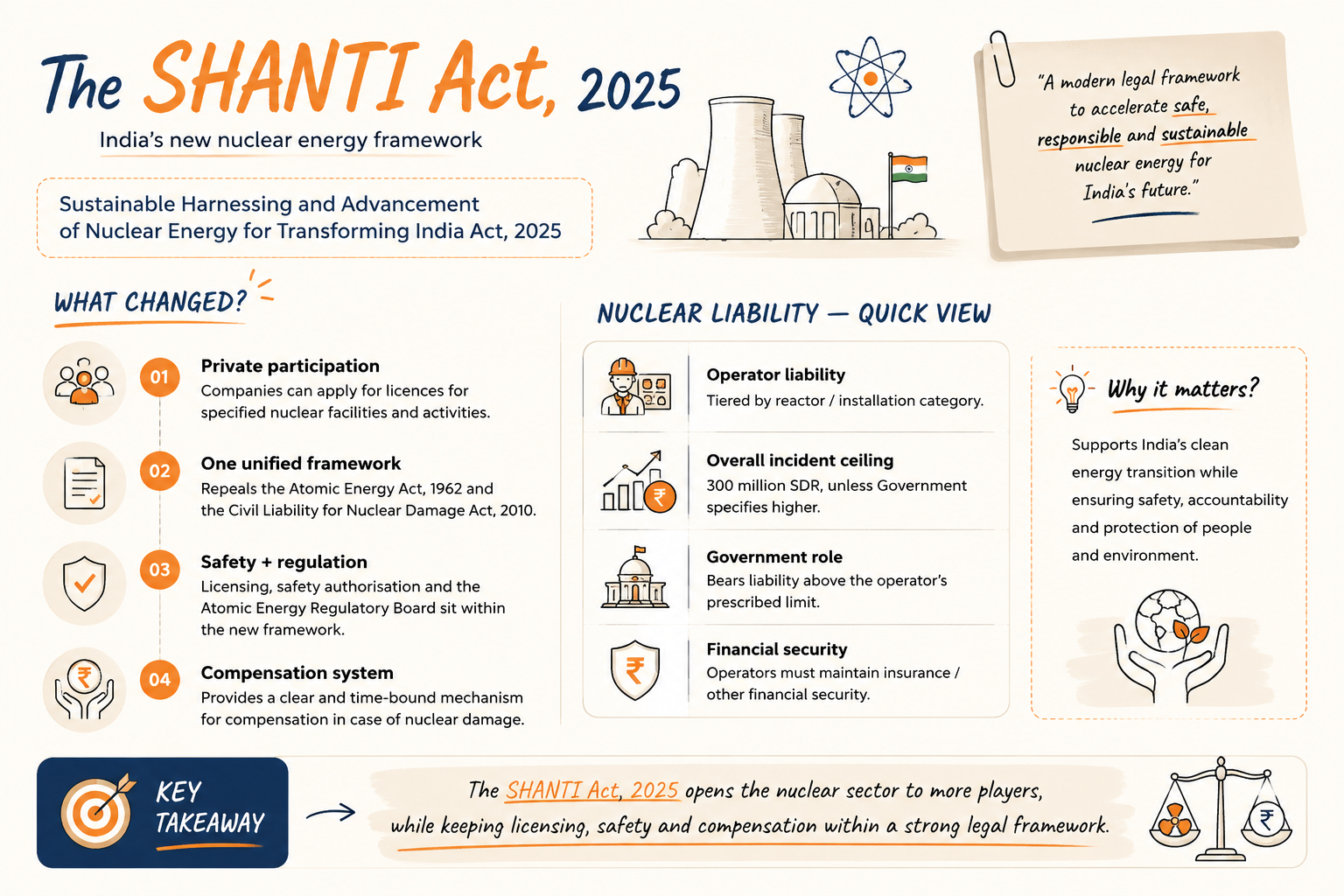
For now, the key distinction for understanding the SHANTI Act is: The Act limits the operator's statutory liability; it does not simply declare ₹3,000 crore to be the universal ceiling on all compensation arising from a nuclear accident.
Subscribe for updates
Join 10,000+ subscribers.
SH
Shruti chauhan
Contributing author
Have a doubt about this?Ask Doubts
