
Powers of Magistrates under BNSS, 2023
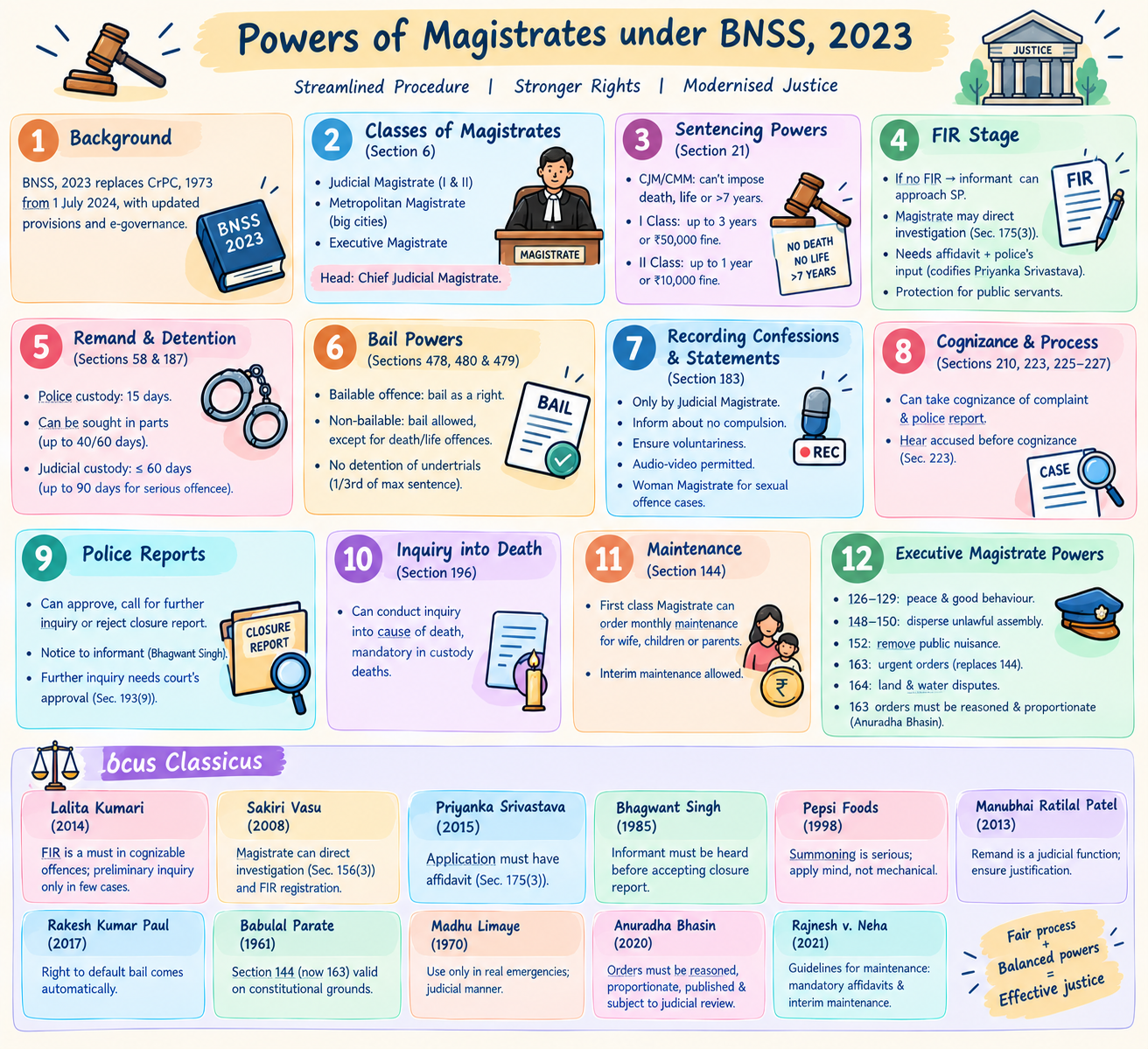
Under the BNSS, 2023, the powers of magistrates have been modernized to streamline criminal procedure, enhance judicial efficiency, and integrate electronic governance in India.
1. Background
The Bharatiya Nagarik Suraksha Sanhita,2023 shall supersede the existing CrPC, 1973 from 1st July, 2024 onwards. The major portion of the authority of the magistrate has been retained with some changes in the provisions and official form of the code. The changes are put to test by the examiners in practice.
2. Classes of Magistrates (Section 6)
The BNSS recognizes the Judicial Magistrates of the first and second class, Metropolitan Magistrates in big cities, and Executive Magistrates. The head of the Judicial magistrate is the Chief Judicial Magistrate.
3. Sentencing Powers (Section 21)
Chief Judicial Magistrate/Chief Metropolitan Magistrate has the power to impose any type of sentence except for death, life imprisonment and imprisonment for more than seven years.
First Class Magistrate has the power to impose a sentence not exceeding three years or fine not exceeding ₹50000.
Second Class Magistrate has the power to impose a sentence not exceeding one year or fine not exceeding ₹10000. The limits in fines which have been prescribed under the BNSS are enhanced from those prescribed under the CrPC.
4. Powers at the FIR Stage
If an FIR is not registered by police, the informant can report the matter to the Superintendent of Police. In such a case, then the Magistrate may direct an investigation per Section 175(3).
As per BNSS, the application must be submitted along with an affidavit of the applicant and the Magistrate must consider the submission of the police officer as well. And through this, the ruling of Priyanka Srivastava is codified.
It also adds a layer of protection for public servants by requiring a report from their superior authority before a Magistrate directs an investigation against them for actions taken in the line of official duty.
5. Remand and Detention (Section 187)
In the case of arrest, the accused should be produced before a Magistrate, and as per Section 187, the detention may be permitted; many judicial acts are associated with the remand process. The detention period of police custody is limited to 15 days, while as per BNSS rules, it may take place separately within up to 40 or 60 days during investigation.
It can now be sought in parts/tranches spread across the first 40 days (for offences punishable up to 7 years) or 60 days (for offences above 7 years). The overall limits for filing a chargesheet (60/90 days) before default bail applies remain identical to the old Section 167 of the CrPC.
The period of judicial custody shouldn't exceed 60 days, which goes up to 90 days in the case of offences in which the maximum punishment of imprisonment is death, life, or at least ten years of imprisonment.
6. Bail Powers (Sections 478, 480 and 479)
In the case of bailable offences, bail can be demanded as matter of right (Section 478). In the case of non-bailable offences, a Magistrate has been given powers as per Section 480 but cannot allow bail if there are reasonable grounds for believing that the accused has committed a crime punishable by death or life.
Under Section 479, there is a prohibition against the detention of undertrials. If the person is a first-time offender, he is released after serving one-third of the maximum possible sentence.
7. Recording Confessions and Statements (Section 183)
Confessions can only be recorded by a Judicial Magistrate. The Magistrate is required to inform the accused that he is not mandated to make a confession and also ensure that the confession is voluntary. According to BNSS, audio-video recording is permitted. A woman Magistrate must record the testimony of a woman in cases of sexual offences.
8. Cognizance and Process (Sections 210, 223, 225-227)
Pursuant to Section 210, a Magistrate can take cognizance of both a complaint & a police report or other information. In the case of a complaint, the Magistrate will interrogate the complainant or may defer the process till inquiry (Section 225) and then reject the complaint (Section 226) .
Section 223 of the BNSS introduces a major shift from the CrPC: The Magistrate cannot take cognizance of a private complaint without giving the accused an opportunity of being heard.
9. Powers on Police Reports
When the police submit a closure report, the Magistrate has the option to approve it, call for further inquiry, or reject the report nonetheless. The informant should be aware of this (Bhagwant Singh).
According to section 193(9), the court's approval is required for further inquiry after a report has been submitted, which must be completed within 90 days although it can be extended with permission.
10. Inquiry into Death (Section 196)
In addition to the police inquiry, the Magistrate can conduct an inquiry into the cause of death as well. Such an inquiry is mandatory in cases where someone dies in custody.
11. Maintenance (Section 144)
The first-class magistrate can give orders for monthly maintenance for a wife, children or parents who have no means to support themselves. Maintenance can also be of the interim type. This was section 125 of the CrPC and is subject to the principles of Shah Bano.
12. Executive Magistrate Powers
- Sections 126-129: orders for keeping peace and good behavior.
- Sections 148-150: dispersal of unlawful assembly
- Section 152: orders for elimination of public nuisance.
- Section 163: urgent orders related to nuisance and apprehended danger (previously section 144). Section 163 orders must be reasoned and proportionate. Repeated or indefinite orders are an abuse of power (Anuradha Bhasin).
- Section 164: disputes over land and water likely to cause a breach of peace.
Locus Classicus
Lalita Kumari v. Govt. of U.P.: The registration of an FIR is a must in cases related to cognizable offences. Preliminary inquiry is only permitted in a few instances covered though not comprehensively by BNSS Section 173(3).
Sakiri Vasu v. State of U.P.: A Magistrate directing an investigation under Section 156(3) CrPC has powers implied to allow FIR registration and to supervise the investigation.
Priyanka Srivastava v. State of U.P.: The application for the order for investigation has to be supported with the affidavit. This is a situation that was demanded by BNSS Section 175(3).
Bhagwant Singh v. Commissioner of Police: The point regarding a closure of the report, it is to be noted that a Magistrate has to give a notice to the informant and hear him first before accepting the same.
Pepsi Foods Ltd. v. Special Judicial Magistrate: Summoning the accused is a very serious act. A Magistrate has to apply mind and cannot act in a mechanical manner.
Manubhai Ratilal Patel v. State of Gujarat: The act of remanding is the judicial function. A Magistrate should be sure that the detention is justified and proper before allowing the same.
In the case of Rakesh Kumar Paul v. State of Assam, it has been stated that the right to default bail comes automatically at the end of the statutory period no matter how late the charge sheet is submitted.
The case of Babulal Parate v. State of Maharashtra shows that the old Section 144 (now Section 163) is valid on constitutional grounds as a reasonable limitation in the interest of public order.
In the case of Madhu Limaye v. SDM, Monghyr, the court stated that this power is applicable only in real emergencies; that is it must be exercised in a judicial manner.
According to Anuradha Bhasin v. Union of India, orders made under the old Section 144 should be reasoned, not disproportionate, published, and also should be subject to judicial review.
In the case of Rajnesh v. Neha the court laid down directives regarding maintenance proceedings which cover mandatory declaration affidavits and interim maintenance as well.
Subscribe for updates
Join 10,000+ subscribers.
HA
Hanspal Bakul
Contributing author
Have a doubt about this?Ask Doubts