Case Brief: Ram Charan v. Sukhram
Citation: Ram Charan & Ors. v. Sukhram & Ors., Civil Appeal No. 9537 of 2025, decided on July 17, 2025, by a bench of Justice Sanjay Karol and Justice Joymalya Bagchi (also reported as 2025 INSC 865).
Facts
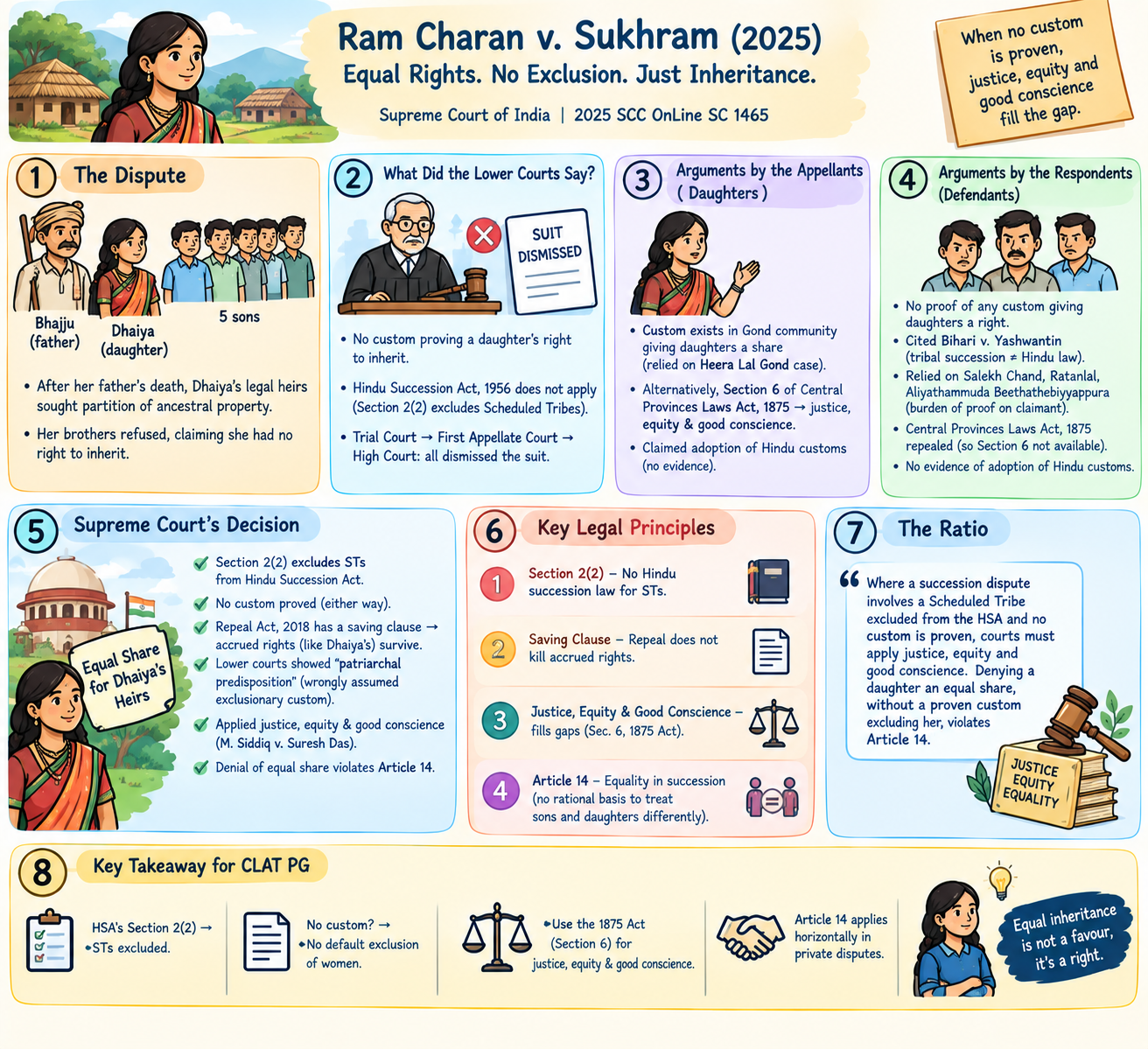
The appellants were the legal heirs of Dhaiya, a woman belonging to a Scheduled Tribe. Dhaiya's father, Bhajju alias Bhanjan Gond, had six children, five sons and Dhaiya as the only daughter. After her father's death, the appellants sought partition of his ancestral property, claiming that Dhaiya was entitled to an equal share alongside her brothers.
The dispute began in October 1992 when the other legal heirs refused to allow partition. The Trial Court dismissed the suit, holding that the plaintiffs failed to prove any custom entitling a daughter to inherit, and that the Hindu Succession Act, 1956 did not apply since Section 2(2) of that Act excludes Scheduled Tribes.
The First Appellate Court and the Chhattisgarh High Court both upheld this dismissal.
Arguments on Behalf of the Appellants (Plaintiffs)
The appellants first argued that a custom existed within the Gond community recognising a daughter's right to succeed to her father's property, relying on the judgment in Heera Lal Gond v. Sukhbariya Bai, which had recognised succession rights for widows and daughters based on proven Gond caste custom.
They contended this precedent supported their claim even without separately proving the custom afresh in their own case.
As an alternative and fallback argument, the appellants submitted that even if no specific custom could be established, the principle of justice, equity, and good conscience under Section 6 of the Central Provinces Laws Act, 1875 must govern the dispute, since the statute itself contemplates this residuary standard wherever no other law or custom applies.
They relied on Daduram v. Bhuri Bai, a coordinate bench ruling of the Chhattisgarh High Court that had applied this very principle to grant inheritance rights to a female heir in similar circumstances.
The appellants also argued, though with less success, that their family had adopted Hindu customs and a Hindu way of life, which would bring them within the ambit of Hindu succession principles despite their tribal status. However, no evidence was placed on record to substantiate this claim at any stage of the proceedings.
Arguments on Behalf of the Respondents (Defendants)
The respondents' primary argument was that the appellants had failed to discharge their burden of proving the existence of a custom entitling daughters to inherit within the Gond community.
They relied on Bihari v. Yashwantin, in which the High Court had held that persons of the Gond caste are governed not by Hindu custom but by their own specific tribal tradition in matters of succession, and that a mere assertion of custom, without concrete evidentiary proof through real instances, is legally insufficient.
The respondents further relied on Salekh Chand v. Satya Gupta, Ratanlal v. Sundarabai Govardhandas Samsuka, and Aliyathammuda Beethathebiyyappura Pookoya v. Pattakal Cheriyakoya, each reinforcing the principle that a party asserting a customary right of inheritance bears a strict burden of proving that custom through cogent evidence, not mere oral assertion or isolated precedent.
On the alternative argument concerning justice, equity, and good conscience, the respondents contended, and the High Court accepted, that the Central Provinces Laws Act, 1875 stood repealed with effect from March 30, 2018, and therefore could no longer form the basis of any claim.
They also disputed the claim that the family had adopted Hindu customs, pointing to the complete absence of supporting evidence on this point.
Judgment
The Supreme Court allowed the appeal and set aside the concurrent findings of the Trial Court, First Appellate Court, and High Court, holding that Dhaiya's legal heirs were entitled to an equal share in the ancestral property.
The Court first confirmed that Section 2(2) of the Hindu Succession Act, 1956 unambiguously excludes Scheduled Tribes from its application unless the Central Government issues a specific notification extending it to them, and since no such notification existed, Hindu succession law had no bearing on the dispute.
The Court also agreed with the courts below that no custom, in either direction, had been proved on the evidence actually placed on record.
On the repeal question, the Court held that the High Court had erred. The Repeal Act No. 4 of 2018, which repealed the Central Provinces Laws Act, 1875, carried a saving clause expressly preserving rights that had already accrued before the repeal.
Since Dhaiya's right to inherit had crystallised decades earlier, upon her father's death roughly thirty years before the suit was filed, the repeal could not retroactively extinguish that accrued right, and Section 6 of the 1875 Act therefore remained fully applicable to the dispute.
The Court then addressed what it called a "patriarchal predisposition" infecting the reasoning of the lower courts.
It held that the courts below had wrongly assumed an exclusionary custom existed and placed the burden on the daughters to disprove it, when an equally plausible starting presumption would have been inclusion, requiring the brothers to prove any custom that actually excluded women.
The Court held this assumption was an unwarranted borrowing from Hindu law, with no place in a dispute governed by an entirely different legal framework.
Applying the doctrine of justice, equity, and good conscience, as explained in the Constitution Bench ruling in M. Siddiq v. Suresh Das (the Ayodhya case), the Court held that this principle properly fills a gap where personal law is silent, inapplicable, or incapable of ascertainment, and courts cannot abdicate their duty to decide a dispute merely because the facts do not neatly fit existing legal categories.
The Court further held that denying a female heir her share, purely because no custom of inheritance has been established either way, violates Article 14 of the Constitution, since no rational nexus justifies granting succession rights to sons while denying identical rights to daughters.
Analysis of Law
This judgment operates at the intersection of three distinct legal sources, each requiring careful sequencing. The Court first eliminated Hindu succession law through the plain language of Section 2(2), then eliminated customary law for want of proof on either side, and only then reached the residuary standard of justice, equity, and good conscience under Section 6 of the 1875 Act.
This sequencing matters because it illustrates the correct method for resolving a succession dispute involving a community outside the Hindu Succession Act's reach, working through each potential source of law in order rather than defaulting immediately to equitable principles.
The Court's treatment of the repeal question also carries independent doctrinal significance. By applying the saving clause in the 2018 Repeal Act to protect an already-accrued right, the Court reaffirmed a well-established principle of statutory interpretation: repeal of a statute does not retrospectively extinguish rights that vested while the statute was in force, unless the repealing legislation expressly says so.
Perhaps the most significant doctrinal move in this judgment is the Court's willingness to apply Article 14 horizontally within a succession dispute between private parties, rather than confining it to state action in the conventional sense.
By holding that an absence of any proven custom cannot default to excluding women, the Court effectively read a constitutional equality presumption into the gap-filling exercise under justice, equity, and good conscience, ensuring that residuary legal principles themselves operate consistently with constitutional values rather than independently of them.
Ratio Decidendi
Where a succession dispute involves parties who are members of a Scheduled Tribe excluded from the Hindu Succession Act under Section 2(2), and where no party is able to prove the existence of an applicable custom governing inheritance, courts must resolve the dispute by applying the principle of justice, equity, and good conscience rather than presuming, by default, that women stand excluded from inheritance.
Denying a female heir an equal share in ancestral property, where no proven custom actually excludes her, violates the right to equality guaranteed under Article 14 of the Constitution, since no rational basis exists for treating sons and daughters differently in matters of succession absent a positively established customary distinction.
Get case-law updates weekly
Join 10,000+ subscribers.
HA
Hanspal Bakul
Contributing author
Have a doubt about this judgment?Ask Doubts

