Relationship between Constitutional Law and Administrative Law
Edit
TABLE OF CONTENTS
Introduction
Administrative Law and Constitutional Law as Parts of Public Law
Overlapping Areas: The Watershed in Administrative Law
Similarities between Administrative Law and Constitutional Law
Differences between Administrative Law and Constitutional Law
Conclusion
Introduction
Administrative law and Constitutional law are two branches of law that play integral roles in governing the activities of the government and its administrative organs. While they are distinct fields, a significant overlap exists between them, referred to as the watershed area in administrative law.
This post aims to provide a comprehensive analysis of the relationship between Administrative law and Constitutional law, highlighting their similarities, differences, and the implications of their intersection.
Administrative Law and Constitutional Law as Parts of Public Law
Administrative law and Constitutional law also exhibit numerous similarities in their application and enforcement.
Firstly, both branches of law are concerned with the distribution and exercise of governmental powers and functions. Constitutional law provides the overarching framework for the exercise of these powers, while administrative law ensures that they are carried out in a fair, just, and accountable manner.
Furthermore, both administrative law and constitutional law impose boundaries and establish mechanisms of accountability on those who exercise governmental powers. They seek to prevent the arbitrary and unchecked exercise of authority by administrative authorities, ensuring that their actions are consistent with the rule of law and do not infringe upon the rights of individuals. This aspect of both branches of law is crucial in maintaining a system of checks and balances, which is essential for a democratic society.
Moreover, the principles and doctrines of both administrative law and constitutional law often intersect and rely on each other. Administrative law draws heavily from constitutional law principles to determine the legality and validity of administrative actions. The constitutional study of administrative law involves extensive references to constitutional provisions, precedents, and doctrines to assess the constitutionality of administrative decisions and actions.
Both administrative law and constitutional law are deeply concerned with human rights issues. Constitutional law safeguards individual rights and freedoms by providing constitutional protections, such as due process rights, freedom of speech, and equal protection. Administrative law, in turn, ensures that administrative authorities respect and uphold these rights in their decision-making processes and administrative actions.
Another similarity between administrative law and constitutional law lies in their reliance on statutes and case law for their principles and operations. Both branches draw upon legislative enactments, statutes, regulations, and judicial decisions to establish legal standards and guidelines for administrative authorities. These sources of law provide the framework within which administrative actions are carried out and the legal basis upon which they can be challenged or reviewed.
Lastly, both administrative law and constitutional law are enforced by similar institutions, such as courts and law enforcement agencies. Courts play a significant role in interpreting and applying both branches of law, ensuring that administrative authorities act within the limits of their powers and comply with constitutional requirements. Law enforcement agencies may also be involved in enforcing the decisions and orders issued by administrative bodies, ensuring compliance with administrative law principles.
Overlapping Areas: The Watershed in Administrative Law
In India, the relationship between administrative law and constitutional law is particularly significant, as various constitutional provisions directly impact the control and regulation of administrative authorities. These provisions form the watershed area in administrative law, where the two branches overlap and influence each other.
One crucial constitutional provision is Article 32, which grants individuals the right to move the Supreme Court for the enforcement of fundamental rights. This article acts as a vital control mechanism, allowing individuals to seek constitutional remedies when their fundamental rights are violated by administrative authorities.
Similarly, Article 136 confers discretionary power upon the Supreme Court to grant special leave to appeal, providing individuals with a recourse to challenge administrative decisions that may have an impact on their rights or interests.
High courts also play a significant role in the control and regulation of administrative authorities through Article 226. This article empowers high courts to issue writs, including writs of habeas corpus, mandamus, certiorari, prohibition, and quo warranto, to safeguard the rights and interests of individuals and ensure the proper functioning of administrative bodies. Through these writs, high courts can exercise judicial review over administrative actions, ensuring their conformity with the principles of natural justice and legality.
Additionally, Article 300 addresses the right to property, highlighting the constitutional protection afforded to individuals in matters of property rights. This provision sets limits on the exercise of administrative powers concerning property, ensuring that administrative authorities do not arbitrarily infringe upon an individual’s property rights.
Other constitutional provisions such as Article 227, Article 311, Article 263, Article 280, Article 262, Article 315, and Article 324 contribute to the control mechanism within the administrative law framework. Article 227 grants high courts the power of superintendence over all subordinate courts and tribunals within their respective jurisdictions, enabling them to supervise and correct any errors or irregularities committed by these bodies. Article 311 lays down the procedure for disciplinary action against civil servants, protecting their interests and ensuring fairness in administrative proceedings.
Furthermore, provisions like Article 263, Article 280, Article 262, Article 315, and Article 324 establish administrative bodies and councils to regulate specific fields and promote effective governance. These provisions demonstrate the constitutional recognition of administrative authorities and their role in the functioning of the state.
The inclusion of these constitutional provisions within the administrative law framework in India showcases the intertwined nature of administrative law and constitutional law. It reflects the interdependence between the two branches, where constitutional principles and rights provide the foundation for administrative actions, and administrative law ensures the adherence of administrative authorities to these constitutional principles.
Similarities between Administrative Law and Constitutional Law
Several similarities can be identified between administrative law and constitutional law, further highlighting their intertwined nature.
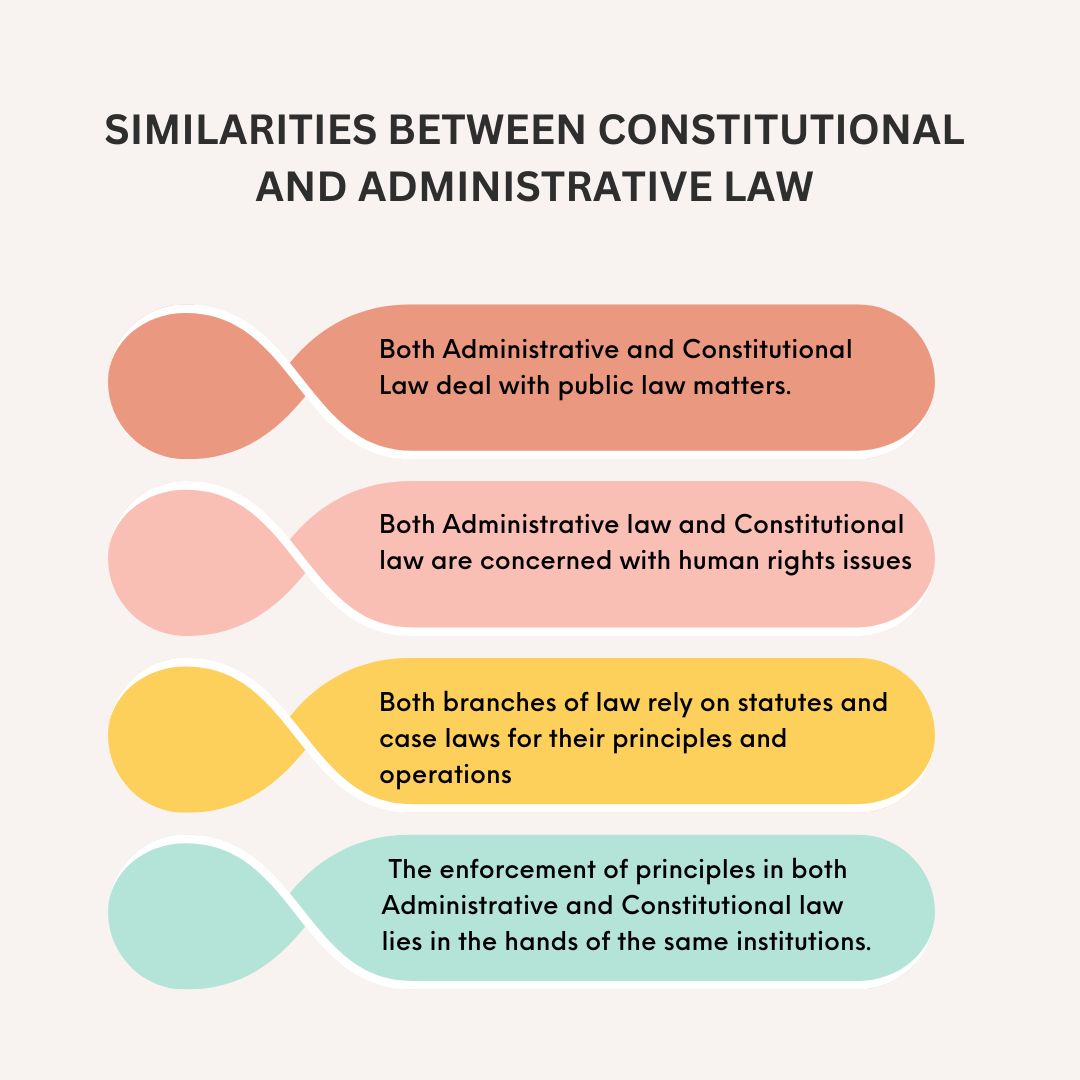
Firstly, both branches deal with public law matters, including the relationship between the government and individuals. They share a focus on the distribution and exercise of governmental powers, aiming to establish boundaries and ensure accountability. This common objective reflects their shared goal of creating a legal framework that governs the actions of administrative authorities while safeguarding individual rights.
Additionally, both administrative law and constitutional law are concerned with human rights issues. Constitutional law explicitly protects fundamental rights and liberties, ensuring that individuals are not subjected to arbitrary government actions. Administrative law complements this by providing mechanisms and remedies for individuals aggrieved by the abuse of administrative powers. It establishes procedures for fair adjudication and ensures that administrative decisions are in line with principles of natural justice.
Furthermore, both branches of law rely on statutes and case laws for their principles and operations. Constitutional law interprets and applies constitutional provisions, while administrative law refers to legislation and regulations that define the powers and procedures of administrative bodies. The principles derived from statutes and precedents guide the actions and decisions of both administrative authorities and constitutional courts, maintaining consistency and legal certainty.
Lastly, the enforcement of principles in both administrative law and constitutional law lies in the hands of the same institutions. Courts, including constitutional courts and administrative tribunals, play a vital role in upholding the rule of law and ensuring the proper functioning of the legal system. Law enforcement agencies and other relevant bodies also contribute to the enforcement of both branches of law, assisting in the implementation of administrative decisions and the protection of constitutional rights.
Differences between Administrative Law and Constitutional Law
The dissimilarities between administrative law and constitutional law highlight the distinct characteristics and functions of each branch, underscoring their different areas of focus and objectives.
Constitutional Law Describing Organs at Rest vs. Administrative Law Describing Organs in Motion
Constitutional law primarily deals with the organization and powers of various organs of the government when they are at rest. It establishes the fundamental principles and structure of government, outlining the framework within which administrative authorities operate.
On the other hand, administrative law comes into play when these organs are in motion, focusing on their functions, organization, powers, and duties. It addresses the practical implementation of constitutional principles, ensuring that administrative authorities act within legal limits and fulfill their assigned responsibilities.
Majoritarian Nature of Constitutional Law vs. Anti-Authoritarian Stance of Administrative Law
Constitutional law tends to reflect the will of the majority, embodying the principles and values of the broader society. It safeguards the democratic ideals and principles upon which the government is founded.
In contrast, administrative law adopts an anti-authoritarian stance, aiming to prevent the abuse of power by administrative authorities. It establishes checks and balances, ensuring that decisions and actions of administrative bodies are fair, transparent, and accountable, even in cases where they may not align with popular opinion.
General Principles vs. Specific Details
Constitutional law deals with general principles concerning the organization and powers of governmental organs. It sets out broad frameworks and establishes foundational principles that guide the functioning of these organs.
On the other hand, administrative law delves into specific details, focusing on the practical aspects of how administrative authorities carry out their functions. It addresses specific procedures, rules, and regulations that govern administrative actions, ensuring that they are consistent with the principles outlined in constitutional law.
Emphasis on Individual Rights vs. Focus on Public Needs
Constitutional law places significant emphasis on protecting individual rights and liberties. It guarantees fundamental rights and freedoms, limiting the power of the government to infringe upon these rights.
Administrative law, while still concerned with individual rights, places greater emphasis on addressing public needs and the common good. It seeks to balance the rights and interests of individuals with the broader societal welfare, ensuring that administrative decisions and actions promote the overall welfare of the population.
Constitutional Law as Supreme Law vs. Administrative Law within the Constitutional Framework
Constitutional law holds the highest legal authority in a legal system, serving as the supreme law of the land. It establishes the fundamental principles, structures, and rights that shape the entire legal framework.
Administrative law, while operating within this constitutional framework, is subordinate to constitutional law. It derives its legitimacy and authority from the constitution, ensuring that administrative actions are in line with constitutional principles and do not exceed the boundaries established by the constitution.
Conclusion
In conclusion, the relationship between administrative law and constitutional law is complex and intertwined. While they are distinct branches of law, their intersection in the watershed area of administrative law reflects their interdependence and mutual influence.
Administrative law focuses on the organization, powers, and duties of administrative authorities, while constitutional law sets out the fundamental principles and structure of government. Both branches contribute to the establishment of a legal framework that governs the government, protects individual rights, and ensures accountability.
Understanding the relationship between administrative law and constitutional law is essential for comprehending the legal landscape in which administrative authorities operate and individuals interact with the government.
Subscribe for updates
Join 10,000+ subscribers.
SA
Samridhi M
Contributing author
Have a doubt about this?Ask Doubts

