Sale under the Transfer of Property Act, 1882
Introduction
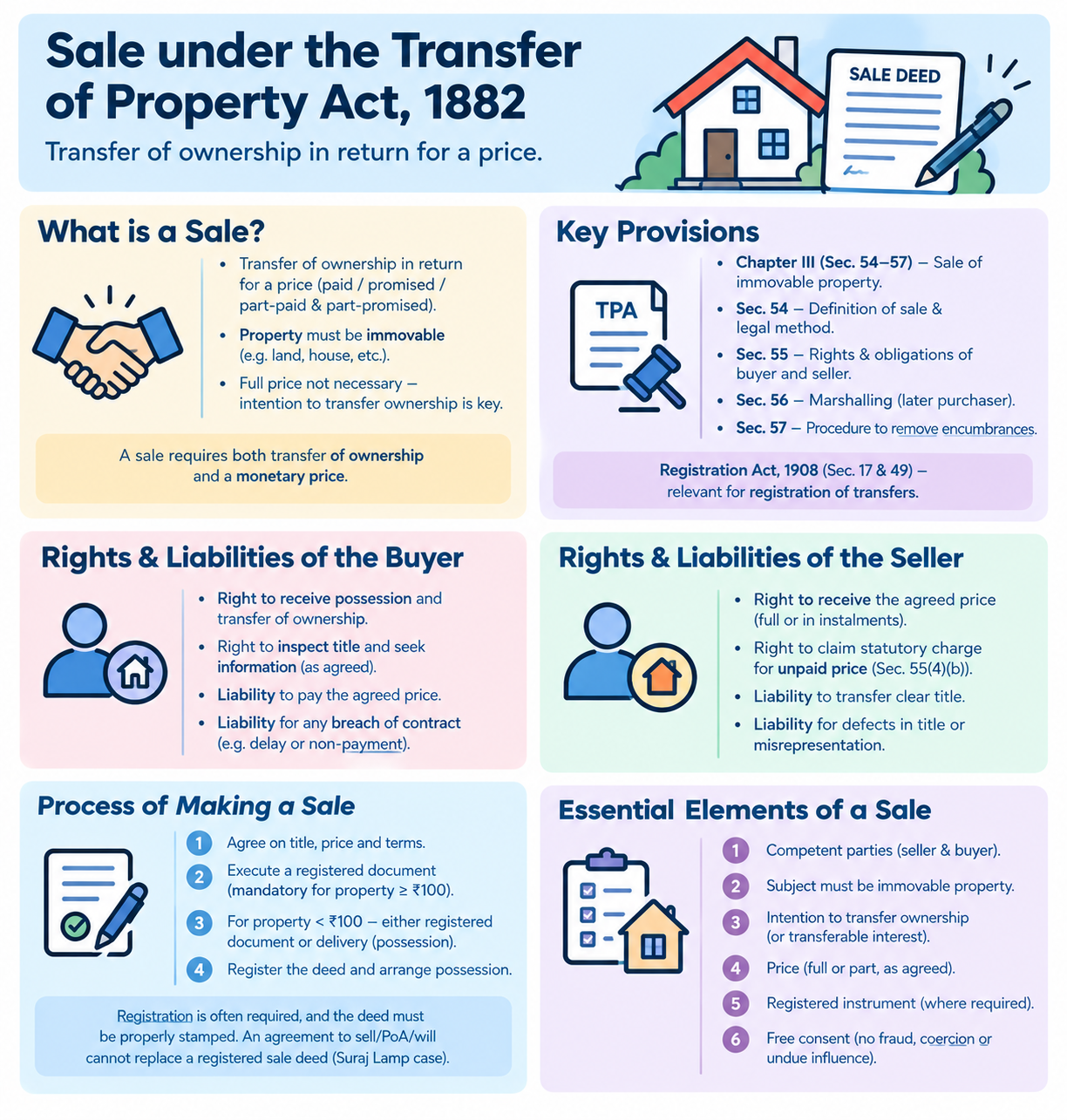
Chapter III of the Transfer of Property Act, 1882 (TPA) includes the provisions relating to the sale of immovable property in Sections 54 to 57. Section 54 sets out the definition of sale and describes the legal method of it. Section 55 specifies the rights and obligations of both the seller and the buyer.
Section 56 refers to the action of a later purchaser in respect of marshalling, and Section 57 outlines the procedure that can be followed in court for removing encumbrances. The Registration Act, 1908, particularly Sections 17 and 49, is also relevant since the majority of transfers of immovable property must be registered.
What is a Sale?
Section 54 describes a sale as “a transfer of ownership in return for a price which is paid or promised or part-paid and part-promised”. It therefore follows that in order for there to be a sale there must be a transfer of ownership and a monetary price. The property in question must be immovable, for example land, a house or a legally recognised interest connected to land, simply having possession does not usually result in ownership.
It is not necessary to pay the whole price at once. In the case of Vidhyadhar v. Manikrao, (1999), the Supreme Court stated that a sale is not automatically invalid merely because the full price has not been paid, provided that the deed indicates an intention to transfer ownership. The seller can claim the statutory charge for the unpaid price under section 55(4)(b). The parties may agree that payment should be a condition precedent. The case of Kaliaperumal v. Rajagopal, (2009) shows that it is the deed and the intention of the parties which determine this matter.
What is the Process of making a Sale?
Section 54 has always required a registered document for tangible immovable property worth ₹100 or more, as well as for a reversion or some other intangible property. But in the case of tangible property valued at less than ₹100, the historical version allows either a registered document or delivery. Delivery taking place when the seller places the buyer or the buyer’s nominee in possession.
The provision limiting it to ₹100 is outdated and refers to old statutory wording, students must not regard it as a safe rule when it comes to current transactions. The Registration Act, state-level amendments, stamp duties and local property laws might call for registration, and furthermore registration does not remedy defects in title, fraud, lack of authority or insufficient stamping.
In reality, the parties could look at the title, agree on the price, carry out the sale and register the deed, and make arrangements for possession. In the case of Suraj Lamp & Industries (P) Ltd. v. State of Haryana, (2012), the Supreme Court stated that an agreement to sell, a power of attorney or a will cannot take the place of a registered conveyance of the title.
Essential Elements of a Sale
A valid sale generally requires:
- Competent parties i.e. the seller must own the property or have the right to transfer it and the buyer must be legally able to buy it.
- The subject has to be immovable property.
- Regarding the transfer of ownership: the transaction has to demonstrate an intention to transfer ownership or a transferable interest.
- The price can be paid in full or in parts, either before the execution or at a later date, as agreed.
- The correct legal procedure is to use a registered instrument in every case where the law mandates it.
- Consent which is free can be questioned if there has been fraud, coercion, undue influence.
The fact that the price is inadequate is not usually enough to make a sale invalid, although it might be used as a basis for a claim of fraud or undue influence.
What constitutes a Contract for Sale?
A contract of sale is an agreement under which the sale will happen on the terms that have been settled. It is clearly stated in Section 54 that it of itself creates no interest in or charge against the property.
The agreement confers on the buyer a contractual right to obtain a sale deed. Under the Specific Relief Act, 1963, the buyer may obtain specific performance by demonstrating that there is a valid agreement and that they are ready and willing to carry out their obligations. However, the agreement alone does not make the buyer the owner.
Section 53A can provide protection in situations involving part-performance. It acts as a defence rather than as a means of conferring ownership. In the case of Nathulal v. Phoolchand, (1969), the Supreme Court examined the necessity of a written contract, definite terms, possession, an act in furtherance thereof and the intention to perform. Agreements of this kind may be required to be registered under section 17(1A) of the Registration Act.
Difference Between Sale and Contract for Sale
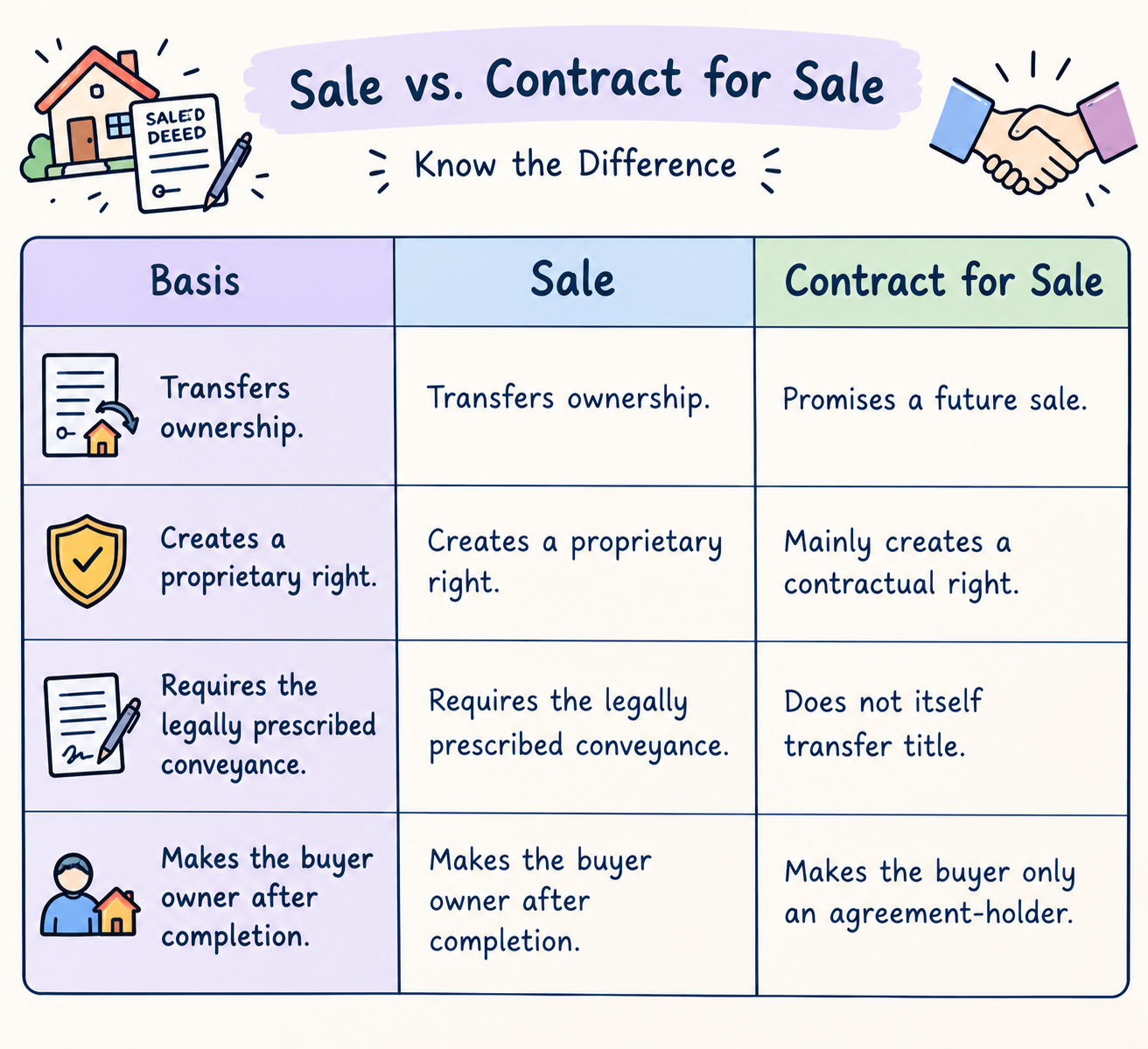
In the case of Narandas Karsondas v. S.A. Kamtam, (1977), the Supreme Court stated that a contract for sale does not create any interest or charge. In Rambhau Namdeo Gajre v. Narayan Bapuji Dhotra, (2004), the Court made it clear that Section 53A safeguards possession but does not grant title.
Parties to a Sale
In order for a sale to take place there must be both a seller and a buyer. The seller has to have a good title or the necessary legal authority. An authorised agent can sell on the basis of a valid power of attorney. A guardian is only allowed to sell the property of a minor within the bounds of the law, and a karta may transfer joint-family property only if the law allows it. The buyer must not be statutorily disqualified.
Rights and Liabilities of the Seller and Buyer : Section 55
Where no contract exists to the contrary, Section 55 provides the default rules.
Seller’s duties before completion
The seller is required to bring to the buyer's attention any known latent defects in the property or in the title, to allow the title documents to be inspected, to answer any relevant questions and to carry out a proper conveyance. He or she must at all times take reasonable care of the property and of the title documents until they are handed over and must pay any public charges, rent and encumbrance interest that are due before the completion date.
Seller’s rights
Until ownership has passed over, the seller is entitled to the rents and profits. If the price has not been paid after the work is completed, the seller can be granted a charge for the unpaid purchase price together with interest. The case of R.K. Mohammed Ubaidullah v. Hajee Abdul Wahab, (2000), outlines the reciprocal disclosure obligations provided under Section 55.
Buyer’s duties before completion
When the buyer knows a material fact relating to the nature or extent of the seller’s interest and believes that the seller does not know it, then the buyer is obliged to disclose that fact since it substantially increases the value of the interest. The buyer is also required to pay or tender the price at the correct time and to cooperate in the completion of the conveyance.
Buyer’s rights after completion
Once ownership has passed, the buyer assumes the risk of loss, is liable for the later payment of public charges and gets the rents and profits later on. According to Section 55(6)(b) the buyer may be charged interest on the advance money if the sale fails or if delivery is refused under the statutory circumstances. The case of Videocon Properties Ltd. v. Dr. Bhalchandra Laboratories, (2004) covers this point concerning the buyer's charge.
Marshalling by a Subsequent Purchaser : Section 56
Let us imagine that an owner mortgages two properties to a single mortgagee and then sells one of them. Section 56 enables the subsequent buyer to request that the mortgagee should pay the debt first out of the property which the owner did not sell. This right must not work to the disadvantage of the mortgagee or of anyone who has a claim under the mortgagee.
For example, if A mortgages Houses 1 and 2 to B and then sells House 1 to C, C might request that B should proceed first against House 2. In J.P. Builders v. A. Ramadas Rao, (2010), the Supreme Court acknowledged this right with the condition that lawful mortgage interests should be protected.
Encumbrances and Court Sale : Section 57
An encumbrance is a burden for example a mortgage or charge. Under Section 57 a person who has an interest in the property or who is entitled to redeem the encumbrance may deposit the sum required with the court. The court can then declare the property to be free from the encumbrance after having given notice and where there has been statutory compliance.
Section 56 divides the mortgage obligation between the properties. Section 57 offers a court-supervised procedure for removing the encumbrance. In neither case is it allowed for a seller to disregard an existing mortgage.
Rescission of a Contract of Sale
Rescission involves the cancellation of a contract and the restoration of the parties, as far as can be done, to the position they were in before. The sections from 54 to 57 do not provide a general unilateral right to cancel a sale. Rescission is primarily based on the Indian Contract Act, 1872, the Specific Relief Act, 1963, and the agreement.
A party can ask for rescission in the case of a serious breach, a refusal to perform, fraud, misrepresentation or legal impossibility. An agreement to sell is still executory and may therefore be rescinded in accordance with the law. When a registered sale has been completed, ownership is transferred and it cannot be simply cancelled just because the price has not yet been paid. The seller can claim the price or enforce the statutory charge unless the deed states that payment is a condition precedent or some other valid reason exists.
Effects of Rescission
In most cases restoration of the benefits is necessary. The buyer can return the possession or the documents and the seller can give back the money in advance. The court has the power to grant compensation and to take into account the rights of third parties. A completed conveyance might need to be cancelled under the Specific Relief Act instead of an informal declaration being made.
Effect of an Unregistered Sale Deed
A sale deed which is not registered and which is required to be registered will not result in the transfer of ownership. According to Section 49 of the Registration Act, it cannot have any effect regarding the property or be used to prove that a registration was required. Although a court might permit limited use for an independent collateral purpose, for example in order to establish possession, the parties cannot make use of this exception to prove title indirectly.
In the case of Bondar Singh v. Nihal Singh, (2003), the Supreme Court stated that an instrument which is not registered cannot convey title.
Conclusion
The framework for the sale of immovable property is established by Sections 54 to 57. Section 54 sets out what is meant by a sale and specifies the method required by law, Section 55 ensures that both the seller and the buyer are given a fair balance of duties and remedies. Section 56 safeguards a later purchaser by introducing the principle of marshalling, and Section 57 offers a judicial procedure for removing encumbrances.
The important rule for exams is that an agreement to sell gives rise to a contractual right, whereas a legally completed sale results in the transfer of ownership.
Subscribe for updates
Join 10,000+ subscribers.
JU
Julie Nigam
Contributing author
Have a doubt about this?Ask Doubts