
What is the Status of a Scheduled Caste After Religious Conversion?
This article examines the constitutional status of Scheduled Caste (SC) individuals upon religious conversion and reconversion under Article 341 and the constitution (Scheduled Castes) Order, 1950. The judiciary maintains that someone who is born into a Scheduled Caste loses their legal status as a Scheduled Caste if they convert to a religion other than Hinduism, Sikhism or Buddhism. So, let's understand what is the status of scheduled caste after religious Conversion
The Supreme Court has stated that this loss takes place immediately and has an effect on statutory reservations and protections, and it is only possible to regain that status again upon reconversion if the strict conditions are met.
Major question that arose
The key issue is whether a person's status as a member of the Scheduled Caste is based solely on birth or whether it also depends on the religion that the person follows.
Someone can be born into a Scheduled Caste, convert to a different religion, and then ask for reservation or protection under the SC/ST (Prevention of Atrocities) Act, 1989. It might be claimed that caste is inherited and therefore conversion cannot remove the discrimination suffered.
The State referred to Clause 3 of the 1950 Order, on the grounds that SC status is only available to people who follow Hinduism, Sikhism or Buddhism.
Related Case : Chinthada Anand v. State of Andhra Pradesh & Ors (2026 INSC 283)
Facts
Chinthada Anand belonged from birth to the Madiga community, a Scheduled Caste in Andhra Pradesh, he afterwards became a Christian and served as a pastor in a public capacity for approximately ten years. He held Sunday prayer meetings and was active in the local pastors’ fellowship.
In January 2021 Anand said that some people had assaulted him, had abused him by employing caste-related terms, had restrained him and had threatened both him and his family.
On this basis the police filed a first information report (FIR) under the SC/ST (Prevention of Atrocities) Act, 1989, as well as under the then applicable sections of the Indian Penal Code. While the investigation was underway the Tahsildar produced a certificate in which he was described as being a member of the Hindu-Madiga community.
The man accused went to the Andhra Pradesh High Court under section 482 of the Code of Criminal Procedure and asked that the proceedings should be quashed.
The High Court decided that although Anand had openly declared himself to be a Christian he could not claim Scheduled Caste status in order to make use of the SC/ST Act, and it also identified flaws in the evidence before it and cancelled the proceedings.
Issues
The questions arose were-
- Does conversion result in the loss of SC status and can a practising Christian make use of the SC/ST Act?
- Whether a state order extends statutory benefits, and what has to be proven in the case of reconversion?
Judgment
The Supreme Court rejected Anand’s appeal and maintained the judgment of the High Court. The reasons for this were as follows-
Eligibility is governed first by Clause 3 of the Constitution (Scheduled Castes) Order, 1950, which provides that any person who follows a religion other than Hinduism, Sikhism or Buddhism shall not be regarded as a Scheduled Caste. Sikhism was included in 1956 and Buddhism in 1990. Christianity and Islam are not covered.
Secondly, to 'profess' is to make an open declaration or to practise religion publicly. The fact that Anand had been a pastor for a long time shows that he openly professed Christianity. The Court ruled that it is impossible for a person to practise a religion which does not qualify and at the same time claim SC status for the purpose of receiving statutory benefits, the two situations are mutually exclusive. Therefore, birth alone is not enough.
Since Anand was not, at the relevant time, a member of the Scheduled Castes, he had no right to invoke the SC/ST Act. The Court agreed with the decision to quash those proceedings.
Rule on reconversion
The Court held that restoration after reconversion requires proof of all three conditions:
| Condition | What must be proved? |
| Original caste | The person originally belonged to a caste notified under the 1950 Order. |
| Genuine reconversion | The person genuinely returned to Hinduism, Sikhism or Buddhism, completely renounced the later religion, and adopted the relevant customs and practices. |
| Community acceptance |
The burden is on the claimant. Failure to prove even one condition defeats the claim. This is in line with C.M. Arumugam v. S. Rajagopal, which recognised the importance of community acceptance after reconversion.
Who are Scheduled Castes?
According to Article 341, the President designates the castes, races or tribes, or the various groups or subgroups among them, who are to be regarded as Scheduled Castes in a given State or Union Territory, thereafter only Parliament can by law include or exclude a group.
A person making a claim must be a member of a caste listed in the relevant list, meet the applicable State or area conditions, and comply with the religious requirement set out in Clause 3 of the 1950 Order. SC status is specific to States or Union Territories since a caste which is recognised in one State will not have the same status in another.
Is caste identity by birth or religion?
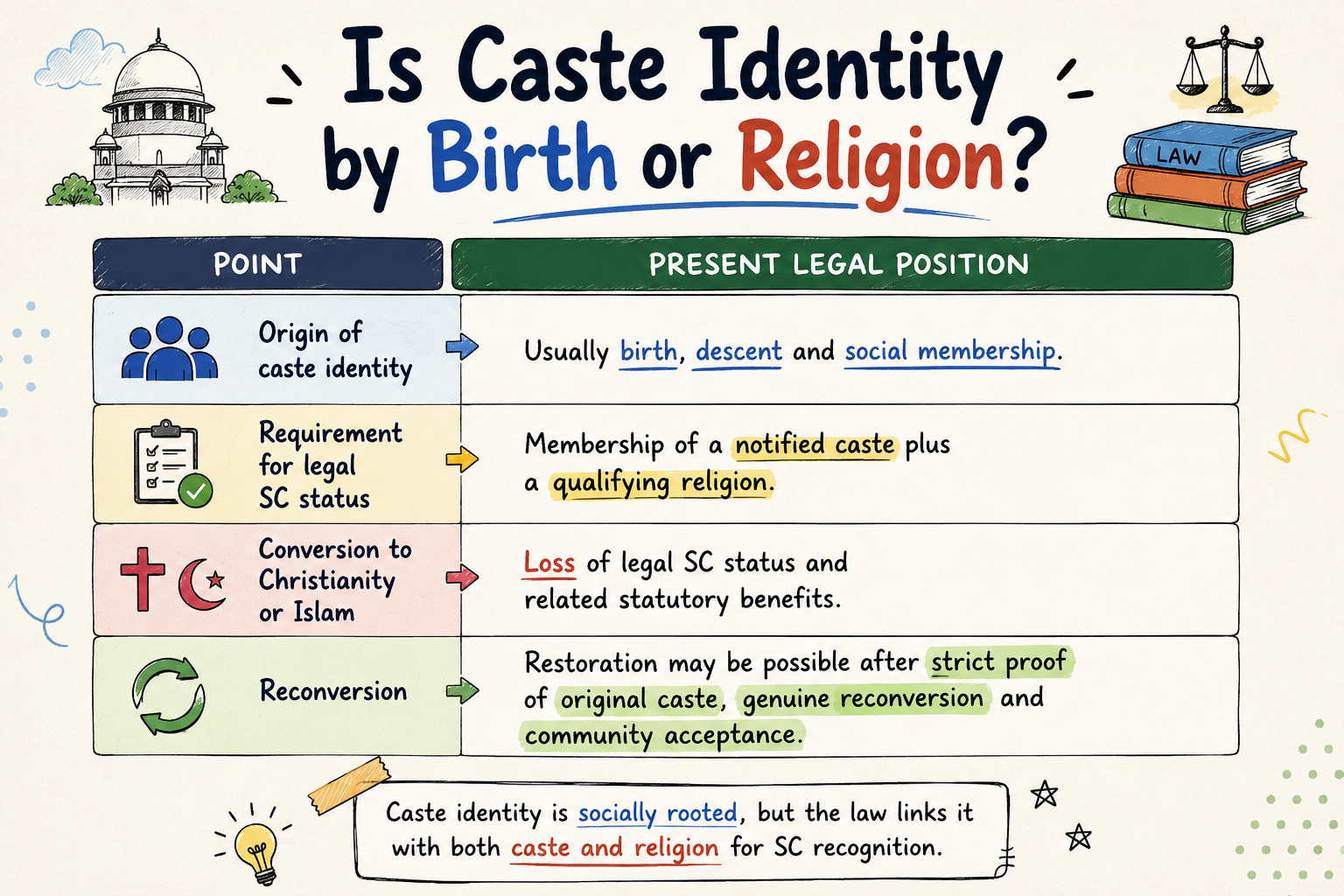
The right answer is that social caste identity usually begins at birth, but legal Scheduled Caste status is based on both caste and religion.
Caste is normally passed on by birth, descent and membership of a Community, but in the case of constitutional reservations and statutory protections, as provided for in Article 341 and Clause 3, the person must profess Hinduism, Sikhism or Buddhism.
Thus, a person may be born into a notified Scheduled Caste but lose the legal status and benefits attached to it after converting to Christianity, Islam or another excluded religion.
Earlier important decisions
In the case of Soosai v. Union of India (1985) the Supreme Court confirmed the religious restriction contained in paragraph 3 of the 1950 Order and stated that it was not sufficient merely to show that the same caste label had been retained after conversion. It was also necessary to prove that there were comparable social, economic and educational disadvantages in the new religious context.
The Court in C.M. Arumugam (1976) stated that a person could return to their original caste if the community accepted that person.
The court stated in C. Selvarani (2024) that someone who is openly practising Christianity cannot claim to be Hindu just in order to be eligible for SC reservation.
Current position as of August 2026
The current operative legal position is-
- A member of a notified caste who practices Hinduism, Sikhism or Buddhism may apply for SC status provided that other legal requirements are met.
- If a person converts to Christianity, Islam or any other religion other than that specified in Clause 3, their legal SC status is immediately lost, even if they were born into an SC community.
- A person who has undergone conversion cannot assert their right to reservation or to statutory protection under laws such as the SC/ST Act simply because of their original caste.
- The conditions set out in the 1950 Order cannot be overridden by a caste certificate.
- To restore oneself after reconversion it is necessary to provide evidence of one's original caste, demonstrate a genuine reconversion, and have been accepted by the original community.
Conclusion
The current law makes a distinction between social identity and legal status. It is possible for someone to have been born into a Scheduled Caste and still to encounter social prejudice. However, according to Clause 3 of the 1950 Order, present legal SC status requires a person to profess Hinduism, Sikhism or Buddhism as well as belonging to a notified caste.
The key CLAT PG point is, caste may originate by birth, but Scheduled Caste status under the present constitutional scheme depends on both membership of a notified caste and profession of a qualifying religion.
Subscribe for updates
Join 10,000+ subscribers.
JU
Julie Nigam
Contributing author
Have a doubt about this?Ask Doubts
