
Strict Liability under Tort Law: Definition, Elements and, Defences
Edit
TABLE OF CONTENTS
Strict Liability
Elements of Strict Liability
Important Cases of Strict Liability
Defences against Strict Liability
Strict Liability
Strict liability under tort law refers to the legal responsibility imposed on a party for harm caused to another, regardless of fault or intent. Unlike negligence, which requires a showing of a breach of duty of care, strict liability holds parties responsible for their actions regardless of their level of care or intention to cause harm.
Strict Liability was introduced in Rylands v Fletcher. In this case, Fletcher had gotten an independent contractor to make a reservoir. The independent contractor ignored mine shafts while constructing the reservoir as a result of which the mines of Rylands were flooded. Fletcher said that he didn’t have any knowledge of the mines and wasn’t responsible for the flooding as he had delegated the task to an independent contractor.
Here, Court introduced the concept of strict liability. Blackburn J. said that if a person gets something on his land, which, if escaping from the land, can cause mischief, he must keep it at his peril and be answerable for the damages that are the natural consequences of such escape.
The rule in Rylands v. Fletcher applies only where the substances are likely to do harm under normal circumstances.
Elements of Strict Liability
(1) Presence of dangerous thing on land
(2) Escape of dangerous thing
(3) Non-natural use of land
(2) Escape of dangerous thing
(3) Non-natural use of land
Important Cases on Elements of Strict Liability
Crowhurst v Amersham Burial Board: The defendant had planted a yew tree on their property but the tree was planted very close to the plaintiff’s property. Gradually, the tree’s branch grew over the fence and protruded into the plaintiff’s ground. A few leaves fell on the other side of the fence and the plaintiff’s horse ate some and died from poisoning. The plaintiff brought an action against the defendant for damages for the death of his horse. This claim was not successful as the defendant was not making non-natural use of his land.
Read v Lyons: In this case, the claimant was employed by the defendant in his factory which made explosives for the Ministry of Supply. While on inspection, an explosion occurred that injured the claimant. While there was no evidence of negligence on the part of the defendant, the judge held that the case was governed by the rule in Rylands v Fletcher and therefore, strict liability would apply. The Court of Appeal then reversed this decision as escape of the hazardous matter from land is an essential element of strict liability and there was no escape in this case. Besides, there was no non-natural use of the land either.
Defences to Strict Liability under Tort Law
There are 8 general defences in tort available in all cases except in strict liability. These are the defences that are available ONLY in case of Strict Liability:
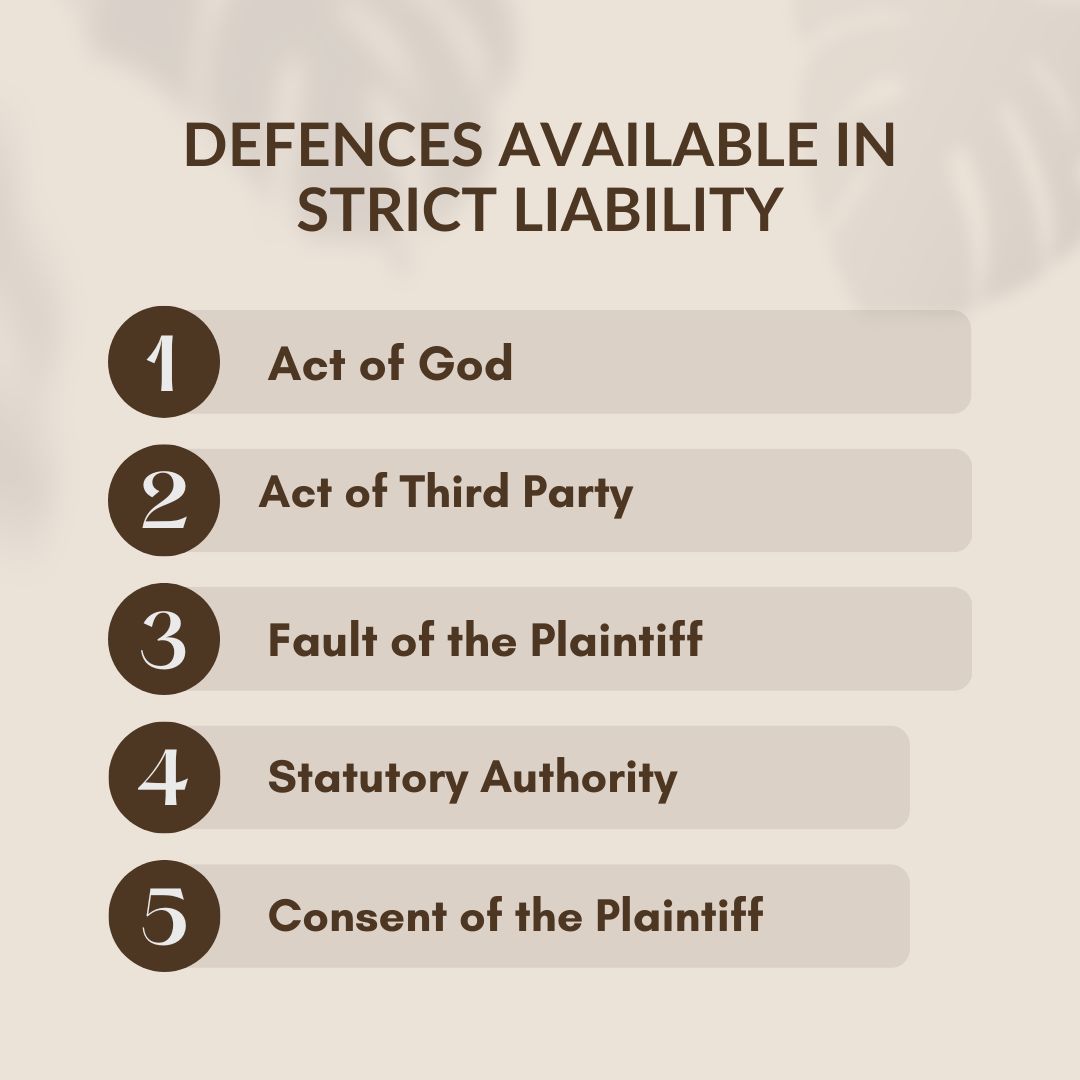
- Act of God: Two important cases i.e. Rylands v. Fletcher and Nichols v. Marshland talk about Act of God and define it as an event wherein the circumstances are beyond human foresight. As these events happen because of supernatural forces and without any human intervention, no one can be held liable for them.
- Fault of the Plaintiff: If the damage is caused by plaintiff’s own default or wrongdoing then the rule of strict liability can’t be applied. In the case of Ponting v. Noakes, the plaintiff’s horse trespassed into the defendant’s property and ate poisonous leaves. The Court held that the damage was caused by plaintiff’s own fault as he let his horse go into the property of defendant. Therefore, under such circumstances the defendant cannot be held liable.
- Statutory authority: If the damage has been caused by an act which the legislature has authorized, the rule of strict liability can’t be applied.
- Consent of the Plaintiff: If the plaintiff has consented to the accumulation of a dangerous thing on the defendant’s land, then he cannot complain about the consequences. This is similar to the rule of volenti non fit injuria.
Conclusion
The doctrine of strict liability under Tort Law has evolved over centuries of legal precedent and judicial decisions. Its roots can be traced back to ancient legal systems, where individuals were held responsible for the consequences of their actions, irrespective of intent or negligence. Strict liability is often contrasted with fault-based liability, such as negligence. While fault-based liability focuses on the defendant’s conduct, strict liability focuses on the nature of the activity or condition itself. Unlike negligence, which requires a showing of breach of duty of care, strict liability does not depend on the defendant’s level of care or foresight.
Subscribe for updates
Join 10,000+ subscribers.
RU
Ruchika Mohapatra
Contributing author
Have a doubt about this?Ask Doubts
