
Succession in Case of Hindu Females
Statutory Framework: Sections 15 and 16
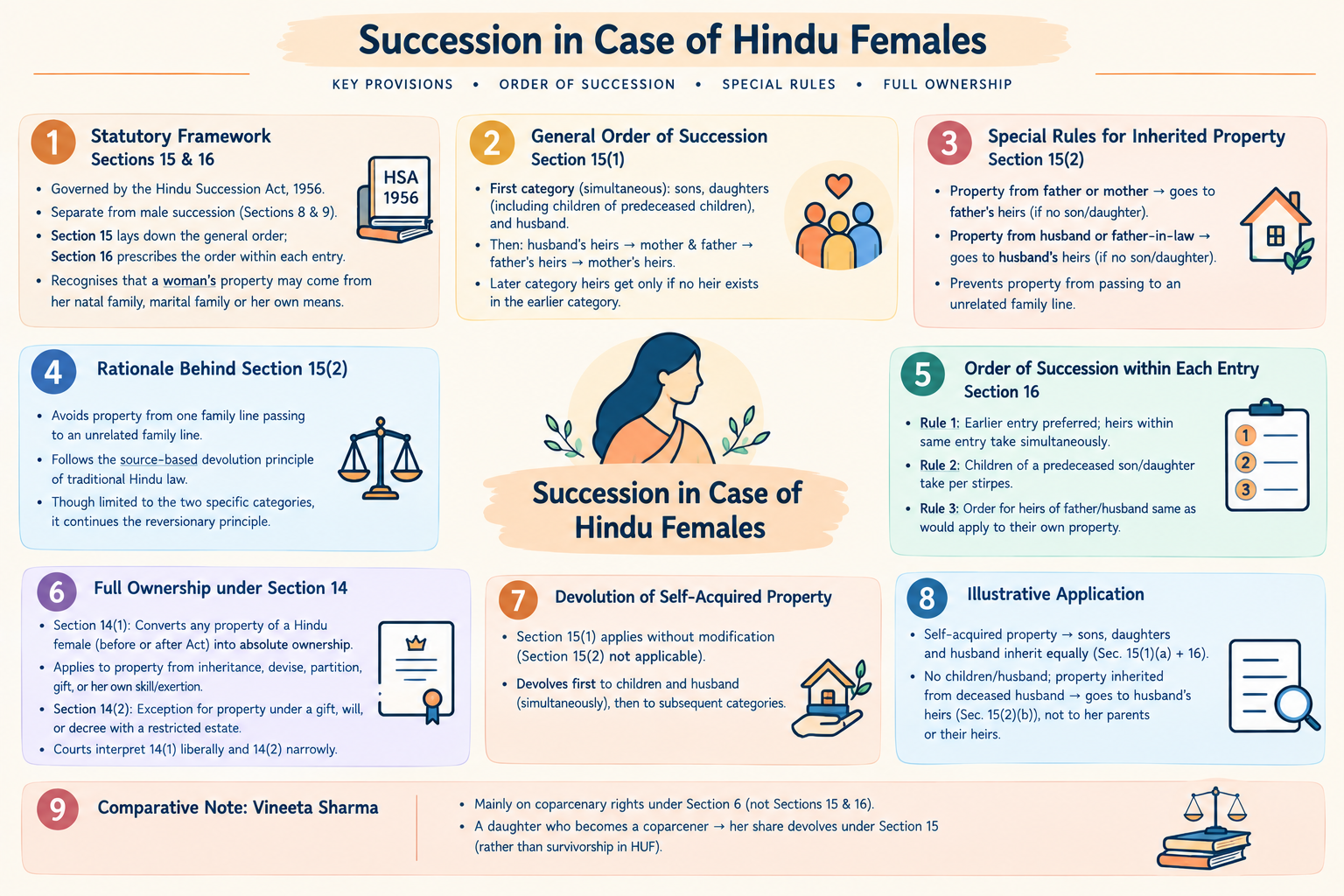
The Hindu Succession Act, 1956 governs intestate succession in case of Hindu female through Sections 15 and 16, establishing a scheme distinct from the general order of succession applicable to Hindu males under Sections 8 and 9.
Section 15 lays down the general order of heirs who succeed to a Hindu female's property, while Section 16 prescribes the specific order and manner in which these heirs inherit within each category.
This separate treatment reflects the legislature's recognition that property acquired by a Hindu woman may originate from different sources, including her natal family, her marital family, or her own independent means, each warranting distinct rules of devolution.
General Order of Succession: Section 15(1)
Section 15(1) lists the heirs to whom a Hindu female's property devolves in the absence of a will, arranged in a specific hierarchical order rather than as simultaneous claimants. The first category comprises the sons and daughters, including children of any predeceased son or daughter, and the husband, all of whom inherit simultaneously.
In the absence of these heirs, the property passes to the heirs of the husband, followed successively by the mother and father, then the heirs of the father, and finally the heirs of the mother.
This ordering means that heirs in a later category can inherit only if no heir exists in any preceding category, distinguishing the scheme for females from the simultaneous class-based inheritance structure under Section 8 governing male intestate succession.
The inclusion of the husband within the very first category, alongside her own children, marks a significant departure from the treatment of a Hindu male's property, where the widow inherits alongside children but the husband's family does not receive similar automatic priority in a female's estate.
Special Rules for Property Inherited from Parents or Husband: Section 15(2)
Section 15(2) carves out important exceptions to the general order laid down in Section 15(1), applicable specifically to property a Hindu female has inherited from her father or mother, or from her husband or father-in-law.
Section 15(2)(a) provides that property inherited from the father or mother devolves, in the absence of any son or daughter of the deceased, including children of a predeceased son or daughter, upon the heirs of the father, rather than passing to the husband's heirs or other heirs contemplated under the general order.
Section 15(2)(b) similarly provides that property inherited from the husband or father-in-law devolves, in the absence of any son or daughter, including children of a predeceased son or daughter, upon the heirs of the husband, rather than upon her own natal family.
These provisions ensure that property retains a connection to its source, preventing inherited property from passing entirely outside the family from which it originated merely because the woman who inherited it died without children.
Rationale behind Section 15(2)
The rationale behind Section 15(2) lies in preventing a situation where property that entered a Hindu woman's hands through inheritance from one family line would, upon her death without heirs of her own, pass to an entirely unconnected family line under the general order in Section 15(1).
Without this provision, property inherited from a woman's parents could pass to her husband's relatives, and property inherited from her husband could pass to her own parental relatives, outcomes the legislature considered inconsistent with principles of source-based devolution traditionally recognised in Hindu law.
This reversionary principle, though limited to the two specific categories of property mentioned in Section 15(2), reflects a partial continuation of the source rule that historically governed women's limited estate before the Act's enactment, even as the Act otherwise establishes full ownership rights for Hindu women under Section 14.
Order of Succession within Each Entry: Section 16
Section 16 lays down three rules governing the order and manner of succession among the heirs specified under Section 15.
Rule 1 provides that among the heirs specified in any one entry under Section 15(1), those in an earlier entry are preferred to those in a later entry, and heirs within the same entry take simultaneously.
Rule 2 addresses the devolution of property among the children of a predeceased son or predeceased daughter, providing that they take per stirpes, meaning they collectively inherit the share their deceased parent would have taken had that parent survived, divided equally among themselves rather than sharing equally with the surviving children of the propositus.
Rule 3 clarifies the devolution of property referred to in Section 15(2), providing that the order of succession among the heirs of the father, or the heirs of the husband, as the case may be, shall be the same order as would have applied to the property of the father or husband himself had they died intestate immediately after the female's death.
This rule effectively imports the succession scheme applicable to the source-family's own property into the devolution of the specific categories of property covered under Section 15(2).
Full Ownership under Section 14
Section 14(1) of the Hindu Succession Act converts any property possessed by a Hindu female, whether acquired before or after the Act's commencement, into her absolute and full ownership, effectively abolishing the earlier concept of a limited or "Hindu woman's estate" that restricted her rights to alienate or bequeath such property.
This provision applies broadly to property acquired by inheritance, devise, partition, gift, or through her own skill or exertion, ensuring that once property vests in a Hindu woman, she holds it with the same rights of disposal as any male owner.
Section 14(2) carves out an exception for property acquired under a gift, will, or other instrument, or under a decree, order, or award, which prescribes a restricted estate, in which case the woman takes only the limited interest specified in such instrument rather than absolute ownership.
Courts have consistently interpreted Section 14(1) liberally and Section 14(2) narrowly, ensuring that the exception does not swallow the rule of converting limited estates into absolute ownership.
Devolution of Self-Acquired Property
Where a Hindu female dies possessed of self-acquired property, meaning property that did not originate from inheritance from her father, mother, husband, or father-in-law, the general order of succession under Section 15(1) applies without any modification by Section 15(2).
Such property devolves first upon her children and husband simultaneously, and only in their absence does it pass through the subsequent categories listed in Section 15(1), namely the husband's heirs, then her parents, then her father's heirs, and finally her mother's heirs.
Illustrative Application
Where a Hindu woman dies intestate leaving behind self-acquired property, her sons, daughters, and husband inherit simultaneously and equally under Section 15(1)(a), read with Section 16 Rule 1, since they fall within the same entry.
Where she dies leaving no children or husband, but leaving property she had inherited from her deceased husband, that specific property passes to the husband's heirs under Section 15(2)(b) rather than progressing through the remaining general categories under Section 15(1), such as her own parents or their heirs.
This distinction illustrates why examiners frequently test Section 15(2) through fact patterns requiring identification of the property's source before applying the correct devolution rule, since applying the general order under Section 15(1) to property actually covered by Section 15(2) produces an incorrect result.
Comparative Note: Vineeta Sharma and Coparcenary Rights
Although Vineeta Sharma v. Rakesh Sharma primarily addressed a daughter's coparcenary rights under Section 6 rather than intestate succession under Sections 15 and 16, the ruling remains conceptually connected, since a daughter who becomes a coparcener and subsequently dies possessing her share of coparcenary property would have that property devolve according to the general succession rules under Section 15, rather than through the survivorship principles applicable to an undivided Hindu Undivided Family.
This connection between coparcenary reform and succession rules illustrates how the 2005 amendment's expansion of women's property rights interacts with the pre-existing devolution scheme under Sections 15 and 16.
Subscribe for updates
Join 10,000+ subscribers.
HA
Hanspal Bakul
Contributing author
Have a doubt about this?Ask Doubts
