
Supreme Court Explains Motor Insurance Policies: A Must-Read Judgment for CLAT PG 2027
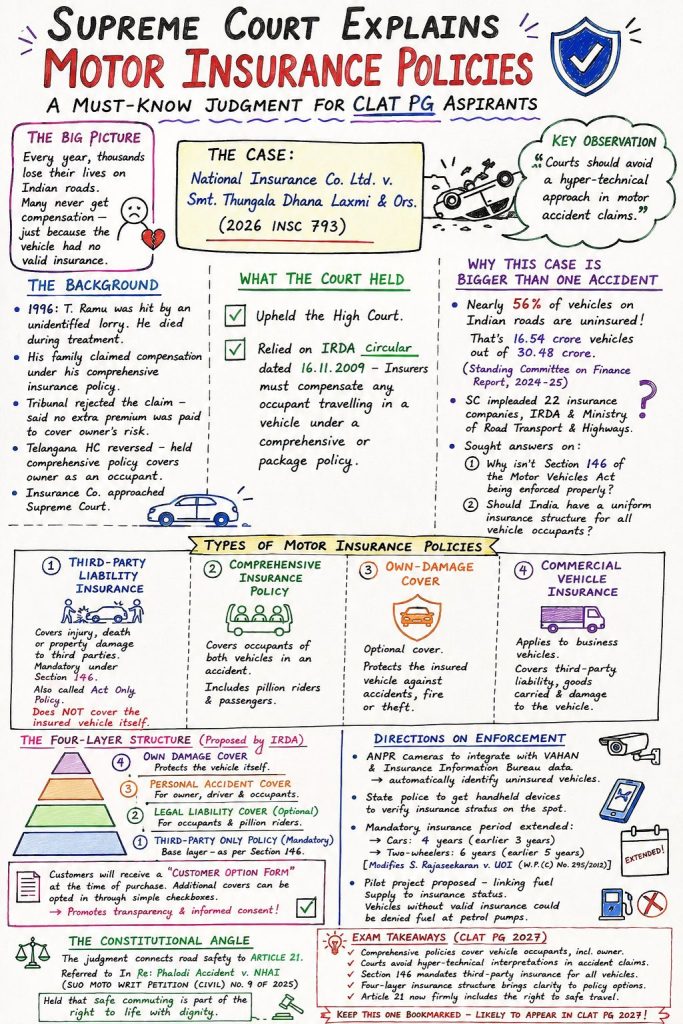
Every year, thousands of families lose their loved ones on Indian roads. Many of these victims never receive compensation. Why? Because the vehicle involved had no valid insurance. The Supreme Court recently tackled this exact problem in National Insurance Co. Ltd. v. Smt. Thungala Dhana Laxmi & Ors. (2026 INSC 793). Let’s break it down.
The Background
The case began with a tragic accident in 1996. T. Ramu was driving home from Tirupathi when an unidentified lorry hit his car from behind. He died during treatment. His family sought compensation under his own comprehensive insurance policy.
The Insurance Tribunal rejected the claim. It held that Ramu hadn’t paid an extra premium to cover his own risk as the owner. However, the Telangana High Court reversed this decision. It ruled that a comprehensive policy covers the vehicle owner too, since he was travelling as an occupant. National Insurance Company challenged this before the Supreme Court.
What the Court Held on the Core Dispute
The Bench of Justice Sanjay Karol and Justice Prashant Kumar Mishra upheld the High Court’s ruling. The Court relied on an IRDA circular dated 16.11.2009. This circular states that insurers must compensate any occupant travelling in a vehicle under a comprehensive or package policy.
The Court also made an important observation. “Courts should avoid a hyper-technical approach in motor accident claims.”
Why This Case Became Bigger Than One Accident
Here’s where the judgment gets interesting for aspirants. The Court didn’t stop at deciding the appeal. It used this case to examine a much larger crisis.
Nearly 56% of vehicles on Indian roads remain uninsured. That’s a staggering 16.54 crore vehicles out of 30.48 crore. This data comes from the Standing Committee on Finance Report, 2024-25.
The Court impleaded twenty-two insurance companies, IRDA, and the Ministry of Road Transport and Highways. It wanted answers on two things:
- Why isn’t Section 146 of the Motor Vehicles Act being enforced properly?
- Should India have a uniform insurance structure for all vehicle occupants?
Types of Motor Insurance Policies
The Court categorized motor insurance into four types.
Third-Party Liability Insurance covers injury, death, or property damage to third parties. It’s mandatory under Section 146. It’s also called an Act Only Policy. Importantly, it doesn’t cover the insured vehicle itself.
Comprehensive Insurance Policy goes further. It covers occupants of both vehicles involved in an accident. Pillion riders and passengers fall under this umbrella.
Own-Damage Cover is optional. It protects the insured vehicle against accidents, fire, or theft.
Commercial Vehicle Insurance applies to business vehicles. It covers third-party liability, goods carried, and damage to the vehicle.
The Four-Layer Structure
IRDA proposed a new framework before the Court. This structure aims to give vehicle owners clearer choices.
The base layer remains the mandatory Third-Party Only Policy. Above this sits an optional Legal Liability Cover for occupants and pillion riders. Next comes a Personal Accident Cover for the owner, driver, and occupants. Finally, an Own Damage Cover protects the vehicle itself.
Customers will now receive a “Customer Option Form” at the time of purchase. They can opt into additional covers through simple checkboxes. This move promotes transparency and informed consent, both important themes in consumer protection law.
Directions on Enforcement
The Court didn’t limit itself to policy structure. It issued several enforcement directions too.
ANPR cameras will now integrate with VAHAN and Insurance Information Bureau data. This will help automatically identify uninsured vehicles. State police will also get handheld devices to verify insurance status on the spot.
Interestingly, the Court extended the mandatory insurance period. Cars now require four years of third-party insurance instead of three. Two-wheelers need six years instead of five. This modifies the earlier direction in S. Rajaseekaran v. Union of India ( W.P.(C) No.295/2012)
The Court even floated a pilot project linking fuel supply to insurance status. Vehicles without valid insurance could be denied fuel at petrol pumps.
The Constitutional Angle
This judgment connects road safety to Article 21. The Court referred to its earlier ruling in In Re: Phalodi Accident v. National Highways Authority of India (SUO MOTO WRIT PETITION (CIVIL) NO. 9 OF 2025). There, it held that safe commuting is part of the right to life with dignity.
Remember these points before your exam. Comprehensive policies cover vehicle occupants, including the owner. Courts avoid hyper-technical interpretations in accident claims. Section 146 mandates third-party insurance for all vehicles. The four-layer insurance structure brings clarity to policy options. Article 21 now firmly includes the right to safe travel.
Keep this one bookmarked. It’s likely to appear in the CLAT PG 2027 paper.
Get case-law updates weekly
Join 10,000+ subscribers.
HA
Hanspal Bakul
Contributing author
Have a doubt about this judgment?Ask Doubts
