
Top 5 Supreme Court Judgments: June 2026
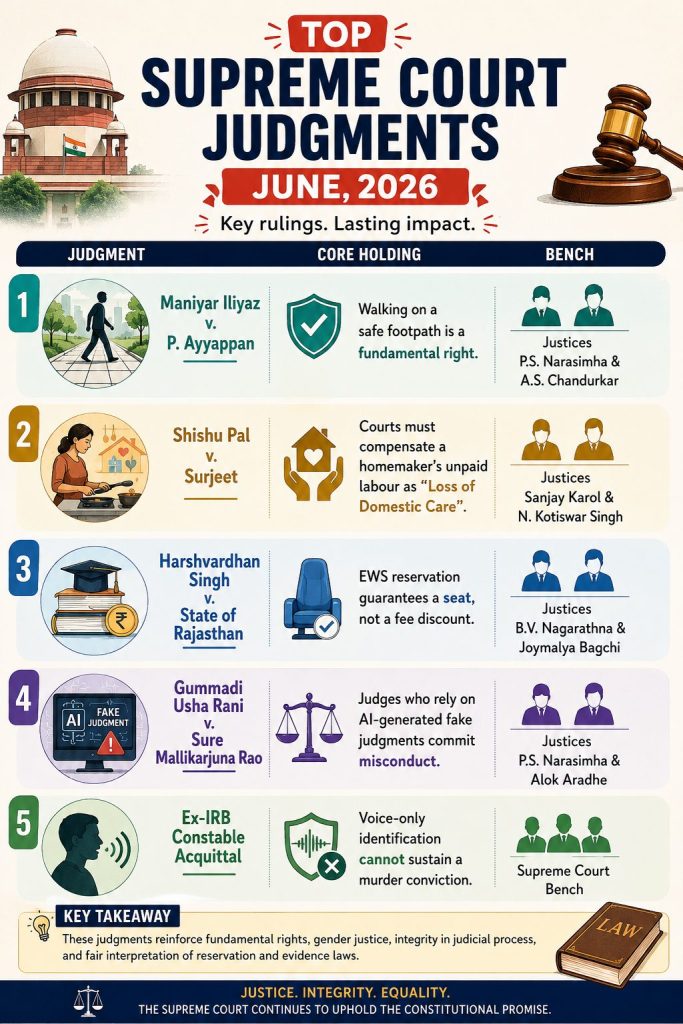
Supreme Court Judgments of June 2026 changed Indian law in ways that touch daily life. The Supreme Court declared a new fundamental right, put a price tag on a homemaker’s labour, and drew a hard line against AI-generated fake case law. Judicial aspirants, working lawyers, and curious citizens all need to know these rulings.
This blog walks you through each judgment. We use plain language, not jargon. You will finish this article with exam-ready notes and a clear picture of where Indian law stands today.
1. The Right to Walk Becomes a Fundamental Right
Case: Maniyar Iliyaz @ Shaik Riyaz & Anr. v. P. Ayyappan & Ors.
Citation: 2026 INSC 647
What happened
A five-year-old boy died while walking to school with his father because their neighbourhood had no footpath. A water tanker struck him on the open road. The case started as a routine insurance dispute over compensation. The Supreme Court turned it into something much bigger.
What the Court held
The bench ruled that citizens have a fundamental right to walk on safe, demarcated footpaths. This right flows from Article 19(1)(d), which protects freedom of movement, read together with Article 21, the right to life. The Court made three points clear:
- Pedestrian movement now takes priority over motorised traffic on shared urban spaces.
- Authorities cannot let vehicles monopolise roads while pedestrians walk at risk.
- Citizens can seek a restitutionary remedy directly against the authorities who fail to build safe footpaths. This remedy exists separately from any compensation claim under the Motor Vehicles Act, 1988.
The Court also converted the matter into an ongoing suo motu proceeding titled Re: Fundamental Right to Walk and Footpath. It directed the Union Ministries of Housing and Urban Affairs, Road Transport and Highways, and Rural Development to build a statutory framework and appoint a dedicated regulator for pedestrian safety.
Why this matters
India records a high number of pedestrian deaths every year. This judgment gives victims and activists a direct constitutional tool. Municipal bodies and highway authorities now carry an enforceable duty, not just a moral one. Expect litigation across states as citizens invoke this right against unsafe roads.
2. Homemakers Become “Nation Builders”: A New Compensation Head
Case: Shishu Pal @ Shish Ram & Ors. v. Surjeet & Ors.
Citation: 2026 SCC OnLine SC 1114
What happened
The case involved a motor accident claim that took nearly 25 years to reach a final decision. At its heart lay a simple but long-ignored question: how should courts value a homemaker’s unpaid labour when she dies in an accident?
What the Court held
The bench of Justices Sanjay Karol and N. Kotiswar Singh created a fresh, standalone compensation head called “Loss of Domestic Care.” This head sits apart from the existing “loss of consortium” head, which only covers emotional loss. The new head captures the economic reality of running a household.
Key takeaways from the ruling:
- The Court fixed a notional monthly income of ₹30,000 for a homemaker’s domestic services, subject to periodic revision.
- Judges must now factor in three separate contributions: household management, maternal or spousal support, and the loss children and parents suffer when that support disappears.
- The Court raised the compensation in this specific case from ₹8.43 lakh to ₹62.77 lakh.
- The bench cited the National Statistical Office’s 2019 Time Use Survey, which shows women’s unpaid caregiving contributes roughly 15–17% of India’s GDP.
- The judgment quoted economist A.C. Pigou’s classic observation: national income appears to fall when a man marries his housekeeper, simply because her paid labour turns unpaid. The Court used this to expose how economic accounting hides domestic work.
The Court also expressed hope that the terms “housewife” and “homemaker” give way to “Nation Builder” in judicial and public language.
Why this matters
This ruling rewrites how Motor Accident Claims Tribunals calculate compensation nationwide. Every pending and future claim involving a deceased or injured homemaker must now apply this framework. Family lawyers and insurance companies both need to revise their calculation models immediately.
3. EWS Reservation Does Not Guarantee a Fee Discount
Case: Harshvardhan Singh v. State of Rajasthan
What happened
A NEET-UG 2025 candidate from the Economically Weaker Section (EWS) category challenged the fee structure of private medical colleges in Rajasthan. His argument was straightforward: the EWS income ceiling stands at ₹8 lakh a year, yet private medical colleges charge between ₹18.9 lakh and ₹25 lakh annually. He argued this gap makes the reservation meaningless in practice.
What the Court held
A bench of Justices B.V. Nagarathna and Joymalya Bagchi dismissed the plea and refused to disturb the Rajasthan High Court’s earlier ruling. The Court reasoned as follows:
- EWS reservation guarantees a seat at the admission stage. It does not create a right to reduced tuition fees.
- Self-financing private colleges cannot be forced to match government college fee levels merely because they reserve EWS seats.
- The petitioner could pursue scholarships and financial aid instead of a blanket fee concession.
- The Court relied on the existing Islamic Academy of Education and TMA Pai precedents, which distinguish between banning capitation fees and regulating general tuition costs.
Importantly, the Court left the larger policy question open. It did not shut the door permanently on future arguments about linking EWS reservation to fee relief; it simply declined to grant that relief in this specific case.
Why this matters
This ruling clarifies a genuine gap in reservation jurisprudence. Aspirants and policymakers now know that reservation policy and fee policy operate as two separate legal questions. Expect legislative or policy intervention if this gap continues to draw criticism.
4. AI-Generated Fake Judgments: The Supreme Court Draws a Line
Case: Gummadi Usha Rani v. Sure Mallikarjuna Rao and connected matters
What happened
A trial court in Andhra Pradesh relied on judgments that later turned out to be non-existent – fabricated by an AI tool. The petitioners flagged the fake citations, and the Supreme Court took suo motu notice of the issue. Through June 2026, the Court expanded its scrutiny of AI use across the judicial system and issued a firm ruling on accountability.
What the Court held
The Court did not treat this as a harmless technical slip. It held that:
- Relying on non-existent or fabricated AI-generated case law amounts to misconduct, not merely an error in reasoning, and it can trigger legal consequences.
- A decision that rests even partly on fake or hallucinated material is “no decision in the eyes of the law” and must be set aside.
- Advocates who cite unverified AI-generated judgments without checking them commit a serious professional lapse.
- Judges who lean on AI research tools that surface fake precedents also bear responsibility.
- The Court directed the Bar Council of India to form a committee and frame verification norms for AI-assisted legal research.
The Court stopped short of banning AI tools outright. Instead, it called for a sovereign, India-specific large language model and a verified legal database to reduce the risk of hallucinated citations.
Why this matters
This is the first time India’s top court has treated AI hallucination as a conduct and ethics issue rather than a technical glitch. Law firms, chambers, and even law students using AI for research now carry a clear duty to verify every citation before relying on it. Expect the Bar Council’s upcoming norms to shape how legal research tools operate in India going forward.
5. Voice Identification Alone Cannot Convict: 12 Years Behind Bars, Then Acquittal
What happened
A former Constable with the Indian Reserve Battalion spent nearly 12 years in prison after a court convicted him for murdering his superior officer. The prosecution’s case rested heavily on the informant’s claim that he recognised the accused by voice alone, without a clear visual sighting.
What the Court held
The Supreme Court found the evidence unconvincing and ordered an acquittal. The bench held that voice identification, without corroborating visual recognition or other reliable evidence, cannot safely sustain a murder conviction. The Court granted the former Constable liberty to seek reinstatement in service.
Why this matters
This judgment reinforces a settled but often-ignored principle of criminal law: courts must apply a strict standard of proof before relying on identification evidence, especially when a person’s liberty and career hang in the balance. It is a strong precedent for defence lawyers challenging weak identification evidence.
Other Notable Developments in June 2026
- Five new judges joined the Supreme Court on June 2, 2026, including Justice V. Mohana, who became only the second woman judge elevated directly from the Bar. The sanctioned strength of the Court rose from 34 to 38 judges.
- The Court continued hearing urgent matters through specially constituted benches during the partial working days of June, with regular functioning resuming on July 13, 2026.
- The Court used its plenary powers under Article 142 in The Commissioner, BBMP v. K.K. Umesh Kumar, sustaining a liability apportionment in a motor accident case to ensure the victim received prompt financial relief, even where a strict statutory reading might have gone the other way.
June 2026 showed a Supreme Court willing to expand constitutional rights into everyday realities, the footpath you walk on, the household labour that keeps a family running, and the AI tool sitting on a lawyer’s desktop. Keep these judgments close. They will shape courtrooms, classrooms, and public policy for years to come.
Get case-law updates weekly
Join 10,000+ subscribers.
SH
Shruti chauhan
Contributing author
Have a doubt about this judgment?Ask Doubts
