
Important Supreme Court Judgments: March 2026
March 2026 delivered some of the most consequential Supreme Court rulings of the year. The Court permitted India’s first judicially sanctioned passive euthanasia, settled a long-running constitutional question on caste status after religious conversion, and secured full pension rights for women officers in the armed forces. A nine-judge Constitution Bench also reopened a 45-year-old labour law debate.
This Article breaks down every major judgment in plain language. You get the facts, the reasoning, and why each ruling matters, whether you are preparing for a law exams or simply want to understand how the law changed this month.
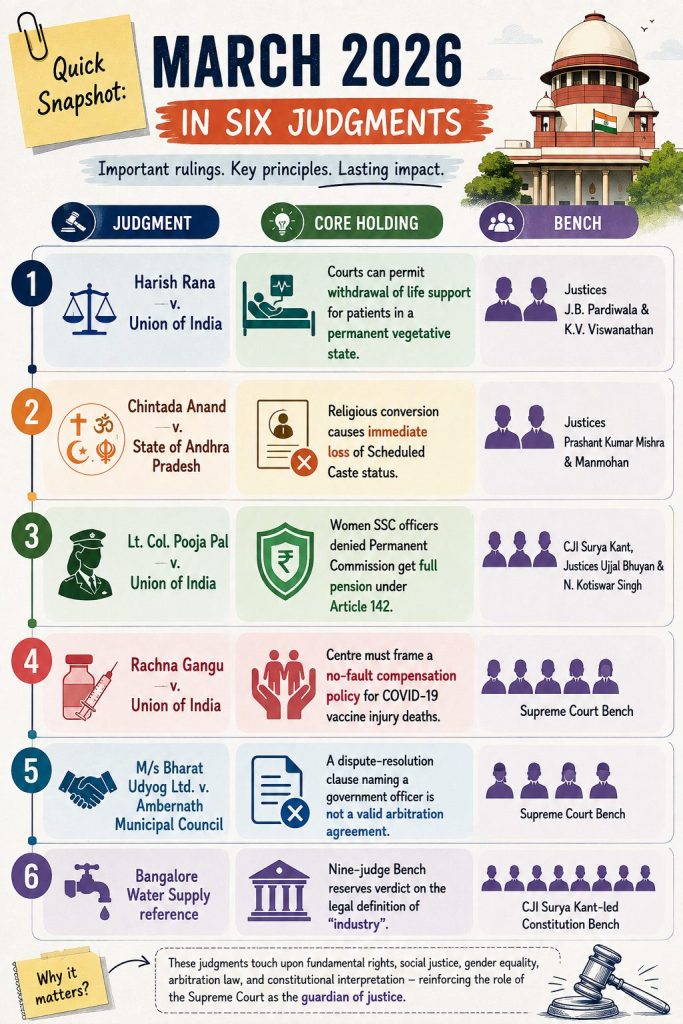
1. India’s First Court-Sanctioned Passive Euthanasia Order
Case: Harish Rana v. Union of India
Citation: 2026 INSC 222 / 2026 SCC OnLine SC 358
What happened
Harish Rana fell from a fourth-floor building in Chandigarh in 2013, when he was nineteen years old. The fall left him in a permanent vegetative state with complete paralysis of all four limbs. His family maintained his care for thirteen years through Clinically Assisted Nutrition and Hydration, delivered through a feeding tube. The Delhi High Court rejected their plea to withdraw this treatment in 2024, holding that Rana was not “terminally ill” and did not depend on a ventilator. The family approached the Supreme Court.
What the Court held
A bench of Justices J.B. Pardiwala and K.V. Viswanathan reversed the High Court’s reasoning entirely. The Court held that:
- Clinically Assisted Nutrition and Hydration (CANH) qualifies as medical treatment, not basic nursing care. This distinction matters because only medical treatment can lawfully be withdrawn under the passive euthanasia framework.
- A permanent vegetative state qualifies for withdrawal of life support regardless of whether the patient needs a ventilator. The absence of mechanical breathing support does not disqualify a patient from relief.
- The ruling applies and substantially expands the guidelines the Constitution Bench laid down in Common Cause v. Union of India (2018), marking the first time an Indian court has actually implemented those guidelines in a real case.
- The Court directed AIIMS Delhi to admit Rana to its palliative care centre and oversee a humane, medically supervised withdrawal process.
- Going forward, if a treating hospital or physician refuses to initiate the withdrawal process, families can approach the High Court directly under Article 226 to compel action.
Why this matters
This judgment moves India from a theoretical right to die with dignity to a working, enforceable process. Families facing similar situations no longer need to fight a decade-long legal battle from scratch; they now have a functioning roadmap through medical boards and, if needed, the High Court.
2. Religious Conversion Ends Scheduled Caste Status
Case: Chintada Anand v. State of Andhra Pradesh & Ors.
What happened
Chintada Anand was born into the Madiga community, a Scheduled Caste in Andhra Pradesh. He converted to Christianity and worked for over a decade as a pastor. In 2021, he alleged that members of a dominant local community assaulted and abused him using caste-based slurs. He filed a complaint under the SC/ST (Prevention of Atrocities) Act, 1989. The Andhra Pradesh High Court quashed the FIR, holding that the caste system is alien to Christianity, so Anand could not claim protection meant for Scheduled Castes.
What the Court held
A bench of Justices Prashant Kumar Mishra and Manmohan upheld the High Court’s view and laid down a clear constitutional rule:
- A person who converts from Hinduism, Sikhism, or Buddhism to any other religion immediately and completely loses Scheduled Caste status, regardless of the caste they were born into.
- This bar comes directly from the Constitution (Scheduled Castes) Order, 1950, and the Court described it as absolute, admitting no exception.
- A person cannot simultaneously practise a different religion and claim Scheduled Caste protections. The Court held that Anand, having converted to Christianity, could not seek relief under the SC/ST Act.
- Holding a valid caste certificate does not override this rule. The Court clarified that certificate validity is a separate administrative question from constitutional SC status.
- The Court did leave a door open: a person can reclaim Scheduled Caste status by reconverting to Hinduism, Sikhism, or Buddhism, but only after satisfying three conditions – proving they were originally born into a recognised Scheduled Caste, proving genuine reconversion with complete renunciation of the religion they had adopted, and proving that their original caste community has accepted them back.
Why this matters
This is one of the most significant rulings on caste identity in recent years. It settles a question that has produced conflicting High Court decisions for decades and will directly affect eligibility for reservation, welfare schemes, and legal protections for lakhs of individuals who have converted religions.
3. Full Pension for Women Armed Forces Officers Denied Permanent Commission
Case: Lt. Col. Pooja Pal & Ors. v. Union of India & Ors.
Citation: 2026 INSC 281
What happened
Women Short Service Commission (SSC) officers in the Army, Navy, and Air Force, commissioned largely between 2010 and 2012, had been denied Permanent Commission despite the Supreme Court’s earlier landmark ruling in Babita Puniya (2020), which was meant to open that door. The lead petitioners, including Wing Commander Sucheta Edan, challenged the evaluation process that kept them out.
What the Court held
A bench led by Chief Justice Surya Kant, along with Justices Ujjal Bhuyan and N. Kotiswar Singh, found that the evaluation process itself was flawed and discriminatory. The Court held that:
- The Annual Confidential Reports used to assess these women officers were reviewed carelessly and shaped by an existing assumption that they would not receive Permanent Commission anyway. The Court called this systemic discrimination.
- Using its extraordinary powers under Article 142 of the Constitution, the Court deemed the affected officers to have completed the 20 years of qualifying service needed for pension eligibility, even though many were released from service after just 10 to 14 years.
- This relief applies as a one-time measure to SSC women officers considered for Permanent Commission in selection boards held between 2019 and 2021.
- The relief does not extend to officers in the Army’s Judge Advocate General and Army Engineering Corps cadres, since those cadres have already been eligible for Permanent Commission since 2010.
Why this matters
The Court used Article 142 to deliver “complete justice” without disturbing the operational structure of the armed forces. This gives financial security to women officers whose careers were cut short by a process the Court itself has now labelled discriminatory, and it builds directly on the equality principles set out in Babita Puniya.
4. No-Fault Compensation Policy for COVID-19 Vaccine Injury Deaths
Case: Rachna Gangu v. Union of India
What happened
The petitioner sought compensation and formal recognition for deaths that families believed followed COVID-19 vaccination. The case raised a difficult question: how should the state respond to alleged vaccine-related deaths without either denying every claim outright or attributing individual deaths to vaccination without clear medical proof?
What the Court held
The Supreme Court directed the Union of India to formulate a no-fault compensation policy for recognising deaths allegedly linked to COVID-19 vaccination. The Court deliberately avoided attributing any specific death to the vaccine. Instead, it extended Article 21’s protection of the right to life into the space of mass public health interventions, holding that the state carries a responsibility to support families even without proving individual causation.
Why this matters
This ruling extends constitutional accountability into public health policy. However, the judgment set out almost no implementation procedure, which means the real impact depends heavily on how the Centre drafts the compensation framework in the months ahead.
5. A Government Officer Named as Adjudicator Is Not a Valid Arbitration Clause
Case: M/s Bharat Udyog Ltd. v. Ambernath Municipal Council
What happened
A commercial contract contained a clause directing disputes to the Collector and Divisional Commissioner. When a dispute arose, one party sought to enforce this clause as an arbitration agreement under the Arbitration and Conciliation Act, 1996.
What the Court held
The Supreme Court held that this clause was not a valid arbitration agreement. A genuine arbitration agreement requires mutual consent between the parties a real meeting of minds to resolve disputes through arbitration. Directing disputes to a government officer who sits within a departmental or administrative hierarchy does not meet this standard, because that officer resolves disputes as part of an official chain of command, not as an independent arbitrator chosen by agreement.
Why this matters
Government contracts across India often route disputes to designated officers instead of independent arbitrators. This ruling gives contracting parties a clear test to challenge such clauses and push disputes toward genuine, independent arbitration instead.
6. Nine-Judge Bench Reopens the Definition of “Industry”
What happened
On March 19, 2026, a nine-judge Constitution Bench led by Chief Justice Surya Kant began hearing arguments on the scope of “industry” under Section 2(j) of the Industrial Disputes Act, 1947. The Bench heard arguments over three days from state governments and trade union organisations.
What the Court is examining
The Bench clarified early on that it will decide only the correctness of the 1978 ruling in Bangalore Water Supply v. R. Rajappa, which has governed how courts classify establishments as “industries” for over four decades. Whatever the Court decides will serve as an interpretive guide for matters pending between 1978 and 2020. The Court reserved judgment at the end of March, so the final ruling remains pending.
Why this matters
The definition of “industry” determines which workplaces fall under labour law protections and which do not. A shift in this definition could reshape rights and obligations across hospitals, educational institutions, charitable organisations, and government departments. Aspirants should track this case closely once the verdict arrives.
Other Notable Developments in March 2026
- The Supreme Court took suo motu-style cognisance of the risks posed by AI-generated fake and non-existent case citations, issuing notice to the Attorney General, Solicitor General, and Bar Council of India in Sure Mallikarjuna Rao, 2026 SCC OnLine SC 341. This matter later grew into a full misconduct ruling by June and July 2026.
- The Court directed the formation of an appellate mechanism for individuals whose names were deleted during the Special Intensive Revision of electoral rolls in West Bengal, and later asked parties to approach the Chief Justice of the Calcutta High Court to supervise the process.
- In Union of India v. Tarsem Singh (2026 SCC OnLine SC 481), the Court finally settled a long-running dispute over land acquisition compensation, ruling that landowners whose claims were pending on or after March 28, 2008, could seek solatium and interest, while those who raised claims late after that date would not receive interest for the delayed period.
- In Registrar Cane Coop. Societies v. Gurdeep Singh Narval (2026 SCC OnLine SC 346), the Court held that sugarcane growers’ cooperative societies straddling Uttar Pradesh and Uttarakhand do not automatically become Multi-State Cooperative Societies merely because a state was bifurcated.
Want structured, exam-focused updates on every major judgment as it drops? Explore our CLAT PG prep courses for detailed case briefs, Notes, MCQs, and mentor-led discussions on current legal developments.
Get case-law updates weekly
Join 10,000+ subscribers.
SH
Shruti chauhan
Contributing author
Have a doubt about this judgment?Ask Doubts
