
Supreme Court brought Live-In Relationships under Section 498A IPC : An analysis of Dr. Lokesh B.H. & Ors. v. State of Karnataka & Anr (2026)
Recently in the case of Dr Lokesh B.H. & Ors. v. State of Karnataka & Anr, the supreme court delivered a landmark judgment, ruling that section 498A of IPC (now section 85 of BNS) applies to live-in relationships that are in the nature of marriage. Provided that an intent marriage existed. This case highlighted the issue that a male partner cannot evade from the allegations of domestic violence just by citing that they were not formally married.
Live-in relationships in India
Live-in relationships is not a modern concept. The practice of living together with mutual consent and cohabiting without any formal marriage has existed since thousands of years.
The vedic tradition recognised ‘Gandharva Vivah’ a union based entirely on mutual love and consent. Gandharva Vivah is a form of hindu marriage which includes no formal rituals and parental permission.
On the other hand people believed traditionally, that to live together one needs to have some legal relation with another. Some customary practices believe that to live together one needs to marry another.
How Indian courts view live-in relationships
While live-in relationships were historically shamed. The Indian judiciary has increasingly recognized them, through landmark rulings like D.Velusamy vs D.Patchaiammal (2010), Dr Lokesh B.H. & Ors. v. State of Karnataka & Anr (2026) and other case laws .
In D.Velusamy vs D.Patchaiammal (2010), the court ruled that the strict proof of a formal marriage is not required for a woman to claim maintenance under section 125 Crpc. It held that a woman in a live-in relationship can claim maintenance under section 125 provided that the relation is ‘in the nature of marriage’. In the recent case Dr Lokesh B.H. v. State of Karnataka (2026), the court took a step further by making men criminally liable for domestic cruelty under the criminal law.
Case: Dr. Lokesh B.H. & Ors. v. State of Karnataka
Facts and Issue of the Case :
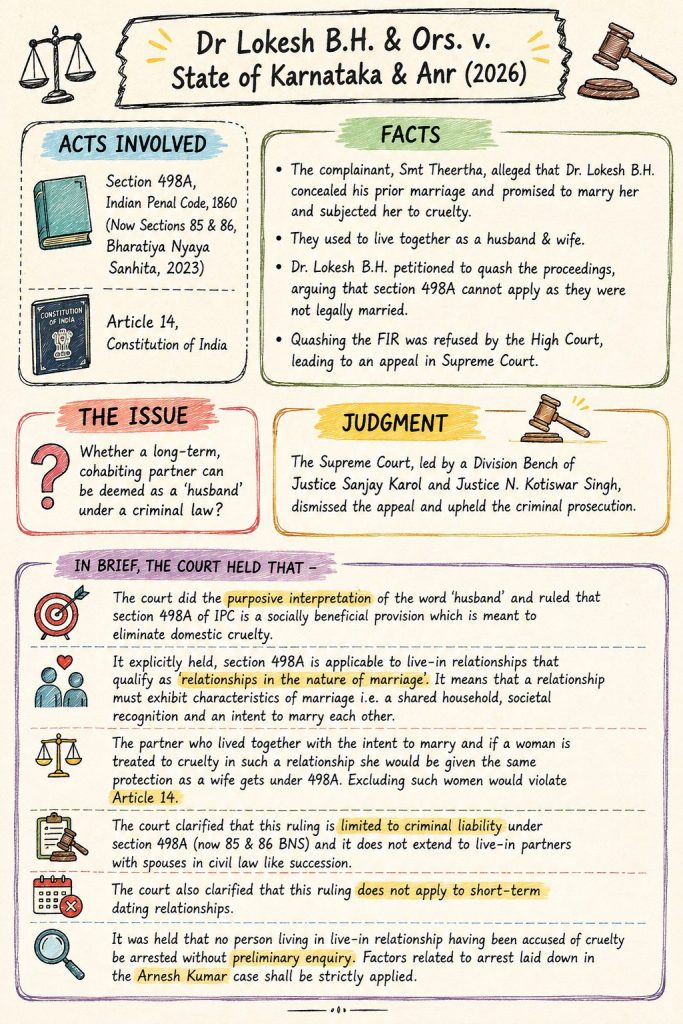
The complainant, Smt Theertha, alleged that Dr. Lokesh B.H. concealed his prior marriage and promised to marry her and subjected her to cruelty. They used to live together as a husband & wife. Dr. Lokesh B.H. petitioned to quash the proceedings, arguing that section 498A cannot apply as they were not legally married. The high court refused to quash the FIR, which led to an appeal in supreme court.
The core issue which arose was whether a criminal law can deem a long-term, cohabiting partner as a ‘husband’.
Judgment
The supreme court led by the division bench of Justice Sanjay Karol and Justice N. Kotiswar Singh dismissed the appeal and upheld the criminal prosecution.
In brief the court held that –
- The court did the purposive interpretation of the word ‘husband’ and ruled that section 498A of IPC is a socially beneficial provision which is meant to eliminate domestic cruelty.
- It explicitly held, section 498A is applicable to live-in relationships that qualify as ‘relationships in the nature of marriage’. It means that a relationship must exhibit characteristics of marriage i.e. a shared household, societal recognition and an intent to marry each other.
- If a partner subjects a woman to cruelty in a relationship whith a intent to marry, the law extends the same protection to her as a wife gets under 498A. Excluding such women would violate article 14.
- The court clarified that criminal liability under section 498A (now 85 & 86 BNS) limits this ruling, and it does not extend to live-in partners with spouses in civil law like succession.
- The court also clarified that this ruling does not apply to short-term dating relationships.
How the case evolved Live-In relationships in India
The Supreme court through various judicial proceedings has evolved the concept of live-in relationships in India. Initially, from S. Khushboo v. Kanniammal (2010), where supreme court shielded cohabitation between two consenting adults under article 21. Though society sees it as a moral wrong but two consenting adults did not commit any criminal offense while cohabiting without marriage or living together.
The judiciary then introduced the welfare remedies by allowing women to claim maintenance under DV Act 2005 and section 125 Crpc (now 144 BNSS) in D. Velusamy and Indra Sarma case. However it was completely a civil liability.
Finally the 2026 judgment of Dr Lokesh B.H. & Ors. v. State of Karnataka bridged the gap of criminal liability by making a man accountable for domestic violence & cruelty under section 498A IPC (now 85 & 86 BNS). Provided that the live-in relation mirrors a marriage and with an intent to marry each other.
Conclusion
Today, long-term live-in relationships are treated as similar to marriage in order to protect the women from abuse. The Supreme Court by various rulings has expanded the scope of human dignity and safety over traditional customs. However, live-in relationships though legal in India still differ from statutory civil property rights provided explicitly to married couples in India.
Subscribe for updates
Join 10,000+ subscribers.
JU
Julie Nigam
Contributing author
Have a doubt about this?Ask Doubts
