
How To Solve Syllogism With Venn Diagrams ?
Syllogism with Venn diagrams
One effective way to check the syllogism is to draw a Venn diagram. They are simple and accurate and help in determining whether there are more than two premises and whether the whole argument is invalid or not.
The validity and invalidity of any syllogism is based on the fact that in a valid syllogism, the conclusion asserts no more information than what is already contained implicitly in the premises, meaning that if there is any new information which is not given directly in the premise then the argument will be invalid.
If the conclusion asserts more than is contained in the premises, then the conclusion does not follow necessarily from the two premises: thus, the syllogism is invalid.
Assuming that the information asserted to be true, after putting it in a diagram, the Syllogism is invalid if more information would have to be added to reach a conclusion and if no information is to be added to represent the conclusion then the syllogism is valid.
Venn diagram is a way to represent sets of an object and picture the relationship between a collection of objects as given in the statements. They are often shown as circles and labelled.
It shows all the definite or logical relationship between the collections of statements.
Definite Conclusions
Based on the premise alone, one can determine whether some things are definitely true and can be concluded and definite conclusions can be inferred and what all things is just a mere possibility.
Definite statements are those that are certainly true, based on the statement(s) given. They are the ones which can be most certainly be concluded on the basis of the least Venn diagram.
Possibilities: Syllogism with Venn diagrams
Possibilities are those that may be true but are not definite. They can be shown using either the least Venn diagram or alternate Venn diagrams.
Alternate Venn diagrams are those Venn diagrams that are not commonly used to depict that particular statement, but are also valid ways of representing the statement.
It is important to understand that alternate Venn diagrams are not always correct all the time, but can often be useful in proving something wrong.
Selection
There are four categories one must remember. These tell one about how many objects have a certain attribute or how many you have selected.
- ALL (you can select every object in the group)
- SOME (you can select a few objects in the group)
- NONE (you can leave out all the objects in the group)
- SOME NOT (you can leave out a few objects in the group)
Points to remember
- A syllogism is a two premises argument having three terms, each of which is used twice in the argument
- Each term can be represented with a circle. Remember that all the statements must be assumed to be true and there is no definite way of drawing the Venn diagrams and they can be drawn as per persons own convenience, the given method here is a classic method.
- Since a syllogism is valid if and only if the premises involve the conclusion, diagramming the premise will reveal the logical terrain of the conclusion in a valid syllogism.
- If the syllogism is invalid, then diagramming the premises is insufficient to show the conclusion must follow.
- Since we have three classes, we expect to have three overlapping circles.
The classic method
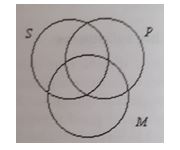
- The area in the denoted circle represents where members of the class would be, and the area outside the circle represents all other individuals.
- Shading represents the knowledge that no individual exists in that area. Empty space represents the fact that no information is known about the area
- An “X” represents at least one (individual) and so corresponds with the word “some”
Single Categorical Propositions with two overlapping circles
TYPE 1 PROPOSITION: ALL S is P
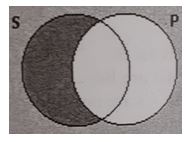
The shaded area indicates that if something is a member of the category S then that something must also be a member of the category P.
Another way to say the same thing is that “it is not the case that something is a member of the category S without at the same time being a member of the category P” or There are no members of the category S outside the category P. Thus, S is distributed and P is not
TYPE 2 PROPOSITION: SOME S IS P
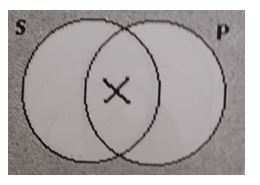
The “X” in the overlapping area graphs the lack of distribution for both S and P. The logical import of the graph is that there exists at least one member of the category S that is also a member of the category P. or, It is not the case that there exists at least one member of the category S that is outside the category P.
It also states the converse of the original: Some S is P. There exists at least one member of the category P that is a member of the category
TYPE 3 PROPOSITION: NO S IS P
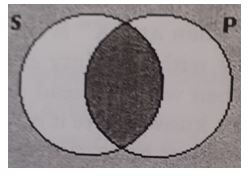
TYPE 4 PROPOSITIONS: SOME S IS NOT P
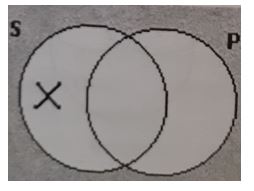
Typical Examples of syllogism with Venn diagrams
Example 1
- The form written out is
No M is P
All S is M
No S is P
- Note, in the diagram below how the area is common between S and P has been completely shaded out indicating that No S is P. The conclusion has been reached from diagramming only the two premises. All syllogisms of the form are valid.
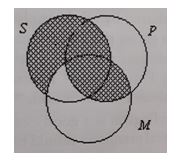
`
Example 2
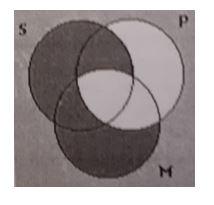
- Its form is written out as:
All M is P
All S is M
All S is P
- Note the diagram below, how the only the non-shaded area of S is in all three classes. The Important thing to notice is that this area of S is entirely within P class. Example 1 and 2 are the most common syllogisms and are almost always valid.
Example 3
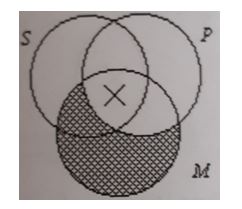
- The Syllogism sets up as
All M is P
Some M is S
Some S is P
- When Diagramming the syllogism, notice how you are forced to put the X from the minor premise in the area of the diagram shared by all three classes. The X cannot go on the P line because the shading indicates this part of the SM area is empty. This logical forcing enables you to read off conclusion Some S is P
- This syllogism is a good example of why the universal premise should be diagrammed before diagramming a particular premise. If we were to diagram the particular premises first, the X would go on the line. Then, we would have to move it when we diagram the universal premises because the universal premises empty an area where the X could have been.
Example 4
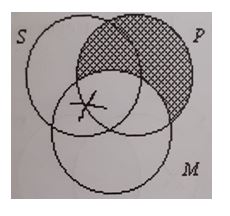
The Syllogism is written as
- All P is M
- Some S is M
- Some S is OP
The diagram below shows that the X could be in SMP area or in the SPM area. Since we do not know exactly which area it is in, we put the X on the line as shown. We do not know with certainty exactly where it is. So, when we go to read the conclusion we do not know where it is. Since the conclusion cannot be read with certainty the syllogism is invalid
Example 5
The Final syllogism described here, raises some interesting problems
- Notice that in this there are universal premises with a particular conclusion
- Its form is written out as
No P is M
All M is S
Some S is not P
- And its diagram is rather easily drawn as
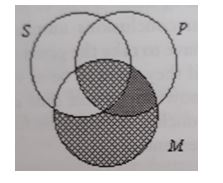
- When we try to read the conclusion, we see that there is no X in the SMP class. We must conclude that the syllogism is invalid because we cannot read off Some S is not P
- However, if we know that M exists, all members of M have to be in the SMP class. These Ms are Ss as well. Hence, we know that some Ss are no Ps! In other words, this is valid syllogism if we know ahead of time the additional premises that “m” exist.
It’s always easier to understand a syllogism with Venn diagrams.
Liked reading about syllogism with Venn diagrams?
Subscribe for updates
Join 10,000+ subscribers.
AD
Aditya Anand
Contributing author
Have a doubt about this?Ask Doubts
