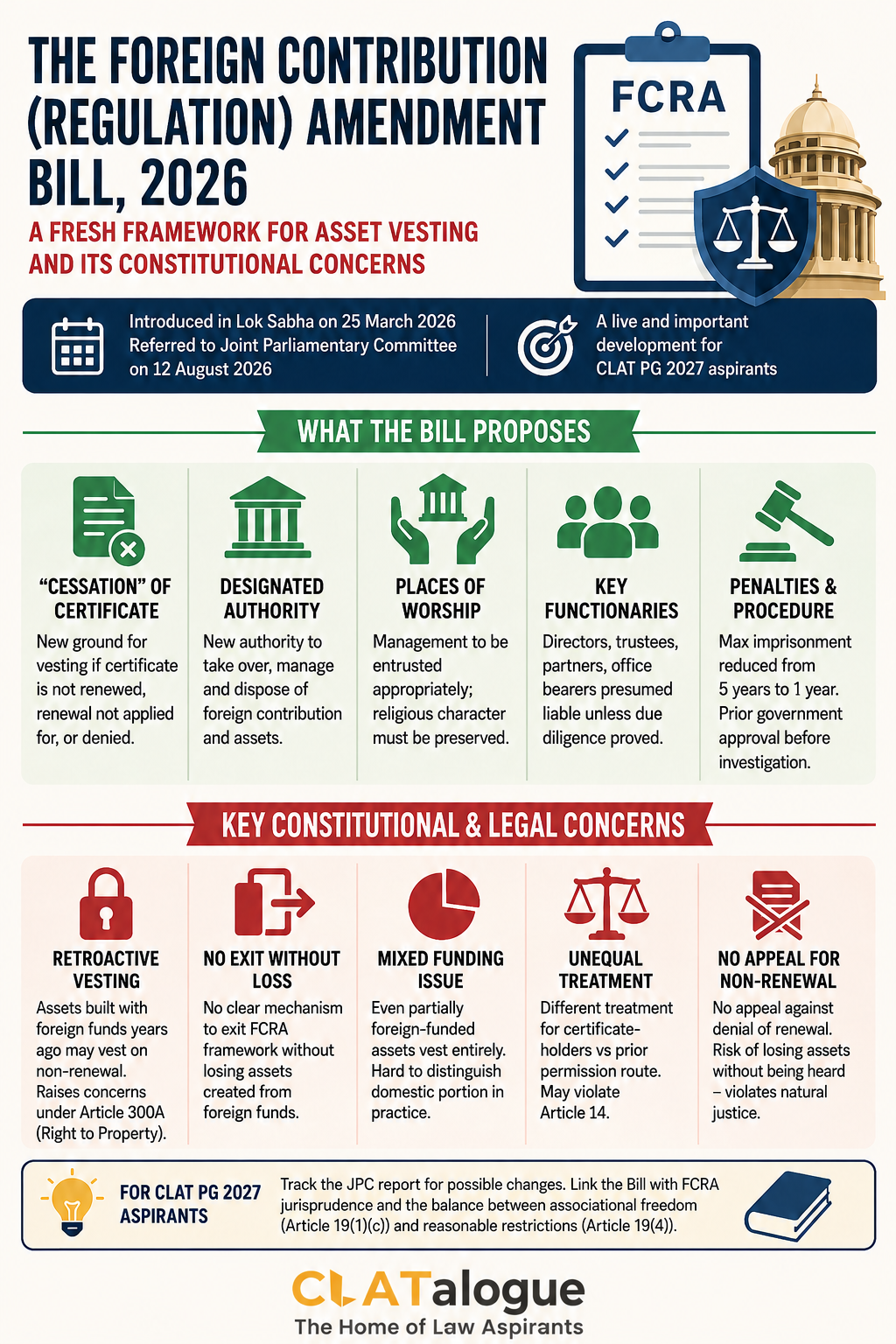
The Foreign Contribution (Regulation) Amendment Bill, 2026, was introduced in the Lok Sabha on March 25, 2026. It amends the Foreign Contribution (Regulation) Act, 2010, which governs the receipt and utilisation of foreign contributions by individuals, associations, and companies in India.
On August 12, 2026, the Bill was referred to a Joint Parliamentary Committee for detailed scrutiny. This referral makes the bill a live and highly relevant topic for CLAT PG 2027 aspirants preparing for current legislative developments.
Background
The parent Act of 2010 replaced the earlier Foreign Contribution (Regulation) Act, 1976, and introduced a five-year renewable registration certificate system along with a prior permission route for one-time recipients of foreign funds. Every entity wishing to receive foreign contribution must first obtain this certificate from the central government. Moreover, the Act seeks to prevent the diversion of foreign funds towards activities that may harm national interest.
According to the Ministry of Home Affairs, over 13,500 organisations received more than Rs 55,000 crore in foreign contribution between 2019 and 2022. As of mid-2026, the FCRA portal shows over 14,000 active certificates alongside a much larger number of cancelled or expired ones.
Features of the 2026 Bill
The Bill introduces the concept of "cessation" of an FCRA certificate. A certificate is deemed to have ceased if it is not renewed before expiry, if no renewal application is made, or if the renewal application is denied. This is a departure from the existing Act, which only recognised cancellation and voluntary surrender as grounds for vesting of assets.
Consequently, the Bill creates a new authority, termed theDesignated Authority, to take over the supervision, management, and disposal of foreign contribution and assets whenever a certificate is cancelled, surrendered, or ceases. Vesting remains provisional until the organisation secures a fresh certificate or renewal. However, if this does not happen within a prescribed period, the vesting becomes permanent.
Where the vested asset is wholly or partly a place of worship, the Designated Authority must entrust its management appropriately and ensure that its religious character continues to be maintained.This safeguard reflects an attempt to balance regulatory oversight with constitutional protections under Articles 25 and 26 relating to freedom of religion.
The Bill also introduces the concept of "key functionaries," a term covering directors, partners, trustees, the Karta of a Hindu undivided family, and office bearers of societies or associations. These functionaries bear a presumption of liability for organisational offences unless they can demonstrate lack of knowledge or the exercise of due diligence. Additionally, the Bill reduces the maximum term of imprisonment for violations from five years to one year, while requiring prior government approval before any investigation can begin.
Critical Legal Issues
The first major issue concerns the retroactive impact of vesting. An organisation that built assets using foreign funds years ago but has since operated on domestic funding could still lose those assets simply for not renewing its certificate. This raises serious concerns about proportionality and the protection of property rights under Article 300A of the Constitution.
Furthermore, the Bill does not provide any clear method for an organisation to exit the FCRA framework without losing assets created from foreign contribution. Even entities that no longer wish to receive foreign funds must continue renewing their certificate indefinitely to retain such assets.
Another significant concern relates to assets created through mixed funding. The Bill states that even partially foreign-funded assets shall vest entirely in the Designated Authority, subject to a subsequent application for the return of any distinct or ascertainable domestic portion. In practice, however, distinguishing a hospital ward or building funded partly by foreign and partly by domestic donations proves nearly impossible, making full vesting the likely default outcome.
The Bill also distinguishes certificate-holders and organisations that used the prior permission route. An organisation that received prior permission and successfully transitioned to domestic funding does not face asset vesting upon non-renewal. However, a certificate-holding organisation in an identical position does face vesting. This differential treatment could invite scrutiny under Article 14, which guarantees equality before law and prohibits arbitrary classification.
Perhaps the most significant issue is the absence of any appeal mechanism for denial of renewal. While the parent Act allows appeal to the jurisdictional High Court against cancellation of a certificate, neither the Act nor the Bill extends this right to cases of non-renewal. Consequently, an organisation may lose its assets permanently without ever being heard or granted a chance to challenge the decision, raising direct concerns under the principles of natural justice.
Since the Bill is currently before a Joint Parliamentary Committee, its final shape may still change based on stakeholder submissions and committee recommendations. Therefore, candidates should track the JPC report once released, as it may substantially alter provisions relating to appeal mechanisms and the treatment of mixed-funded assets.
For CLAT PG aspirants, this Bill offers a rich case study connecting statutory interpretation with constitutional principles, and it deserves close and continuing attention through the JPC process.