The 'Romeo-Juliet clause' provides for an exception to statutory sexual offence laws when the ages of the individuals involved are very close to majority. This clause tells the difference between consensual and non-exploitative sexual activity on the part of adolescents and sexual abuse committed by an adult.
It takes into account an age band, sets a maximum age difference, and excludes cases involving coercion, trust, authority, dependency or exploitation. It does not grant a licence for sexual activity, rather, it establishes a legal safe harbour for relationships in which the partners are still sufficiently close in age.
The Protection of Children from Sexual Offences Act, 2012 (POCSO) defines a ‘child ’ as anyone under the age of eighteen and regards consent as irrelevant in cases involving such a person. While this provision offers protection against exploitation of children, it also subjects consensual relationships between adolescents to the same legal framework as abusive ones.
As a result, there arises a conflict between protecting adolescents, respecting their autonomy, and maintaining family control. The present article examines the comparative approaches, reviews the development of the law in India, evaluates the current situation, and recommends a defined statutory exception instead of lowering the age of consent.
Comparative Position
While various legal systems do have Romeo-Juliet clauses, they do not always refer to them by that name or achieve exactly the same legal results. It is necessary to make a distinction between a genuine close-in-age exception, a rule that brings about a reduced penalty, and a general age of consent system which separately criminalises exploitation.
Position in Canada
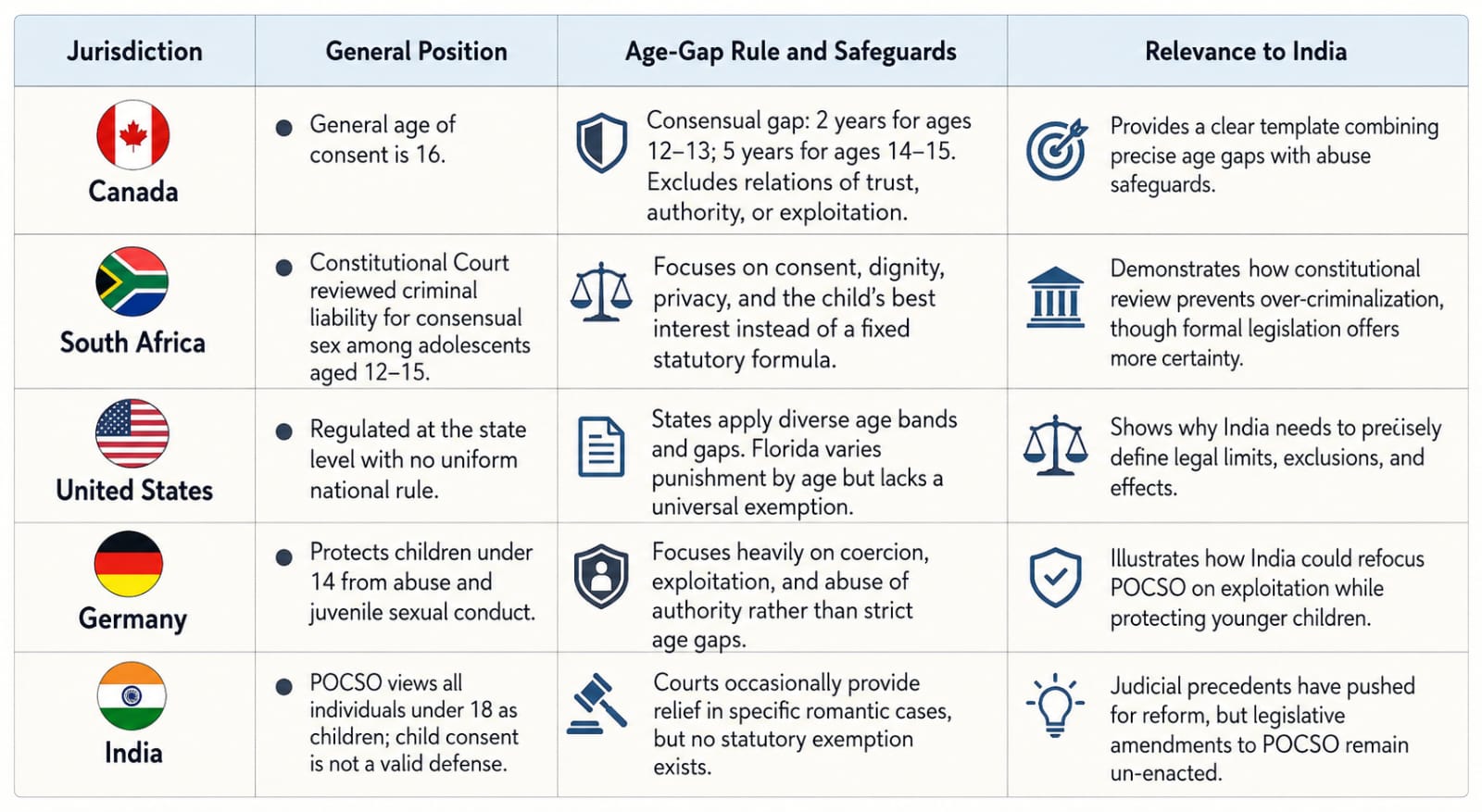
Canada offers one of the most clear examples in statute. The general age of consent is sixteen, but a child who is fourteen or fifteen years old can give consent to sexual activity if the partner is younger than five years old. A child who is twelve or thirteen can consent provided that the age difference is less than two years.
However, these rules do not apply when the older person holds a position of authority, when the younger person is dependent on that person, or when the relationship is found to be exploitative. The Canadian approach illustrates the basic structure of a close-in-age clause is a specified age gap together with an absolute exemption in cases involving power or exploitation.
Position in South Africa
South Africa provides an example of a constitutional approach. In the case of Teddy Bear Clinic for Abused Children v Minister of Justice and Constitutional Development, the Constitutional Court struck down the provisions which made it a criminal offence to engage in consensual sexual penetration or sexual violation with children aged between twelve and sixteen.
The Court did not say that early sexual activity should be encouraged, nor did it reject Parliament's authority to set an age of consent. On the other hand, it ruled that criminal punishment amounted to an unbalanced approach of achieving protection and deterrence where the act in question was consensual. The case is important since it acknowledges that children need guidance and protection, but it also cautions that such protection should not lead to them suffering the negative effects of being criminalised.
Position in Florida, USA
Since the states have the main say in the area of sexual offences, there is no uniform Romeo-Juliet rule. In some states a defence or exemption is given to partners who are close in age, while in others the offence or the penalty is lessened if the person accused is also an adolescent.
Florida is a useful example to warn against this approach. The Florida Statutes takes into account the ages of both the accused and the complainant when determining liability and the punishment, but the provision does not offer a general exemption for all close-in-age relationships.
Thus, the American experience demonstrates that the label by itself is not sufficient to deal with the legal issue, it is necessary for researchers to look at the exact legal effect of the clause.
Position in Germany
Germany takes a different course. According to its Criminal Code, children under the age of fourteen are protected and there is a separate provision covering sexual acts with minors in cases involving exploitation or abuse of a position. This approach does not correspond to what is known as a Romeo-Juliet clause, rather, it illustrates how a jurisdiction might combine a low bar with specific offences focused on coercion, dependency and exploitation.
In all these models, one common principle appears i.e. criminal law should aim at tackling the abuse of vulnerability as well as power and not automatically make every relationship between adolescents a criminal matter.
Position under UN
The same applies to international policy. The UN Committee on the Rights of the Child asks countries to balance protection with the growing capabilities of children. It also refrain from treating adolescents of the same age as criminally responsible for sexual activity which is actually consensual.
Although it does not provide a single legislation, the guidance does promote a closely defined close-in-age exemption.
Position in India and legal development
India developed its present position through the interaction of the Indian Penal Code(IPC), POCSO and post 2012 criminal law reforms. Historically, the IPC primarily targeted girls through its statutory age of consent, and lawmakers changed that age of consent over time. They raised it from ten to twelve in 1891, to fourteen in 1925 and to sixteen in 1940.
Before the 2013 reforms, intercourse with a girl below sixteen constituted rape irrespective of consent, subject to the then existing marital exception. This system adopted a gender-specific approach and differed from the later child-protection model.
Protection of Children from Sexual Offences Act, 2012
The POCSO Act of 2012 includes a gender-neutral definition of ‘child’ as being someone under the age of 18. It makes penetrative sexual assault a criminal offence in Sections 3 and 4 and provides for harsh penalties, Sections 7 and 8 cover cases of sexual assault, and Section 29 establishes a presumption in prosecutions for certain offences.
To strengthen its protective aim, the Act provides for child-friendly procedures and the establishment of Special Courts. Yet the statute does not make a distinction between an adult predator and two adolescents who are of similar age. Consent by a child generally cannot be used as a defence since the Act regards the under eighteen age limit as conclusive for the relevant offences.
Criminal Reforms: 2013
The Criminal Law (Amendment) Act 2013 later modified the IPC as a result of the Nirbhaya assault and the Justice Verma Committee process. It raised the age threshold referred to in section 375 IPC to eighteen and brought it in line with the position already taken by POCSO. This background is significant since the reform mainly focused on enhancing protection against sexual violence rather than on implementing a careful approach to adolescent intimacy. Although the Justice Verma Committee's report is still relevant to the reform discussion, Parliament did not introduce a close-in-age exception.
Recent Developments
Indian courts have at times reduced the severity of the statute by means of constitutional interpretation or by exercising the inherent powers of the High Courts. In the case of Vijayalakshmi v State, (2021), the Madras High Court set aside the proceedings and regarded the dispute as essentially a personal one, and cautioned against using POCSO to criminalise genuine young relationships.
While these rulings offer clear evidence of judicial sensitivity, they do not establish a general legal exception. Moreover, the fact that the decisions are based on specific circumstances leads to uncertainty since adolescents in similar situations may get different results depending on the court, the stage of the proceedings, the evidence and the willingness of the complainant or their family to support the relationship.
The Supreme Court’s decision in State of Uttar Pradesh v Anurudh (2026) marks the latest development. The Court set aside the Allahabad High Court’s general directions concerning medical age determination and the treatment of age evidence at the bail stage. The court also highlighted the societal abuse of POCSO law. Justice Sanjay Karol stated that parents often manipulate their daughters' age to intentionally penalise the young men involved in consensual adolescent relationships.
The Court identified a possible Romeo-and-Juliet clause for genuine adolescent relationships and methods to prevent people from using the statute to settle personal scores. This case therefore carries reform-oriented significance, but it does not change the law.
As of August 2026, India has no law to deal with adolescent consensual relationships. It is not enough for India to deal with the problem by lowering the age of consent alone, since doing so without any safeguards would reduce the protection available against trafficking, coercion and unequal relationships.
On the other hand, the current general rule is too broad because it classifies peer intimacy and adult exploitation as being equally criminal. Therefore, India requires a statute that clearly defines a safe harbour.
Recommended Application of Romeo-Juliet Clause
The clause must be applied only in cases where both individuals are within a particular age range corresponding to adolescence. The age difference should be within a set limit, and the relationship should not involve any external influence. Also there should not be substantial mental or physical incapacity.
It should not be necessary for a child to prove that they have given mature consent, the exception must exclude the specified conduct from liability under POCSO. There should be a judicial review in cases where there is a dispute as to the ages or the voluntariness of the parties. Even when the exception removes criminal liability, authorities should keep providing reporting options, counselling and child-protection services.
Conclusion
The evidence from different countries confirms this need for a balanced approach to adolescent relationships. While Canada provides a detailed statutory framework, South Africa warns against the constitutional risks involved in criminalising consensual behaviour by adolescents. Germany illustrates the advantages of directing criminal law towards cases of exploitation, and the United States highlights the necessity of using carefully drafted legislation rather than depending on a general term.
Recognizing these challenges, the Indian courts recently in the Anurudh case(supra) have introduced these reforms onto the Supreme Court's priorities list. A well-protected Romeo-Juliet clause would prevent the unfair excessive criminalisation of adolescents and preserve the main protective aim of the POCSO Act.