
Top 10 Landmark Cases of Labour Law
This article will help you understand Top 10 Landmark Cases of Labour Law which are frequently asked in the exams.
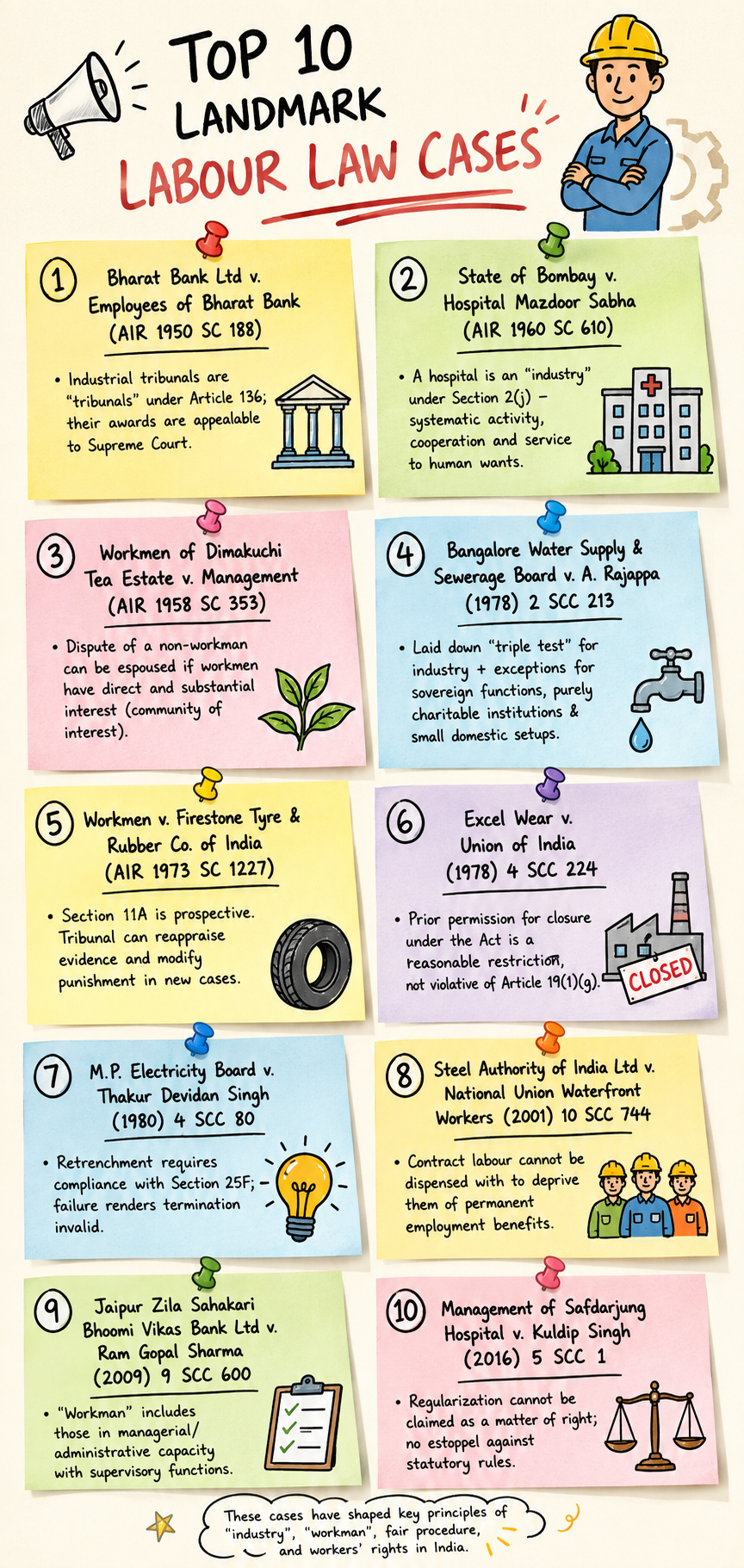
Bharat Bank Ltd v. Employees of Bharat Bank, AIR 1950 SC 188
Facts: An industrial tribunal adjudicated a dispute between the bank and its employees. The bank challenged the tribunal's award, arguing that tribunals are not "courts" and thus their determinations cannot be appealed under this provision.
Issues:
- Whether an industrial tribunal is a "tribunal" for the purposes of Article 136 of the Constitution
- Whether its awards are subject to the appellate jurisdiction of the Supreme Court
Judgment: The Supreme Court held that industrial tribunals, though not courts in the strict sense, exercise functions that are essentially judicial and are therefore "tribunals" within the meaning of Article 136. The Court established that quasi-judicial bodies performing adjudicatory functions are subject to the Supreme Court's overriding constitutional appeal jurisdiction.
State of Bombay v. Hospital Mazdoor Sabha, AIR 1960 SC 610
Facts: Employees of a government-run hospital raised an industrial dispute. The State argued a hospital, being a welfare/charitable activity, could not be classified as an "industry" under the Industrial Disputes Act.
Issues:
- What constitutes an "industry" under Section 2(j) of the Industrial Disputes Act, 1947
- Whether a hospital qualifies.
Judgment: The Court ruled that systematic activity, cooperation between employer and employee, and production/distribution of goods or services to satisfy human wants. A hospital, even if run by the government, was held to be an industry. This broad definition later required refinement.
Workmen of Dimakuchi Tea Estate v. Management, AIR 1958 SC 353
Facts: A tea estate's assistant medical officer, not himself a "workman," was dismissed. Fellow workmen raised an industrial dispute on his behalf, which the management contested as not maintainable.
Issues: Whether a dispute concerning a non-workman employee qualifies as an "industrial dispute" that other workmen can espouse.
Judgment: The Supreme Court held that for a dispute to be an industrial dispute - "any person" in Section 2(k) means someone who is either a workman or a non-workman in whose employment/terms of service the actual disputant workmen have a direct and substantial interest (a community of interest).
Because a medical officer belongs to a completely different managerial/professional class, the workmen lacked that shared community of interest.
Bangalore Water Supply & Sewerage Board v. A. Rajappa, (1978) 2 SCC 213
Facts: A seven-judge bench was constituted to settle conflicting interpretations of "industry," following inconsistent rulings including Hospital Mazdoor Sabha, on whether sovereign, charitable, or professional activities qualify.
Issues: What is the correct, comprehensive test for determining whether an activity constitutes an "industry" under the Act.
Judgment: The Court laid down the elaborate "triple test" (systematic activity + cooperation + production/distribution of goods/services), while carving exceptions for sovereign functions, purely charitable institutions, and small domestic establishments as follows-:
- Technically, the Court ruled that charitable institutions are NOT exempt if they carry out a systematic activity with employer-employee cooperation. Only if it is a purely spiritual or altruistic mission relying solely on volunteers (no workforce) does it escape the net.
- Similarly, for professions and small domestic setups, the court established the "Dominant Nature Test." It isn't an outright categorical exception; rather, if the dominant character is non-industrial (like a single lawyer with a typist), the minimal/marginal employment doesn't convert it into an industry.
Workmen v. Firestone Tyre & Rubber Co. of India, AIR 1973 SC 1227
Facts: The company dismissed several workmen based on findings from a domestic enquiry into alleged misconduct. During the pendency of the dispute, the Industrial Disputes Act was amended to insert Section 11A, which gave Labour Courts and Tribunals appellate powers to review domestic enquiries.
The workmen argued Section 11A applied to their pending case and allowed the Tribunal to reassess the evidence and modify their punishment.
Issues: Section 11A operates retrospectively on disputes referred before its enactment. Whether a Tribunal has the power to reassess evidence, overturn an employer's finding of guilt, and modify the punishment
Judgment: The Supreme Court held that Section 11A is prospective and does not apply to references pending before December 15, 1971. However, the Court clarified that under Section 11A, for new cases, the Tribunal is no longer a mere reviewer; it has the explicit power to reappraise the evidence of a domestic enquiry, satisfy itself on the worker's guilt, and substitute or reduce the punishment if found disproportionate.
The judgment also preserved the employer's right to adduce fresh evidence to justify dismissal if the original domestic enquiry was found to be defective.
Excel Wear v. Union of India, (1978) 4 SCC 224
Facts: Provisions of the Industrial Disputes Act required employers to obtain prior government permission before closing an undertaking. Excel Wear challenged this requirement as an unreasonable restriction on its fundamental right to carry on business.
Issues:
- Whether requiring prior government permission to close a business violates Article 19(1)(g)
- whether the right to close a business is part of the right to carry on business.
Judgment: The Supreme Court held the right to close a business is part of the fundamental right under Article 19(1)(g), and struck down the provision requiring prior permission as an unreasonable restriction.
While reasonable regulation of closure is permissible, an absolute bar amounting to compelled continuance of business is unconstitutional.
Central Inland Water Transport Corp v. Brojo Nath Ganguly, (1986) 3 SCC 156
Facts: A service rule allowed the employer-corporation to terminate a permanent employee's service on three months' notice, without assigning any reason, effectively an unrestrained power of arbitrary dismissal.
Issues: Whether such a service rule, entered into under unequal bargaining power, is unconscionable and violates Article 14.
Judgment: The Supreme Court struck down the rule as unconscionable and opposed to public policy under Section 23 of the Contract Act, and as violative of Article 14's guarantee against arbitrariness.
Contractual terms imposed on employees with weaker bargaining power can be judicially invalidated when they are unfair and unreasonable.
D.K. Yadav v. J.M.A. Industries Ltd, (1993) 3 SCC 259
Facts: An employee was terminated for unauthorised absence under standing orders, without being given any notice, explanation opportunity, or hearing before the termination took effect.
Issues: Whether principles of natural justice must be followed even where standing orders permit termination without a formal hearing.
Judgment: The Supreme Court held that termination without giving the employee an opportunity to be heard violates natural justice and Article 21's guarantee of fair procedure, even where the standing order is silent on hearing. Audi alteram partem applies to employment termination as a facet of the right to livelihood.
Air India Statutory Corporation v. United Labour Union, (1997) 9 SCC 377
Facts: The Central Government issued a notification prohibiting contract labour for sweeping, cleaning, and watching duties in Air India establishments.
The affected contract labourers sought automatic absorption as regular employees of Air India once the system was abolished. The management contended that the Central Government was not the "appropriate government" to issue the notification and that the Act does not mandate absorption.
Issues:
- Which entity constitutes the "appropriate government" for central public sector undertakings under the CLRA Act?
- Whether the abolition of contract labour under Section 10 automatically entitles contract workers to become regular employees of the principal employer.
Judgment: The Supreme Court held that since Air India was an instrumentality of the State under Article 12, the Central Government was the appropriate government.
On the second issue, the Court adopted a pro-labour public law approach, ruling that upon the abolition of contract labour, the link between the contractor and the worker is severed, and a direct employer-employee relationship is automatically created, requiring the principal employer to absorb the workers.
Steel Authority of India Ltd v. National Union Waterfront Workers, (2001) 7 SCC 1
Facts: A five-judge Constitution Bench was constituted to reconsider the automatic absorption principle laid down in Air India, given its severe financial and operational implications for principal employers across public and private industrie
Issues: Whether Section 10 of the CLRA Act, either expressly or by necessary implication, mandates the automatic absorption of contract labour upon the issuance of a prohibition notification
Judgment: The Supreme Court overruled the Air India judgment prospectively. It held that neither Section 10 nor any other provision of the CLRA Act provides for automatic absorption. Instead, the Court established two distinct legal paths:
- Genuine Contracts: If the contract arrangement is genuine, there is no obligation to absorb; however, regular vacancies must give preference to the displaced contract workers.
- Sham Contracts: If the contract arrangement is found by an Industrial Tribunal to be a "sham" or a mere camouflage to hide a direct employment relationship, the workers will be recognized as direct employees of the principal employer and regularized accordingly.
Get case-law updates weekly
Join 10,000+ subscribers.
HA
Hanspal Bakul
Contributing author
Have a doubt about this judgment?Ask Doubts
