Top 10 Supreme Court Judgments: May 2026
If you had to pick one month from 2026 to test whether an aspirant truly understands Indian constitutional law, May would be a strong contender.
Read through once properly. You'll retain far more from one careful pass than from ten hurried ones.
Constitutional Law & Election Law: Association for Democratic Reforms v. ECI (The Bihar Electoral Roll Case)
Bench: CJI Surya Kant & Joymalya Bagchi, JJ.
Citation: 2026 SCC OnLine SC 990
Facts
- The Election Commission of India (ECI) carried out a Special Intensive Revision (SIR) of electoral rolls in Bihar ahead of elections.
- Petitioners challenged this exercise, arguing it was arbitrary, exclusionary, and risked disenfranchising genuine voters through an overly compressed and demanding verification process.
- The matter reached the Supreme Court through writ petitions questioning the constitutional and statutory validity of the SIR process itself.
Issues
- Does the Special Intensive Revision exercise conducted by the ECI conflict with the Representation of the People Act, 1950, and the Registration of Electors Rules, 1960?
- Does the SIR process detract from the constitutional imperative of free and fair elections?
- Is Article 324 of the Constitution which vests the ECI with superintendence, direction, and control of elections, a sufficient source of power for such an exercise?
Legal/Constitutional Principle Involved
This case sits at the heart of election law under Article 324 of the Constitution, which grants the Election Commission wide powers of superintendence, direction, and control over elections, and Section 21(3) of the Representation of the People Act, 1950, which governs the revision of electoral rolls.
The broader principle at play is how far a constitutional body's discretionary power extends when carrying out a function central to democratic governance, and how courts balance administrative flexibility against the risk of disenfranchisement.
Judgment
- The Supreme Court upheld the constitutional validity of the SIR process, holding that Article 324 "is not a dead letter."
- It held that the SIR exercise was traceable to Section 21(3) of the RP Act read with Article 324, and did not conflict with either the RP Act or the 1960 Rules.
- The Court found that the exercise did not detract from the constitutional imperative of free and fair elections, since it was undertaken to advance the very objective Part XV of the Constitution is designed to protect.
Criminal Law & Bail Jurisprudence: Syed Iftikhar Andrabi v. NIA (The UAPA Bail Discipline Case)
Bench: B.V. Nagarathna & Ujjal Bhuyan, JJ.
Citation: 2026 SCC OnLine SC 881
Facts
- The case arose out of the interface between Section 43-D(5) of the Unlawful Activities (Prevention) Act, 1967 (UAPA) which restricts bail in terrorism-related cases and the constitutional guarantee of personal liberty under Article 21.
- A co-equal bench had earlier decided Gulfisha Fatima v. State (NCT of Delhi) in a manner that appeared to significantly narrow the scope for bail under UAPA.
- The present bench had to consider whether that earlier ruling had effectively diluted binding precedent set by a larger bench, without expressly disagreeing with it.
Issues
- Can a bench of the Supreme Court, through its reasoning, "hollow out" the force of a larger bench's binding decision without expressly overruling or disagreeing with it?
- Does the statutory embargo on bail under Section 43-D(5) UAPA override the constitutional principle that "bail is the rule, jail is the exception"?
- What is the correct interpretation of the three-judge bench ruling in Union of India v. K.A. Najeeb regarding delay in trial as a ground for bail in UAPA cases?
Legal/Constitutional Principle Involved
This case is fundamentally about judicial discipline and the doctrine of stare decisis — the principle that a decision of a larger or coordinate bench binds smaller or later benches unless properly distinguished or referred to a larger bench.
It also engages Article 21 of the Constitution, the guarantee of personal liberty, and the settled proposition that "bail is the rule and jail is the exception" flows directly from this constitutional guarantee and cannot be displaced by ordinary legislation, including special statutes like the UAPA.
Judgment
- The Supreme Court expressed serious reservations about aspects of the earlier Gulfisha Fatima ruling, holding that a smaller or co-equal bench cannot hollow out a larger bench's decision without expressly disagreeing with it.
- It clarified that "bail is the rule and jail is the exception" flows from the constitutional primacy of Article 21 and cannot be displaced by statute.
- It held that K.A. Najeeb remains binding law entitled to the full protection of stare decisis, and cannot be diluted or circumvented by any court, including smaller benches of the Supreme Court itself.
- It clarified that K.A. Najeeb was never meant to suggest that the statutory embargo under UAPA automatically justifies continued detention while ignoring constitutional principles nor does it create an automatic entitlement to bail purely on account of delay.
Environmental & Administrative Law: In re City Hounded by Strays, Kids Pay Price (The Stray Dogs Case)
Bench: Vikram Nath, Sandeep Mehta & N.V. Anjaria, JJ.
Citation: 2026 SCC OnLine SC 894
Facts
- This suo motu matter originated from concerns over stray dog attacks, particularly on children, and the Court's earlier directions dated November 7, 2025, on stray dog management.
- Multiple applications were filed seeking modification, recall, or clarification of those earlier directions.
- Simultaneously, other applications sought to expand the directions to cover additional spaces such as gated housing societies, housing complexes, parks, and other public places frequented by the public.
Issues
- Should the Animal Birth Control Rules, 2023 (ABC Rules), particularly the rule on re-release of sterilised strays, apply uniformly across all types of premises, including gated and private residential complexes?
- How should the Court balance animal welfare concerns against public safety, especially the safety of children?
Legal/Constitutional Principle Involved
This case involves the interpretation and application of the Animal Birth Control Rules, 2023, framed under animal welfare legislation, and the broader administrative law question of how courts calibrate competing public interests, animal rights and public safety when issuing supervisory directions in a suo motu matter.
It also touches on the state's duty of care in public spaces and tortious liability principles as they apply to municipal bodies responsible for stray animal management.
Judgment
- The Court affirmed its earlier directions dated November 7, 2025, specifically insofar as they exclude gated housing societies, housing complexes, parks, and similar public-facing premises from the operation of re-release under Rule 11(19) of the ABC Rules.
- It issued comprehensive, nationwide directions for full implementation of the ABC Rules, 2023, including directions on nationwide sterilisation.
- The ruling remains one of the most detailed judicial engagements with the ABC Rules framework to date.
Constitutional Law & Human Rights: Prajwala v. Union of India (The Trafficking Victim Protection Plan)
Bench: J.B. Pardiwala & R. Mahadevan, JJ.
Citation: 2026 SCO.LR 6(2)[6]
Facts
- This matter originated from a public interest litigation filed by an anti-trafficking organisation, seeking enforcement of assurances the Union Government had earlier given in the original Prajwala v. Union of India case (2015) regarding the establishment of an Organised Crime Investigation Agency and a comprehensive anti-trafficking law.
- Over a decade after the original petition, many of those assurances remained unimplemented, prompting the present miscellaneous application.
Issues
- Is rehabilitation of trafficking survivors merely a matter of governmental policy discretion, or does it form part of a constitutionally guaranteed right?
- What comprehensive framework should govern the pre-rescue, rescue, post-rescue, rehabilitation, reintegration, and prosecution stages of anti-trafficking interventions?
Legal/Constitutional Principle Involved
This case rests on Article 21 of the Constitution and its expansive interpretation as guaranteeing not just protection from trafficking, but a life of dignity that includes rehabilitation and reintegration.
It reflects the Court's continuing role in translating constitutional guarantees into concrete institutional frameworks where legislative and executive follow-through has lagged, using its powers to recommend legislative and policy reform in areas of grave human rights concern.
Judgment
- The Supreme Court held that rehabilitation of trafficking survivors is not merely a matter of governmental policy but an integral component of the constitutional guarantee of a life with dignity under Article 21.
- It issued a comprehensive "Victim Protection Plan" governing the pre-rescue, rescue, post-rescue, rehabilitation, reintegration, and prosecution stages for survivors of commercial sexual exploitation and trafficking.
- It simultaneously recommended several legislative and policy reforms to strengthen India's anti-trafficking framework, continuing the unfinished business of the original 2015 Prajwala ruling.
Property Law: Manjula v. D.A. Srinivas (The Benami Act Retrospectivity Case)
Bench: J.B. Pardiwala & R. Mahadevan, JJ.
Citation: 2026 SCC OnLine SC 831
Facts
- The plaintiff's suit was framed as one based on a will and inheritance, but the substance of the claim was that certain properties had actually been purchased by the deceased using the plaintiff's own money and held for the plaintiff's benefit, the classic structure of a benami transaction.
- The defendant sought rejection of the plaint under Order 7 Rule 11 of the Civil Procedure Code, arguing the suit was barred by law since it effectively sought to enforce a benami arrangement.
Issues
- Does a claim dressed up as a will-and-inheritance dispute, but substantively alleging a benami purchase, attract the bar under the Prohibition of Benami Property Transactions Act, 1988?
- Are the 2016 amendments to the Benami Act retrospective, such that they can apply to transactions that occurred before the amendment came into force?
- Does a fiduciary relationship exist between a company director and a company employee for the purposes of the fiduciary exception under benami law?
Legal/Constitutional Principle Involved
This case turns on the Prohibition of Benami Property Transactions Act, 1988, and specifically the 2016 amendments that significantly expanded its scope and enforcement machinery. The core interpretive principle is whether courts should look at the substance of a plaint rather than its form. Here, whether a claim dressed as inheritance can be unmasked as a disguised benami claim at the earliest possible stage, rather than being allowed to proceed to a full trial.
Judgment
The Supreme Court laid down several important propositions in this case:
- Courts may examine whether the foundation of a claim is legally sustainable before subjecting parties to a full trial, even where disputed questions of fact are ordinarily meant to go to trial.
- There is no fiduciary relationship between a company director and a company employee; purely commercial or contractual arrangements do not fall within the fiduciary exception under benami law.
- Contracts entered into to circumvent the law are illegal and unenforceable.
- Courts must weed out frivolous or legally barred suits at the earliest stage through a meaningful reading of the plaint, rather than being misled by clever drafting.
- The 2016 amendments to the Benami Act are retrospective in operation and may apply to transactions that occurred before the amendment.
Criminal Law & Evidence: Gour Acharjee v. State of Tripura (The Homicidal Hanging Case)
Bench: Prashant Kumar Mishra & K.V. Viswanathan, JJ.
Citation: 2026 SCC OnLine SC 931
Facts
- A young woman was found hanging in her matrimonial home within just fifteen months of her marriage.
- The defence argued this was a case of suicide.
- The trial court and the High Court had both concurrently held it to be a case of dowry death and convicted the husband, who then appealed to the Supreme Court.
Issues
- Did the medical and forensic evidence support a finding of suicide, or did it point instead to a "simulated" or homicidal hanging staged to resemble suicide?
- Where a death occurs within the privacy of a matrimonial home, what burden falls on the household members to explain the circumstances?
Legal/Constitutional Principle Involved
This case involves Sections 302 (murder) and 498-A (cruelty by husband or relatives) of the Indian Penal Code, 1860, along with the medico-legal principles used to distinguish suicidal from homicidal hanging, particularly the nature and pattern of ligature marks and the presence of ante-mortem injuries.
It also engages the evidentiary principle that where an offence occurs within the exclusive knowledge of persons inside a house, those persons carry a corresponding duty to explain the circumstances of the death.
Judgment
- The Supreme Court upheld the conviction under Sections 302 and 498-A IPC, holding that the case was one of "simulated hanging or homicidal hanging," not suicide.
- It relied on the absence of a typical suicidal ligature mark and the presence of multiple ante-mortem injuries on the deceased's body to negate the suicide theory.
- It reiterated that household members owe a duty to explain a death occurring within the privacy of their home, and held that the appellant had failed to discharge this burden.
- Finding no reason to interfere with the concurrent findings of the courts below, the Supreme Court dismissed the appeal and directed the Tripura police to apprehend the absconding convict.
SC/ST Act & Criminal Law: Gunjan v. State (NCT of Delhi) (The "Public View" Case)
Bench: N.V. Anjaria & Prashant Kumar Mishra, JJ.
Citation: 2026 SCC OnLine SC 834
Facts
- The appellants were charged under Sections 3(1)(r) and 3(1)(s) of the Scheduled Castes and Scheduled Tribes (Prevention of Atrocities) Act, 1989, along with Section 506 read with Section 34 of the IPC, for alleged caste-based abuse.
- The alleged abuse took place inside a residential house, not in an open or public location.
- The trial court framed charges, and the Delhi High Court upheld this in a criminal revision, prompting the appeal to the Supreme Court.
Issues
- Does caste-based abuse committed inside a private residential house satisfy the requirement of taking place "within public view," which is a precondition for offences under Sections 3(1)(r) and 3(1)(s) of the SC/ST Act?
Legal/Constitutional Principle Involved
This case turns on the precise statutory language of Sections 3(1)(r) and 3(1)(s) of the SC/ST (Prevention of Atrocities) Act, 1989, which require that the alleged insult or intimidation of a Scheduled Caste or Scheduled Tribe member occur "in any place within public view."
This is a settled but frequently litigated requirement, and the case illustrates how courts apply strict statutory construction, a location being merely accessible to some people is not the same as being "within public view."
Judgment
- The Supreme Court held that the alleged incident occurring inside a residential house did not satisfy the "public view" requirement under Sections 3(1)(r) and 3(1)(s) of the SC/ST Act.
- It quashed the Delhi High Court's judgment, the trial court's orders, and the FIR and charge-sheet against the appellants.
- The ruling reaffirms that occurrence "within public view" is a sine qua non, an essential non-negotiable precondition for constituting an offence under these specific provisions of the SC/ST Act.
Constitutional Law & Education: Padam Mehta v. State of Rajasthan (The Mother Tongue Education Case)
Bench: Vikram Nath & Sandeep Mehta, JJ.
Citation: 2026 SCC OnLine SC 849
Facts
- The case concerned whether children in Rajasthan have a constitutional right to receive education in their mother tongue, specifically the Rajasthani language.
- The Rajasthan High Court had earlier ruled against recognising such a right in the manner sought by the petitioners.
- The petitioners appealed to the Supreme Court, framing the issue as one of linguistic rights and meaningful access to education.
Issues
- Does the right to receive education in one's mother tongue flow from Article 19(1)(a) of the Constitution, the freedom of speech and expression?
- What obligations, if any, does this place on the State of Rajasthan to formulate policy recognising and promoting the Rajasthani language in schools?
Legal/Constitutional Principle Involved
This case connects Article 19(1)(a) of the Constitution ordinarily understood as protecting freedom of speech to the right to education, on the reasoning that the true value of free expression lies not just in the ability to communicate, but in the ability to understand, internalise, and process information in order to make informed choices.
It also draws on the National Education Policy, 2020 (NEP 2020), which itself emphasises mother-tongue-based instruction, particularly at the foundational stage.
Judgment
- The Supreme Court held that the right to receive education in one's mother tongue finds its normative constitutional basis in Article 19(1)(a).
- It set aside the Rajasthan High Court's judgment and directed the State of Rajasthan to formulate a comprehensive policy for mother-tongue-based education in line with NEP 2020.
- It directed the State to recognise Rajasthani as a local/regional language for educational purposes, to progressively adopt it as a medium of instruction at foundational and preparatory stages, and to introduce it as a subject in all government and private schools in a phased manner.
Constitutional Law & Criminal Procedure: Condition Being Imposed While Granting Bail, In re (The "Cleaning Police Stations" Bail Case)
Bench: CJI Surya Kant & Joymalya Bagchi, JJ.
Citation: 2026 SCC OnLine SC 809
Facts
- The Supreme Court took suo motu cognizance after noticing a pattern of bail orders passed by the Orissa High Court and subordinate courts, in which accused persons were directed to clean police stations as a condition of bail.
- This practice raised serious concerns about the constitutional guarantees of dignity, equality, and fairness owed to persons in the criminal process, since bail conditions of this kind effectively imposed a form of punishment before any finding of guilt.
Issues
- Can courts impose bail conditions that require an accused person to perform manual or menial labour, such as cleaning a police station, as a precondition for release?
- What broader safeguards are needed to prevent courts from imposing degrading or constitutionally impermissible bail conditions?
Legal/Constitutional Principle Involved
This case is rooted in Article 21 of the Constitution, specifically the guarantee of a fair and dignified criminal process, and the principle that bail conditions must be reasonable, proportionate, and connected to securing the accused's presence at trial not designed as informal punishment or humiliation before conviction.
It reflects the Court's broader concern with ensuring that lower courts do not use bail as an opportunity to impose extra-legal penalties.
Judgment
- The Supreme Court described bail conditions requiring the cleaning of police stations as "abhorrent, degrading, and unknown to law."
- It declared all such conditions requiring cleaning of police stations or similar acts as a precondition for bail null and void.
- Recognising the wider implications of this practice, the Court issued omnibus directions applicable across courts, aimed at preventing similar constitutionally impermissible bail conditions in the future.
Insurance & Motor Vehicles Law: New India Assurance Co. Ltd. v. Dolly Satish Gandhi (The Mediclaim Deduction Case)
Bench: Sanjay Karol & Vipul M. Pancholi, JJ.
Citation: 2026 SCC OnLine SC 861
Facts
- Various High Courts had taken sharply divergent views on whether money received by an accident victim under a mediclaim (health insurance) policy should be deducted from the compensation awarded by a Motor Accident Claims Tribunal (MACT).
- This inconsistency created uncertainty for both accident victims and insurers, prompting the Supreme Court to resolve the conflict authoritatively.
Issues
- Should amounts received under a mediclaim or medical insurance policy be deducted from compensation calculated by a MACT under the Motor Vehicles Act, 1988, particularly where the compensation includes a head for medical expenses?
Legal/Constitutional Principle Involved
This case involves the compensation framework under the Motor Vehicles Act, 1988, and a principle borrowed from general insurance law: the distinction between a contract of indemnity (where a payout is meant to offset an actual loss and can be deducted from other compensation) and a contract that pays out regardless of loss, akin to a personal accident or life policy (where deduction is not appropriate). The case also illustrates how the Supreme Court steps in to resolve a "conflict of precedent" a situation where lower courts have taken genuinely contrary views on an identical legal question, creating unpredictability in the law.
Judgment
- The Supreme Court clarified that amounts received as mediclaim or medical insurance are not deductible from compensation calculated by a MACT under the Motor Vehicles Act, even where that compensation includes a claim for medical expenses.
- The bench specifically noted the existence of "too many surprisingly divergent views" among High Courts on this question, underscoring why judicial certainty on settled precedent matters, contrary views on the same point of law undermine predictability and turn legal outcomes into a matter of which court a litigant happens to be before.
How to Revise These Cases for CLAT PG
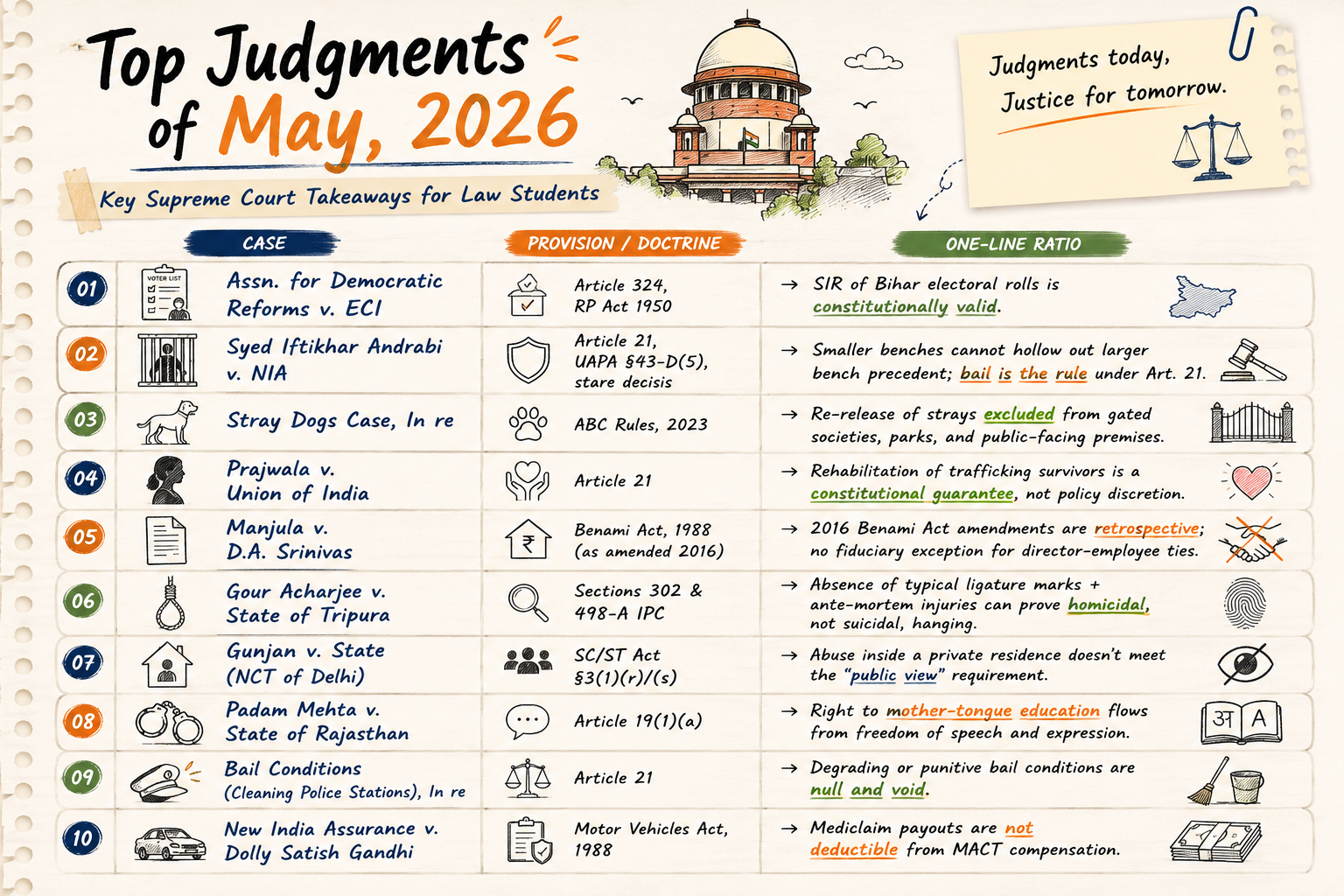
Don't start by memorising the facts rather start with the ratio, and let the facts serve as a memory hook that brings the ratio back to you under exam pressure. Group each case by the provision it really belongs to: the SIR case under Article 324, the UAPA bail case and the bail-conditions case both under Article 21, the mother-tongue case under Article 19(1)(a), and so on. This will help you remember better and apply the ratio in other cases.
Get case-law updates weekly
Join 10,000+ subscribers.
SH
Shruti chauhan
Contributing author
Have a doubt about this judgment?Ask Doubts

