
Top 10 Supreme Court Judgments of August 2025
In August 2025 the Supreme Court reached important decisions on professional regulation, judicial accountability, death-penalty safeguards, criminal evidence, gender equality, taxation, bail and matrimonial relief. The article deals with ten significant Supreme Court rulings and orders issued in August 2025.
These judgements demonstrate to CLAT PG students how constitutional principles function in conjunction with statutory provisions. The cases have been chosen on the grounds of their legal importance and their value for examination.
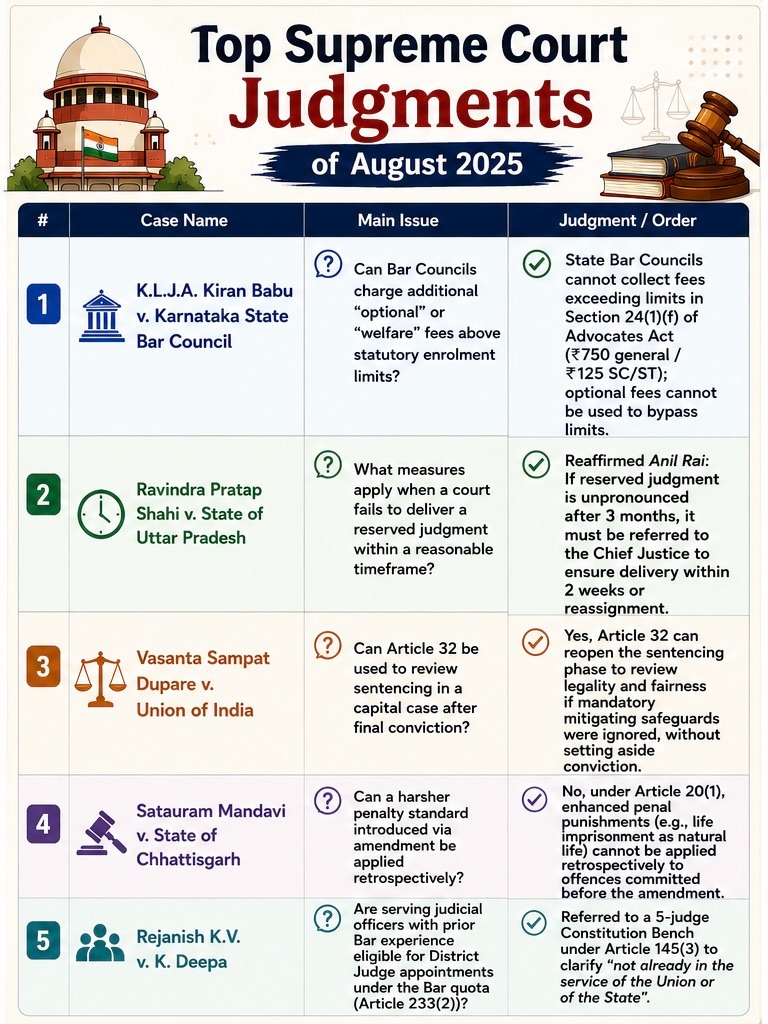
K.L.J.A. Kiran Babu v. Karnataka State Bar Council
Facts
The case was initiated due to complaints that the State Bar Councils and the Bar Council of India were charging amounts referred to as ‘optional’ or additional fees from people who were applying to be admitted as advocates. Previously, the Supreme Court had ruled in Gaurav Kumar v. Union of India that enrolment fees cannot go beyond the limits set by the Advocates Act, 1961.
Issue
The question is whether the bar councils can obtain additional sums by referring to them as optional, welfare or special fees, in addition to the statutory enrolment fee.
Judgment
The Court ruled that there is no substantial difference between a compulsory fee and an ‘optional’ fee in the case where an applicant is required to pay it in order to complete enrolment. State Bar Councils and the BCI are not permitted to collect amounts that exceed the statutory limits.
According to Section 24(1)(f) of the Advocates Act, the fee is set at ₹750 for applicants from the general category and at ₹125 for those from the SC/ST categories, in addition to the relevant stamp duty. This decision safeguards new law graduates against unreasonable obstacles to entry and upholds Articles 14 and 19(1)(g) of the Constitution.
Ravindra Pratap Shahi v. State of Uttar Pradesh (2025 INSC 1039)
Facts
The situation involved a criminal appeal in which the High Court had set aside its judgment without delivering it for nearly a year. The Supreme Court looked at the ongoing issue of judgments staying pending after the arguments had ended.
Issue
What measures should there be when a court fails to deliver a reserved judgment within a reasonable period?
Judgment
In regard to this matter, the Court has reaffirmed the decision in Anil Rai v. State of Bihar and has ordered that where a judgment is not delivered within three months of its reservation, the Registrar General shall refer the case to the Chief Justice. The Chief Justice is then required to make sure that the judgment is delivered within two weeks or else arrange for the case to be reassigned.
The Court has also emphasised the need to record the dates on which the judgment is reserved and when it is delivered. Giving timely and well-reasoned decisions forms part of the fair procedure guaranteed under Article 21, and a litigant must not be left in indefinite uncertainty regarding the outcome of a case.
Vasanta Sampat Dupare v. Union of India (2025 INSC 1043)
Facts
The fact is that the person who had been charged was about to receive a death sentence. The challenge did not lead to a re-examination of the conviction. It claimed that the court which had handed down the sentence had not observed the safeguards which required a proper consideration of any mitigating circumstances, such as the defendant’s psychological, social and personal background.
Issue
Is it possible for the Supreme Court to use Article 32 to review the sentencing phase of a capital case after both the conviction and the sentence have become final?
Judgment
The Court stated that there are circumstances in which Article 32 may be applied in order to reopen the sentencing phase when mandatory safeguards have been ignored. The conviction itself is not automatically set aside. The Court can look again only at the legality and fairness of the sentence.
This decision is based on the case of Manoj v. State of Madhya Pradesh, in which it was required that courts should collect and examine any mitigation material before handing down a death sentence. Article 32 thus continues to be a living constitutional remedy, but it cannot be used as a routine second appeal against a final judgment.
Satauram Mandavi v. State of Chhattisgarh
Fact
The fact is that the person accused was found guilty of a serious offence under the Protection of Children from Sexual Offences Act, 2012. The offence in question was committed before the amendment to section 6 of that Act in 2019 and the court which handed down the sentence applied the revised provision by considering a sentence of life imprisonment as a form of imprisonment until the end of the convict’s natural life.
Issue
Whether a more severe form of punishment, which is introduced after the crime has been committed, can be made to apply to cases that have already occurred.
Judgment
The Supreme Court upheld the conviction but lowered the sentence. It is clearly provided in Article 20(1) that a person should not be convicted or punished under a law which was not in effect at the time the offence was committed.
The subsequent interpretation of a sentence of life imprisonment as meaning the remainder of a person's natural life could not be applied to an offence that occurred before the amendment. This case is a significant example of the principle opposing retrospective penal laws and of the constitutional protection of individual liberty.
Rejanish K.V. v. K. Deepa (2025 INSC 965)
Facts
The matter was about whether a person was eligible to be appointed as a District Judge under Article 233(2) of the Constitution. It concerned an individual who had carried out seven years of practice at the Bar before joining the judicial service and who later applied for consideration under the Bar quota.
In the previous case of Dheeraj Mor v. High Court of Delhi the Bar quota had been regarded as being intended for practising advocates and had excluded serving judicial officers.
Issue
The question is whether a judicial officer who has prior experience as a member of the Bar is eligible to apply under the Bar allocation and at which stage this eligibility should be determined.
Judgment
The judgment involves a three-judge Bench sending the constitutional questions to a five-judge Constitution Bench in accordance with Article 145(3). The reference is concerned with the meaning of the phrase “not already in the service of the Union or of the State” in Article 233(2), and with whether eligibility is examined at the time an application is made, at the time of selection or at the time of appointment.
Although the questions have not been finally settled, the order is significant since it indicates when a substantial constitutional issue should be referred to a larger Bench and it underscores the difference between recruitment by promotion, through the Limited Departmental Competitive Examination (LDCE) and under the Bar quota.
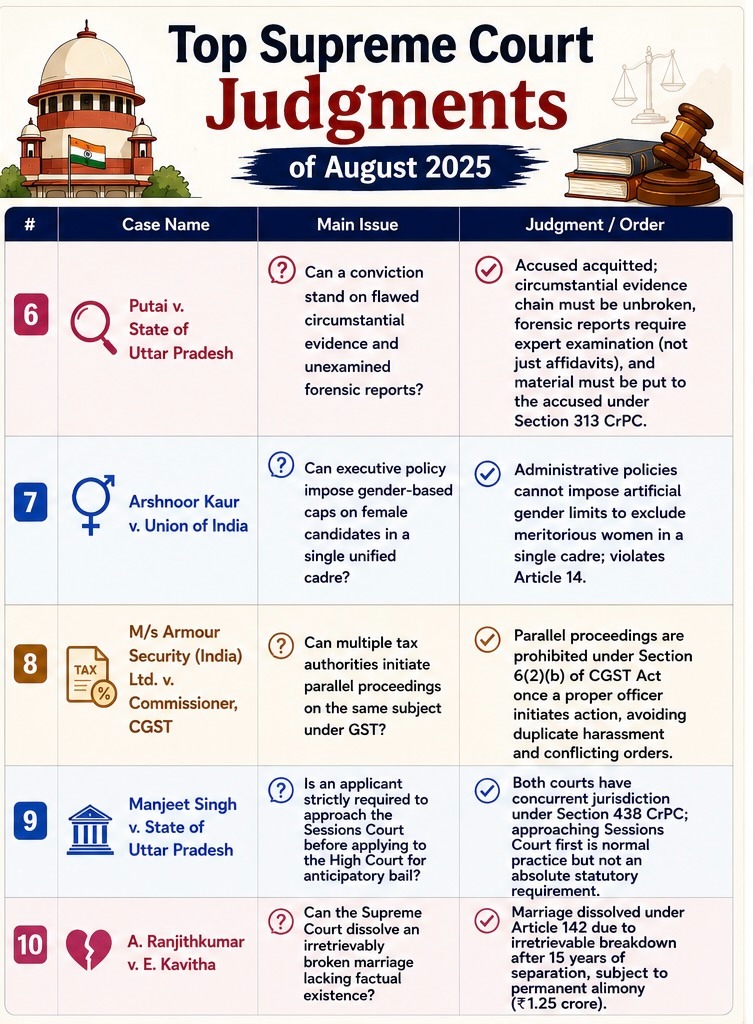
Putai v. State of Uttar Pradesh (2025 INSC 1042)
Facts
It is true that two people have been found guilty of the rape and murder of a girl who was twelve years old. The prosecution had mainly depended on circumstantial and forensic evidence. The investigation had serious flaws, such as gaps in the chain of custody, having failed to examine pertinent witnesses and having improperly handled a DNA report.
Issue
The question is whether a conviction can be upheld if the investigation and the evidence from the forensic material are unreliable.
Judgment
The Supreme Court freed both the accused. It stated that circumstantial evidence has to constitute an unbroken chain which rules out every reasonable possibility of their innocence. A forensic report containing substantial evidence generally cannot be proven simply by means of an affidavit, since it is necessary to have the expert examined properly.
The Court also emphasized that incriminating material must be presented to the accused in accordance with Section 313 of the Code of Criminal Procedure. The case serves as a reminder to the courts that the seriousness of an allegation does not mean that proof beyond reasonable doubt is unnecessary.
Arshnoor Kaur v. Union of India (2025 INSC 954)
Facts
It is true that women who were applying for a position in the Army’s Judge Advocate General's branch had obtained higher scores than men, but the recruitment policy limited the number of women who could be inducted. The Union justified this restriction by citing the “extent of induction” and the relevant operational policy.
Issue
The question is whether the executive authority can limit the number of female candidates or set aside positions for men in the case where men and women constitute a single cadre with identical service conditions.
Judgment
The Court ruled that the executive cannot apply an administrative policy in order to impose a gender limit which is not justified. If women candidates satisfy the required standards and are more meritorious, they should not be excluded just because the policy specifies a cap on the number of them. This kind of discrimination contravenes Article 14.
By applying the principle of equality to military recruitment, the judgment makes it clear that institutional policy cannot override constitutional rights unless there is a strong and constitutionally valid justification.
M/s Armour Security (India) Ltd. v. Commissioner, CGST, Delhi East
Facts
The issue involved the actions of the tax authorities within the Goods and Services Tax system. One of the authorities had already started proceedings on a certain subject, while another authority wished to initiate similar proceedings under both the central and state GST systems.
Issue
The question is whether two tax authorities can at the same time carry out proceedings concerning the same subject matter.
Judgment
In regard to this point, when Section 6(2)(b) of the Central Goods and Services Tax Act, 2017 is being interpreted. The Court ruled that parallel proceedings are prohibited if a single proper officer has already taken action on the same matter.
The purpose of the provision is to avoid duplication, conflicting orders, and the repeated harassment of taxpayers. This ruling is significant for gaining an understanding of administrative coordination within the context of GST and for illustrating the principle that statutory powers must be exercised in an orderly and non-overlapping way.
Manjeet Singh v. State of Uttar Pradesh
Facts
The case involved a procedural question concerning an application for anticipatory bail, namely whether the person accused had to go to the Court of Session before making an application to the High Court.
Issue
Does the High Court and the Court of Session both have the authority to grant anticipatory bail under section 438 of the Code of Criminal Procedure?
Judgment
The Supreme Court ruled that both courts have concurrent jurisdiction. It is not required by law for an applicant to go to the Sessions Court in every case. The High Court has the discretion to take into account the general circumstances, the seriousness of the offence and the applicant's conduct.
The decision is helpful in distinguishing a rule concerning statutory jurisdiction from a usual judicial practice and it also demonstrates that procedural access to a constitutional court cannot be turned into an absolute bar unless the statute expressly provides for it.
A. Ranjithkumar v. E. Kavitha (2025 INSC 978)
Facts
The fact is that the two people had been living apart for approximately fifteen years, mediation had failed and the relationship had entirely broken down, after which the spouse got married again. The Supreme Court then examined whether there was any real purpose in continuing the marriage legally.
Issue
Can the Supreme Court, by means of the powers granted to it under Article 142, annul a marriage which no longer exists in fact?
Judgment
The Court concluded that no substantial matrimonial relationship remained to be preserved and therefore dissolved the marriage in accordance with Article 142, at the same time ordering the payment of ₹1.25 crore as permanent alimony.
The judgment shows that the Court was concerned about issues of dignity, finality and economic security in the context of a prolonged matrimonial dispute. Although Article 142 cannot be used in place of the normal statutory grounds in all divorce cases, it may be applied to achieve a full and fair justice when the marriage is beyond repair and ongoing legal proceedings would cause additional hardship.
Conclusion
August 2025 judgments show that the court is attentive to both constitutional principles and the need for practical justice. The decisions concerning safeguards against the death penalty and retrospective punishment are particularly important when it comes to understanding Articles 20(1), 21 and 32.
For students preparing for CLAT PG, revise each case through three questions- What happened? Which issue was before the Court? What principle was established? This is more useful than memorising names alone.
Get case-law updates weekly
Join 10,000+ subscribers.
JU
Julie Nigam
Contributing author
Have a doubt about this judgment?Ask Doubts
