Top Supreme Court Judgments of March 2025
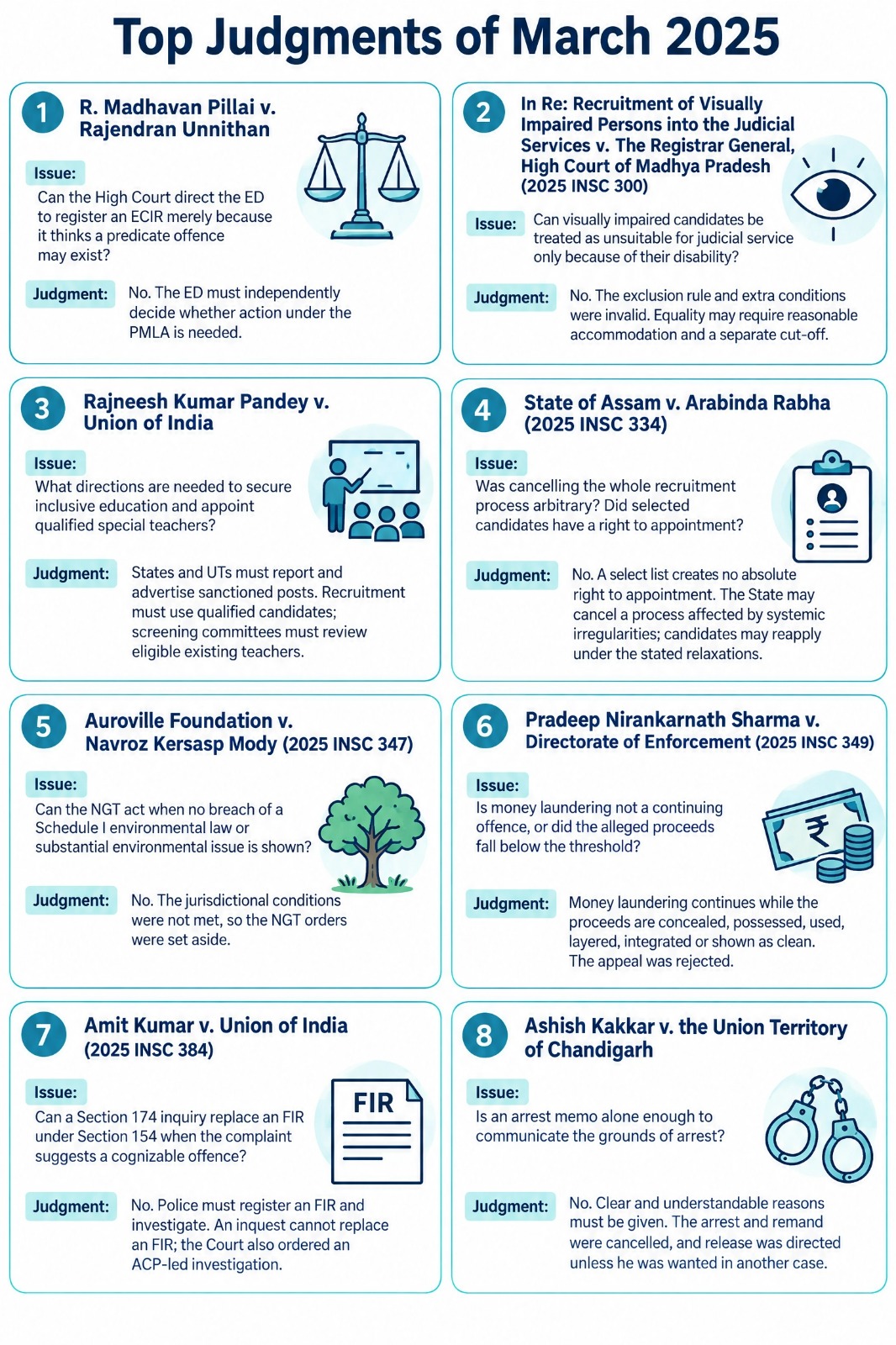
In March 2025 supreme court gave significant decisions concerning equality, disability rights, recruitment, the Prevention of Money Laundering Act (PMLA), environmental jurisdiction, arrest protections and student safety. These rulings link constitutional principles with actual legal issues.
R. Madhavan Pillai v. Rajendran Unnithan
Fact
- The conflict stemmed from a claim of fraud at the Edamulackal Co-operative Bank, with an amount of about Rs. 24 crore supposedly being misused.
- The Kerala High Court observed that the surcharge proceedings had imposed liability on a number of former members of the governing body.
Issue
Can the High Court require the Enforcement Directorate to register an Enforcement Case Information Report (ECIR) merely on the grounds that it has a prima facie view that a predicate offence exists?
Judgment
- The Supreme Court cancelled the High Court's decision. It stated that the High Court could not require the ED to register an ECIR in this way. The ED is required to make its own judgment as to whether the facts warrant action under the PMLA.
- The decision maintains the ED's statutory discretion and is helpful in distinguishing judicial review from judicial control of an investigation.
In Re : Recruitment of Visually Impaired Persons into the Judicial Services v. The Registrar General, High Court of Madhya Pradesh (2025 INSC 300)
Fact
- The case started when the mother of a candidate who was visually impaired and wished to join the judicial service made a complaint.
- The rules of Madhya Pradesh exclude candidates who are visually impaired or have low vision from being recruited, and other rules place further conditions on people with disabilities, such as requiring three years' experience or obtaining 70 per cent marks on the first attempt.
Issue
- The key issue was whether visually impaired candidates should be regarded as unsuitable for appointment to the judicial service just on the grounds of their disability.
- The Court also had to determine if the extra conditions placed on people with disabilities were in line with the principles of equality, reasonable accommodation and the Rights of Persons with Disabilities Act, 2016.
Judgment
The Supreme Court ruled that being visually impaired does not make someone inherently unsuitable for appointment to the judiciary. It invalidated the rule which had excluded educationally qualified individuals who are visually impaired or have low vision. It also set aside the additional requirements of either three years' experience or obtaining 70 per cent in the first attempt.
The Court stated that equality could involve making reasonable accommodations and having a separate cut-off. The decision is an example of substantive equality and affirmative action.
Rajneesh Kumar Pandey v. Union of India
Fact
The case currently under consideration is one of public interest and relates to education for children with special needs. Even though there had been previous instructions, a number of States and Union Territories had not established the posts or appointed special teachers. The Court looked at teacher-pupil ratios of 1:10 for primary and 1:15 for the higher classes.
Issue
What directions were necessary in order to establish the right to inclusive education and to secure the appointment of specially qualified special teachers?
Judgment
The Court required all States and Union Territories to inform about the sanctioned posts for special teachers within three weeks and to publicise them extensively. Recruitment was to be carried out only among candidates who held the necessary certificate issued by the Rehabilitation Council of India.
The Court ordered three-member screening committees to evaluate both contractual and daily-wage teachers, and teachers who were eligible might get the special-teacher pay scale with relaxation of the requirements relating to experience and age. The benefits would take effect in the future.
The case shows that mandamus is still in force. The Court has left the matter open in order to keep an eye on the implementation of a constitutional right.
State of Assam v. Arabinda Rabha (2025 INSC 334)
Fact
The government advertised 104 positions for forest-protection constables through physical testing and interview. When the select list had been prepared, the Principal Chief Conservator pointed out violations of the reservation rules, the imbalance between the districts, and the risks of favouritism. As a result, the government cancelled the selection.
Issue
- Was the decision taken by the State to cancel the entire recruitment process arbitrary or excessive?
- Did the candidates who had been selected have a legal right to be appointed?
Judgment
The Supreme Court agreed to the cancellation, ruling that a select list does not give rise to an indefeasible right to a post. While the State is required to act fairly, it can cancel a recruitment process if the process is itself affected by systemic irregularities.
The Court considered the concerns to be adequate and concluded that the decision was not Wednesbury unreasonable nor disproportionate. Since the process was flawed from the beginning, there was no need to save any part of it. The candidates were allowed to reapply provided that they met the appropriate age requirement and had suitable relaxations regarding the physical test.
The judgment connects Articles 14 and 16 to the boundaries of judicial review in relation to recruitment.
Auroville Foundation v. Navroz Kersasp Mody (2025 INSC 347)
Fact
The disagreement was about the development at Auroville, covering the felling of trees and the proposed Crown Road. The person who made the application stated that forest and environmental clearances were necessary. The National Green Tribunal (NGT) agreed with the application and gave the relevant directions.
Issue
Does the NGT have jurisdiction under the National Green Tribunal Act, 2010 in a case where no clear breach of a Schedule I environmental law or any other significant environmental issue has been established?
Judgment
The Supreme Court agreed with the appeals and set aside the NGT's orders. It concluded that the necessary jurisdictional conditions had not been met. The Court found no proven breach of a Schedule I enactment and no substantial issue concerning the environment in the sense of the Act.
The Court mentioned sustainable development and acknowledged the need for both environmental protection and development. The case is also valuable for the NGT's jurisdiction and for the interpretation of statutes.
Pradeep Nirankarnath Sharma v. Directorate of Enforcement (2025 INSC 349)
Fact
Pradeep Sharma, who had previously served as an IAS officer in Gujarat, was accused of making improper land allocations, bribery and misusing his position. The Enforcement Directorate (ED) claimed that the funds had been dealt with by means of financial transactions. Since the lower courts had refused to grant him discharge, he lodged an appeal.
Issue
Could the PMLA case have been dismissed on the grounds that the underlying offences took place earlier, since money laundering is not a continuing offence, or because the alleged proceeds did not meet the applicable monetary threshold?
Judgment
The Supreme Court rejected the appeal and stated that money laundering constitutes a continuing offence so long as the proceeds of the crime are concealed, possessed, used, layered, integrated or projected as if they were untainted. It therefore follows that the relevant conduct does not have to be dated to the time when the original predicate offence took place.
The financial claims were good enough at the initial stage to mean that a discharge or quashing could not be considered at that point. The case makes clear the connection between the underlying offences and money laundering.
Amit Kumar v. Union of India (2025 INSC 384)
Fact
The parents of two students from IIT Delhi who died by suicide claimed that they had faced caste discrimination, harassment and pressure relating to their studies. Instead of filing FIRs, the police carried out a Section 174 inquiry and the parents then appealed after the High Court had refused to grant them relief.
Issue
Can an inquiry made under Section 174 into the apparent cause of death take the place of registering a First Information Report under Section 154 when the complaint indicates a possible cognizable offence?
Judgment
The Supreme Court stated that the purpose of Section 174 is limited in that it is meant to identify the apparent cause of death. It does not allow the investigation of alleged cognizable offences to be omitted. If the information brings to light such an offence, the police are required to file an FIR under Section 154 and should not carry out a preliminary inquiry simply in order to examine the truth of the complaint.
The Court ordered that an officer of ACP rank should take charge of registering and conducting the investigation. It also set up a National Task Force on student mental health and suicides, with former Justice S. Ravindra Bhat acting as its chairman.
The case links criminal procedure with Article 21 and also involves institutional responsibility.
Ashish Kakkar v. the Union Territory of Chandigarh
Fact
Ashish Kakkar was arrested on allegations of extortion, cheating, forgery and conspiracy. He maintained that the arrest memo contained only general information and provided no valid reasons for the arrest, and also challenged the decision to remand him.
Issue
Is the act of issuing an arrest memo equivalent to the communication of the grounds for arrest required by section 50 of the CrPC and article 22(1) of the Constitution?
Judgment
The Supreme Court stated that it is not the case. While an arrest memo serves to record the fact of the arrest, it does not necessarily set out the reasons for which the person has been arrested. In order for the constitutional right to challenge the arrest to be real and effective, the person who has been arrested must be given clear and intelligible reasons.
The Court cancelled the arrest and remand and directed that Kakkar should be released unless he was wanted in a different case. This ruling supports Article 22(1) and the case of Prabir Purkayastha v. State (NCT of Delhi).
Conclusion
The decisions demonstrate that the Court is safeguarding the principles of equality and inclusion while at the same time stressing the need for fair recruitment and for lawful investigations. They also make clear the principles of the PMLA and the limits of the NGT's jurisdiction.
While preparing for CLAT PG, you should revise the principle together with the case name, which states that equality may require accommodation, a select list does not create a right to appointment, an arrest memo does not communicate the grounds, and an inquest cannot take the place of an FIR in the case of a cognizable offence.
Get case-law updates weekly
Join 10,000+ subscribers.
JU
Julie Nigam
Contributing author
Have a doubt about this judgment?Ask Doubts

