
Transgender Persons (Protection of Rights) Amendment Act, 2026: Key Changes You Need to Know
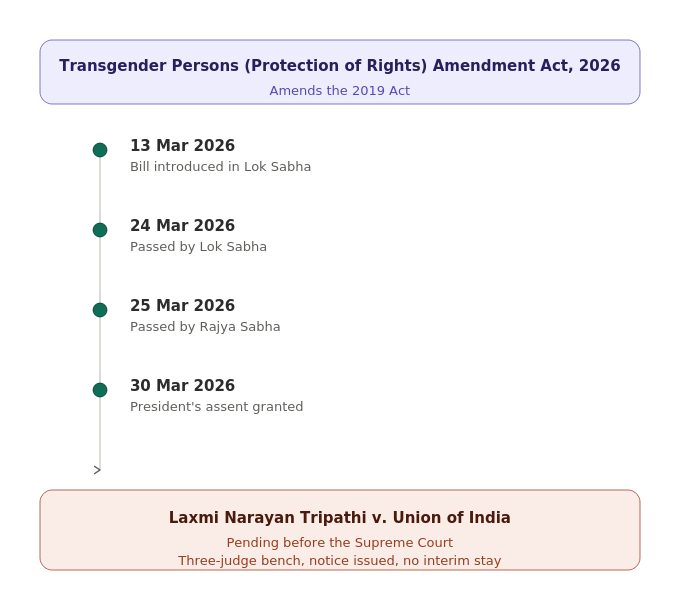
Some laws update numbers or procedures. This one updates something far more fundamental i.e. how the Indian state decides who a person legally is. The Transgender Persons (Protection of Rights) Amendment Act, 2026 rewrites the process by which transgender persons obtain legal recognition in India, and in doing so, has triggered one of the most closely watched constitutional challenges currently pending before the Supreme Court in the case of Laxmi Narayan Tripathi v. Union of India.
Quick Snapshot
Background: Why This Amendment Matters
To understand the 2026 Amendment, you have to go back to two earlier milestones.
1. NALSA v. Union of India (2014): In this landmark judgment, the Supreme Court recognised transgender persons as a distinct “third gender” and held that gender identity is a matter of individual autonomy, not state approval.
The Court grounded this right to self-identification in Articles 14, 19, and 21 of the Constitution, and adopted what is often called a “psychological test” for identity, meaning a person’s deeply felt sense of self, not their anatomy or surgical status, defines their gender.
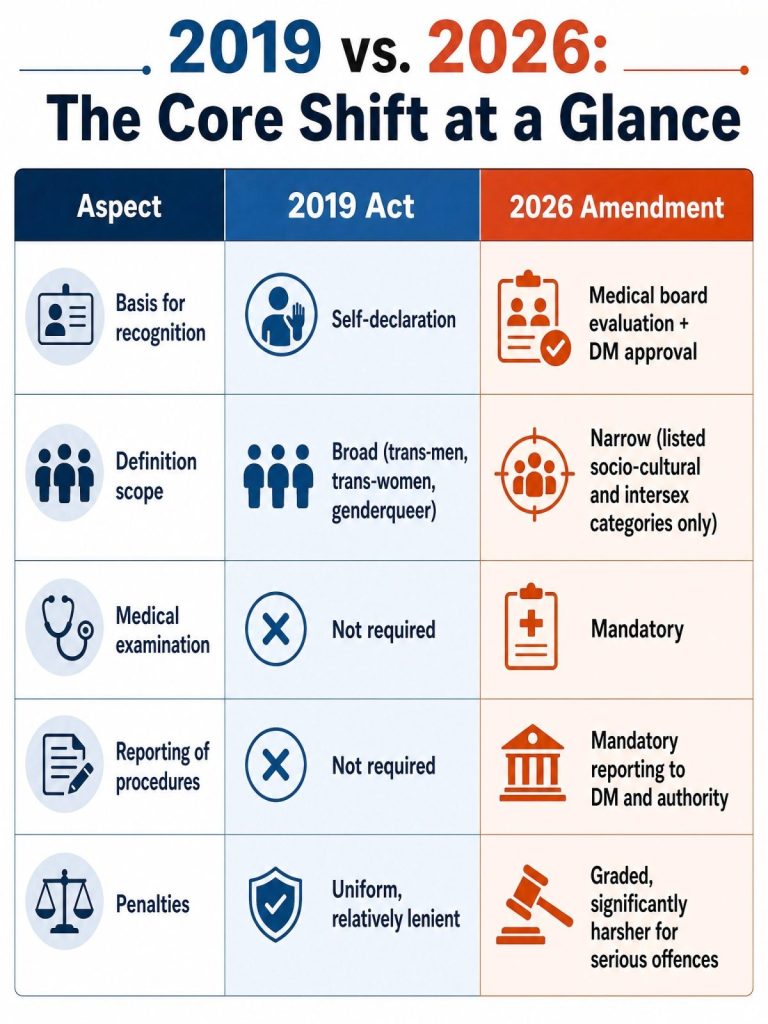
2. Transgender Persons (Protection of Rights) Act, 2019: Parliament’s response to NALSA. It defined “transgender person” broadly by covering trans-men, trans-women, genderqueer individuals, and those with intersex variations and allowed a person to obtain a Certificate of Identity from the District Magistrate purely on the basis of self-declaration. No medical exam. No psychological evaluation. No surgical proof.
The government’s stated reason for revisiting this framework in 2026 was that the 2019 definition was too broad and vague, making it difficult to identify genuinely marginalised persons the law was meant to protect, and that it conflicted with other statutory provisions.
What the 2026 Amendment Actually Changes
1. Self-Identification Is Removed
The Amendment deletes Section 4(2) of the 2019 Act- the provision that guaranteed a transgender person the right to self-perceived gender identity. This is the single biggest change in the law.
2. A Medical Board Now Decides Recognition
In place of self-declaration, the law creates an “authority” – a medical board headed by a Chief Medical Officer or Deputy Chief Medical Officer, appointed by the Central or State Government. This board evaluates the applicant before a District Magistrate can issue a Certificate of Identity. Only after this two-step process firstly, medical evaluation, then administrative approval and after that a person can legally change their name on official documents such as a birth certificate.
3. The Legal Definition of “Transgender Person” Is Narrowed
The 2019 Act’s inclusive definition is replaced with a narrower, listed category covering:
- Recognised socio-cultural identities – kinner, hijra, aravani, jogta
- Eunuchs
- Persons with intersex variations
- Persons compelled into a transgender identity through mutilation, castration, or forced surgical/chemical/hormonal procedures
Notably, trans-men, trans-women, and genderqueer individuals which were all explicitly covered under the 2019 Act have been dropped, along with any reference to self-perceived sexual identity or sexual orientation.
4. Stronger, Graded Penal Provisions
Section 18 of the parent Act has been substantially strengthened, with punishment now scaled to the severity of the offence:
- Forced labour, denial of public access, or forced displacement: 6 months to 2 year imprisonment, with fine
- Kidnapping an adult with grievous harm to force a transgender identity : 10 years to life imprisonment, minimum ₹2 lakh fine
- Kidnapping a child with grievous harm for the same purpose: life imprisonment, minimum ₹5 lakh fine
- Forcing an adult into begging/servitude while presenting as transgender: 5-10 years, minimum ₹1 lakh fine
- Forcing a child into the same: 10-14 years, minimum ₹3 lakh fine
5. Mandatory Reporting and a National Registry
Medical institutions performing gender-affirming procedures must now report details of the person and procedure to the District Magistrate and the authority, a requirement that petitioners say raises serious privacy concerns.
6. Changes to the National Council for Transgender Persons
State and Union Territory representation on the Council is now restricted to officers of the rank of Director or above, nominated on a rotational, region-wise basis (North, South, East, West, North-East).
2019 vs. 2026: The Core Shift at a Glance
The Constitutional Challenge
On 24 April 2026, transgender rights activist Laxmi Narayan Tripathi filed a petition under Article 32 challenging the Amendment’s constitutionality, later joined by Zainab Javid Patel. The case of Laxmi Narayan Tripathi v. Union of India is currently pending before a three-judge Supreme Court bench.
The petitioners argue the law violates:
- Article 14 – by imposing a verification burden on transgender persons that cisgender citizens never face, without a clearly justified objective.
- Article 15 – discrimination on prohibited grounds.
- Article 19 – since gender identity and self-presentation are forms of expression that now require prior state approval
- Article 21 – because dignity and autonomy, as interpreted in NALSA and K.S. Puttaswamy v. Union of India (2017, the right to privacy case), cannot be made contingent on medical or bureaucratic clearance
At the first hearing on 4 May 2026, the Supreme Court issued notice to the Union Government but declined to grant interim relief, partly on the question of whether the challenge was premature since the Amendment had not yet been notified. The matter remains pending.
Arguments on Both Sides
Concerns raised by critics and civil society:
- Reintroduces a medicalised, “diagnostic” model of gender identity that NALSA had explicitly rejected
- Excludes trans-men, trans-women, and genderqueer persons from legal protection entirely
- Creates practical barriers – limited medical board access in rural areas, unclear appeal mechanisms, and uncertainty over the validity of existing certificates
- Passed with minimal stakeholder consultation and no referral to a Select Committee, despite Opposition demands
Points raised by the government and supporters:
- Aims to prevent misuse of welfare benefits meant for the most marginalised
- Seeks a more “precise” and verifiable framework for legal recognition
- The graded penalty structure offers stronger protection against trafficking, forced begging, and coercive procedures
Conclusion
Countries like Argentina and Ireland allow legal gender change purely through self-identification, without any medical requirement. Others tie recognition to medical or psychological evaluation. With the 2026 Amendment, India’s framework moves from the former model toward the latter- a shift some commentators view as running counter to the global trend of expanding self-identification rights.
The 2026 Amendment is less a technical update than a philosophical reversal, it shifts the legal basis of gender recognition from self-declared identity to institutionally verified identity.
Subscribe for updates
Join 10,000+ subscribers.
SH
Shruti chauhan
Contributing author
Have a doubt about this?Ask Doubts
