Water (Prevention and Control of Pollution) Act, 1974
Background and Objective
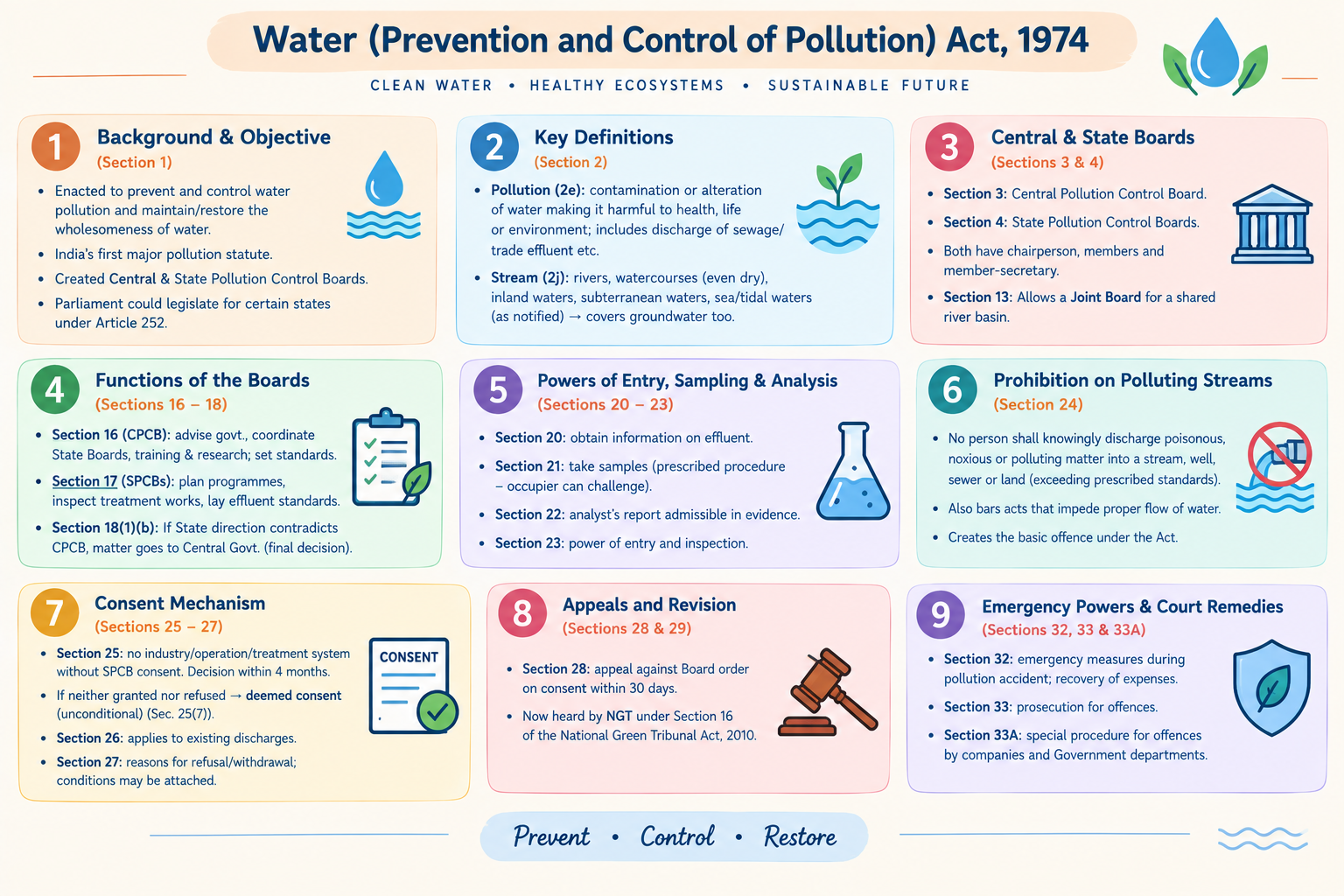
Parliament enacted the Water (Prevention and Control of Pollution) Act, 1974 to prevent and control water pollution and to maintain or restore the wholesomeness of water.
It is India's first major pollution statute, and it created the Central and State Pollution Control Boards. Several state legislatures passed resolutions under Article 252, which allowed Parliament to legislate on a State subject for those states.
Key Definitions: Section 2
Section 2(e) defines "pollution" as contamination of water, or an alteration of its physical, chemical, or biological properties, that is likely to create a nuisance or make the water harmful to public health, safety, animals, plants, or aquatic life.
The definition also covers the discharge of any sewage, trade effluent, or other liquid, gaseous, or solid substance into water.
Section 2(j) defines "stream" widely. It includes rivers, watercourses (even dry ones), inland waters, subterranean waters, and sea or tidal waters to the extent the State Government notifies. Consequently, the Act reaches groundwater as well as surface water.
Central and State Boards: Sections 3 and 4
Section 3 provides for the Central Pollution Control Board, and Section 4 provides for State Pollution Control Boards. Both are statutory bodies with a chairperson, official and non-official members, and a full-time member-secretary. Section 13 also allows two or more governments to set up a Joint Board for a shared river basin.
Functions of the Boards: Sections 16 to 18
Section 16 assigns the Central Board the task of advising the Central Government, coordinating State Boards, and organising training and research. It also lays down standards for streams and wells. Section 17 makes State Boards responsible for planning programmes, inspecting sewage and trade effluent treatment works, and laying down effluent standards.
According to the statutory proviso of Section 18(1)(b), if a direction given by a State Government is inconsistent with a direction from the Central Pollution Control Board (CPCB), the State Board does not automatically default to the State Government. Instead, the matter must be referred to the Central Government for a final decision
Powers of Entry, Sampling, and Analysis: Sections 20 to 23
Section 20 lets the Board obtain information about the volume, nature, and treatment of effluent discharges.
Section 21 authorises Board officers to take samples of effluent, and it requires them to follow a prescribed procedure so the occupier can challenge the result. Section 22 makes the analyst's report admissible in evidence, and Section 23 gives officers a power of entry and inspection.
Prohibition on Polluting Streams: Section 24
Section 24 forbids any person from knowingly causing or permitting poisonous, noxious, or polluting matter to enter a stream, well, or sewer, or to fall on land, where such matter exceeds the standards the State Board prescribes. It also bars any act that impedes the proper flow of water and thereby causes pollution.
This provision creates the basic offence under the Act.
Consent Mechanism: Sections 25 to 27
Section 25 bars any person from setting up an industry, operation, or treatment system that discharges effluent into a stream, well, or sewer without the State Board's prior consent. The Board must decide the application within four months.
If it neither grants nor refuses consent in that period, Section 25(7) treats consent as given unconditionally, which is the deemed consent rule.
Section 26 applies the same discipline to discharges that already existed when the Act began. Section 27 requires the Board to record reasons when it refuses or withdraws consent, and it allows the Board to attach conditions to any consent it grants.
Appeals and Revision: Sections 28 and 29
Section 28 gives a person aggrieved by a Board order on consent an appeal within thirty days. Since the National Green Tribunal Act, 2010, the NGT hears these appeals under Section 16 of that Act. As a result, a specialised environmental forum now decides consent disputes.
Emergency Powers and Court Remedies: Sections 32, 33, and 33A
Section 32 allows the Board to take emergency measures when a pollution accident occurs, and it lets the Board recover the cost from the polluter. Section 33 lets the Board apply to a Magistrate (not below a Metropolitan Magistrate or Judicial Magistrate of the First Class) for an order restraining a person from causing or continuing pollution.
Section 33A, inserted in 1988, empowers the Board to issue written directions, including closure of an industry and stoppage of electricity or water supply. This gives the Board a direct administrative remedy without first going to court.
Penalties and the 2024 Amendment
The original Act punished most violations with imprisonment. The Water (Prevention and Control of Pollution) Amendment Act, 2024, which received assent on 15 February 2024, removed imprisonment for many offences and replaced it with penalties between ₹10,000 and ₹15 lakh.
The Central Government may appoint an adjudicating officer of the rank of Joint Secretary (or a State Secretary) to decide these penalties. An aggrieved person can appeal to the NGT after depositing ten percent of the penalty, and the money goes to the Environment Protection Fund.
The amendment keeps criminal punishment for the most serious violation, which is discharging effluent without the consent Sections 25 and 26 require. It also makes the head of a government department liable to a penalty of one month's basic salary unless the head proves due diligence.
Further, the amendment lets the Central Government exempt certain categories of industrial plants from the consent requirement and issue guidelines on granting or refusing consent.
Section 47 (offences by companies) and Section 48 (offences by government departments) still fix liability on the persons in charge unless they show lack of knowledge or due diligence. Section 49 keeps the sixty-day notice route for citizen complaints, and the amendment adds the adjudicating officer as a source of complaint.
Extent of the 2024 Amendment
The 2024 amendment first applies to Himachal Pradesh, Rajasthan, and the Union Territories. Other states can adopt it by passing a resolution under Article 252. Punjab, for example, adopted it in March 2025. This detail matters for examinations because it shows how Article 252 operates in practice.
Under the original Section 48 of the 1974 Act, a Head of Department (HoD) was deemed criminally guilty unless they proved due diligence or lack of knowledge. The 2024 Amendment replaces criminal liability with a strict civil penalty equal to one month's basic salary.
However, the statutory language changes: the HoD is liable to pay this penalty if a violation occurs within their department, shifting the old criminal "due diligence" defense into a streamlined administrative fiscal penalty.
Judicial Contributions
In Municipal Council, Ratlam v. Vardhichand, (1980) 4 SCC 162, the Supreme Court held that a municipality cannot plead a lack of funds to avoid its statutory duty to provide drainage. Justice Krishna Iyer used Section 133 of the CrPC to force the local body to act.
In Subhash Kumar v. State of Bihar, (1991) 1 SCC 598, the Court held that the right to life under Article 21 includes the right to enjoy pollution-free water and air.
In M.C. Mehta v. Union of India (Ganga Pollution case), (1988) 1 SCC 471, the Court ordered tanneries near Kanpur to install effluent treatment plants and directed municipalities to control sewage discharge into the river.
In Vellore Citizens' Welfare Forum v. Union of India, (1996) 5 SCC 647, the Court held that the precautionary principle and the polluter pays principle form part of Indian environmental law.
Similarly, in Indian Council for Enviro-Legal Action v. Union of India, (1996) 3 SCC 212, the Court applied the polluter pays principle to chemical units whose waste had contaminated groundwater in Bichhri village, and it ordered them to bear the cost of remediation.
Relationship with Other Laws
The Water Cess Act, 1977 supports the Water Act by taxing industries and local bodies for water consumption, and the proceeds help fund the Boards.
The Water Cess Act, 1977 was completely repealed in 2017. With the rollout of the Goods and Services Tax (GST) regime, the tax framework was overhaulled via the Taxation Laws (Amendment) Act, 2017. The old mechanism of levying a specific environmental tax on water consumption to fund the Pollution Control Boards was dissolved.
The Air Act, 1981 and the Environment (Protection) Act, 1986 form the other two pillars of the pollution control framework. The NGT Act, 2010 supplies the appellate forum, and Article 48A and Article 51A(g) supply the constitutional basis for the whole scheme.
Subscribe for updates
Join 10,000+ subscribers.
HA
Hanspal Bakul
Contributing author
Have a doubt about this?Ask Doubts

