WBNUJS Kolkata LLM: Admission, Fees & Cut-Off Guide
JU
Julie Nigam7 min readThe West Bengal National University of Juridical Sciences, Kolkata, commonly called WBNUJS or NUJS Kolkata, is one of India’s leading National Law Universities. For law graduates planning an LL.M., it offers a one-year postgraduate programme that combines compulsory courses, stream-based study, electives and a research dissertation.
The main way to get admission is CLAT PG. This article explains how to get into WBNUJS Kolkata, the required paper, eligibility rules, fees, specialisation structure, recent cut-off trend and the rank that can be treated as a strong target. It also discusses the separate two-year LL.M. in Data Science and Data Protection Law.
About WBNUJS Kolkata
WBNUJS was established under the West Bengal National University of Juridical Sciences Act, 1999, also known as West Bengal Act IX of 1999. The university received formal recognition under the UGC Act in August 2004 and permanent affiliation from the Bar Council of India in July 2005. Candidates can visit the official WBNUJS website for university announcements, academic information and admission notices.
The university is recognised under Sections 2(f) and 12(B) of the UGC Act and has received an A+ grade from NAAC. Its Kolkata campus has a research-oriented academic environment, a central library, legal databases and faculty drawn from different areas of law and public policy.
WBNUJS Kolkata’s National Ranking
WBNUJS was ranked fourth in India in the NIRF 2025 Law category, with a score of 79.39. This is the university’s institutional ranking. It is different from the CLAT PG rank used for admission.
A NIRF ranking reflects the institution’s overall performance on factors such as teaching, research, graduation outcomes, perception and outreach. A CLAT PG AIR, in contrast, indicates a candidate’s position in the admission examination and affects allotment through the Consortium counselling process.
Which paper is required for WBNUJS Kolkata LL.M. admission?
Admission to the one-year LL.M. at WBNUJS is through CLAT PG, conducted by the Consortium of National Law Universities. Candidates do not ordinarily take a separate entrance examination for this programme. After the CLAT PG result, they must participate in the Consortium’s counselling and allotment process and place WBNUJS appropriately in their preference list.
Candidates should use the official Consortium pages for the relevant admission year:
The Consortium’s official WBNUJS brochure for CLAT 2027 contains the university’s seat allocation, domicile rules, course details, specialisation streams and fee structure. After the CLAT result, candidates should also monitor the official WBNUJS admission notices for university-specific fee-payment, document-verification and counselling updates. The latest notice for the relevant academic year will prevail over older brochures or webpages.
CLAT PG Paper Pattern
The CLAT PG 2027 paper contains 120 objective questions carrying 120 marks. The duration is two hours, and 0.25 marks are deducted for every wrong answer.
The paper is based on extracts from judgments, statutes and regulations. Candidates are tested on comprehension, awareness of the legal issue, the ability to summarise the passage and the ability to apply legal principles to facts. Students preparing for WBNUJS should therefore practise passage-based questions instead of relying only on one-line notes.
For detailed syllabus and paper pattern structure see CLATalogue’s post on CLAT PG 2027: Syllabus and Exam Pattern
Eligibility at WBNUJS One-Year LL.M.
According to CLAT PG 2027 eligibility rules, a candidate must have passed an LL.B. degree or an equivalent examination with at least 50% marks. The minimum is 45% for SC, ST and PwD candidates.
There is no upper age limit for CLAT PG 2027. Candidates appearing for their qualifying examination in 2027 may also apply, but they must produce proof of passing at the time of admission. Failure to do so can result in the loss of the admission opportunity.
The WBNUJS brochure states that the one-year LL.M. has 100 seats. 70 for All India candidates and 30 for West Bengal domicile candidates. The seat structure also includes applicable category reservations and a horizontal reservation for Persons with Disabilities.
West Bengal Domicile Category
- The brochure states that a candidate may be considered for the West Bengal domicile category if they have studied for at least ten years in a recognised educational institution in West Bengal by the CLAT application deadline.
- A candidate may also qualify where the parent is a permanent resident of West Bengal with a permanent home address in the state.
- Domicile candidates must carefully follow the certificate requirements in the relevant CLAT and university notices. A West Bengal connection alone should not be treated as sufficient without the required proof.
How long is the WBNUJS LL.M. through CLAT PG?
- The main WBNUJS LL.M. admitted through CLAT PG is a one-year programme. It is divided into two semesters of 18 weeks each.
- The first semester includes general compulsory courses such as Research Methodology and Legal Writings, Comparative Public Law, and Law and Justice in a Globalizing World. Students also take stream-specific compulsory courses. The second semester includes additional stream papers, electives and the dissertation.
- The course has a strong research and writing component. Students prepare research papers as part of their courses and complete an independent dissertation. This makes the programme relevant for students considering doctoral study, teaching, policy research and advanced legal practice.
WBNUJS LL.M. Specialisations and Courses
WBNUJS does not simply ask every student to follow an identical LL.M. curriculum. The university’s brochure identifies five broad specialisation streams:
- Corporate and Commercial Law
- International and Comparative Law
- Criminal and Security Law
- Law and Technology
- Intellectual Property Law
The university states that specialisation seats are allotted after admission, on the basis of CLAT rank and subject to the final decision of the Admission Committee. The indicative allocation is:
| Specialisation | Seats |
| Corporate and Commercial Law | 30 |
| International Law | 15 |
| Criminal and Security Law |
Examples of courses include Principles of Corporate Law, International Trade Law, Criminology and Criminal Justice Administration, Victimology, Public International Law, Law of International Organisations, Introduction to Science, Technology and Law, Introduction to IPRs, Bankruptcy Law, Competition Law, Private International Law, International Criminal Law and Commercial Arbitration.
The exact course offering may be revised by the university. Candidates should not assume that every elective will be offered in the same form every year.
WBNUJS Kolkata LL.M. Fees
The WBNUJS brochure lists the following 2026–27 annual fee structure for the one-year LL.M. for General, SC, ST, OBC, PwD and J&K students:
| Fee component | Amount |
| Tuition fee | ₹80,000 |
| Refundable deposit | ₹10,000 |
| Admission fee |
The total is subject to revision by the competent authority. The refundable deposit is included in the stated total. Students should also check the latest university notice for any additional accommodation, living or incidental expenses because the LL.M. fee table itself does not include a separate hostel and mess total.
WBNUJS also states that financial assistance and scholarships may be available on a merit-cum-means basis, in addition to certain government and private scholarship schemes.
WBNUJS Kolkata CLAT PG Cut-off: What Rank is Safe?
No single rank guarantees admission to WBNUJS. The closing rank changes with the difficulty of the CLAT PG paper, the number of candidates, the counselling round, category, West Bengal domicile allocation, reservations and withdrawals.
For a General-category All India candidate, AIR under 350 can be treated as a strong target. AIR 350–500 remains competitive, while AIR 500–650 may depend on later-round movement, preference choices and the year’s seat withdrawals. These are planning bands, not guarantees.
Candidates from reserved categories and West Bengal domicile categories should study the cut-off applicable to their own category rather than compare themselves only with the General All India figure.
Four-year WBNUJS CLAT PG rank Trend
The graph below presents reported General-category All India closing ranks for 2023–2026. The figures are indicative.
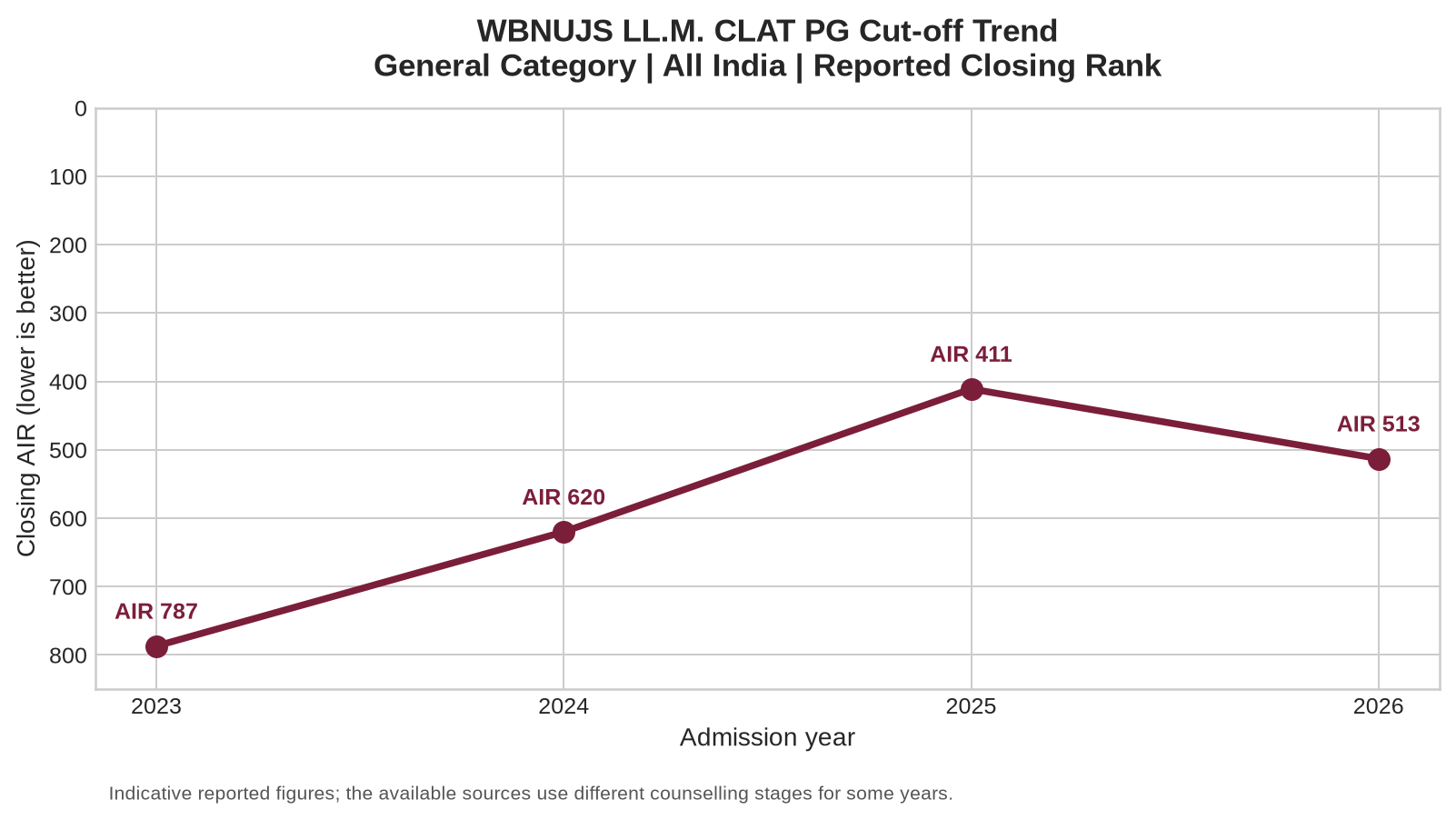
| Admission year | Reported General-category All India closing rank |
| 2023 | 787 |
| 2024 | 620 |
| 2025 |
Does WBNUJS offer any other LL.M. programme?
The main programme relevant to CLAT PG candidates is the one-year LL.M. with the five specialisation streams described above. WBNUJS has also listed a separate two-year LL.M. in Data Science and Data Protection Law.
The separate programme is not the regular CLAT PG route. The 2026 admission notice described eligibility of a law bachelor’s degree with 55% marks, a 40-seat intake, and admission through the NUJS-PGET All-India Entrance Test followed by a personal interview. The test was described as a 100-MCQ paper covering aptitude and domain knowledge, with a 90-minute duration and 0.25 negative marking.
However, the university’s 2026 admissions page also carries a notice cancelling that admission process. Therefore, candidates should not rely on the 2026 details for a future cycle. If WBNUJS reopens the programme, the current notification will decide the eligibility, test, dates, fee and selection process. Students seeking the ordinary one-year LL.M. should apply through CLAT PG instead.
Frequently Asked Questions
Is the WBNUJS LL.M. one year or two years?
The regular LL.M. admitted through CLAT PG is a one-year programme divided into two semesters. WBNUJS has separately listed a two-year LL.M. in Data Science and Data Protection Law with a different admission route.
Is CLAT PG compulsory for the regular WBNUJS LL.M.?
Yes. Admission to the one-year LL.M. is through CLAT administered by the Consortium of NLUs.
Can a final-year LL.B. student apply?
Yes, a candidate appearing for the qualifying examination in the admission year may apply, subject to producing proof of passing at the time of admission.
Does WBNUJS allot the specialisation at the time of application?
The brochure states that specialisation seats are allotted after admission on the basis of CLAT rank and subject to the Admission Committee’s decision.
Is AIR 350 guaranteed to secure WBNUJS?
No. AIR under 350 is a strong planning target for a General All India candidate, but admission depends on the category, seat allocation, counselling round, preferences and the year’s cut-off movement.
What is the 2026–27 WBNUJS LL.M. fee?
The brochure lists the annual academic total as ₹1,79,800 for the categories covered in the fee table, subject to revision.
Subscribe for updates
Join 10,000+ subscribers.
JU
Julie Nigam
Contributing author
Have a doubt about this?Ask Doubts