Actionable Claim under the Transfer of Property Act, 1882
Introduction
Property can be tangible property such as a house, car or book, or intangible property such as a debt, insurance benefit or right to receive money under a contract. Intangible property does not have physical form but the law recognizes it as valuable and enforceable in courts.
For example, A lends ₹50,000 to B without security. A has no physical object, but has a legal right to recover the money. When such a right is an unsecured debt or a beneficial interest in movable property not in the claimant’s possession, it becomes an actionable claim under Section 3 of the TPA. Its transfer is mainly governed under Chapter VIII from Sections 130 to 137.
Meaning under Section 3
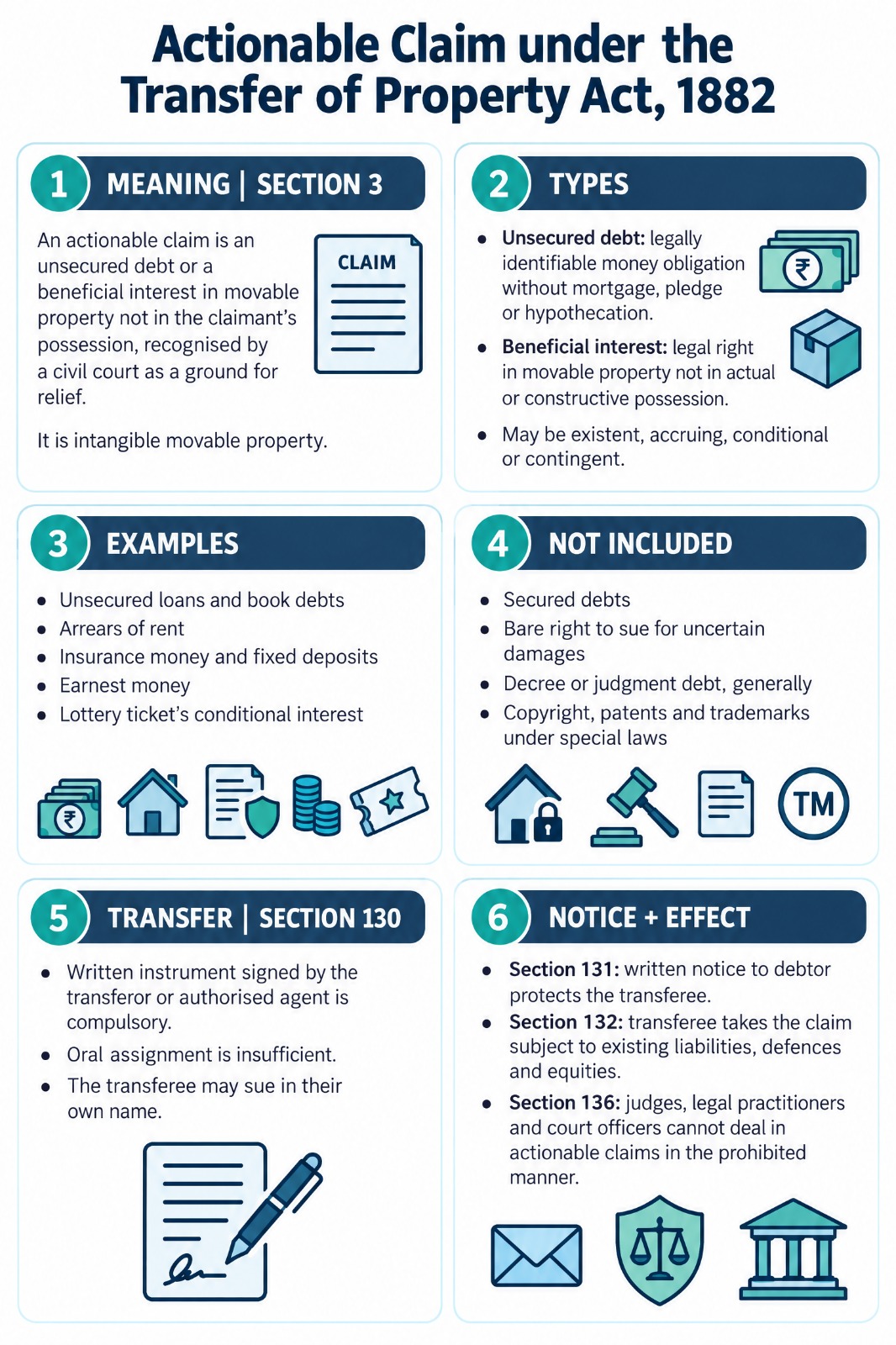
Section 3 defines an actionable claim as a claim to:
- An unsecured debt, other than a debt secured by mortgage of immovable property, or by pledge or hypothecation of movable property, or
- A beneficial interest in movable property not in the claimant’s actual or constructive possession.
The claim must be one which civil courts recognise as giving grounds for relief. It may be existent, accruing, conditional or contingent. Thus, every right to approach a court is not an actionable claim. The definition is limited to the two categories mentioned above.
An actionable claim is generally treated as an intangible movable property. It can be assigned even though it has no physical form. In State of Kerala v. Mini Shamsudin (2009) the court recognized that actionable claims are movable property. The court though observed that they may be treated differently under particular tax legislations.
Unsecured Debt
An unsecured debt is a monetary obligation not supported by mortgage, pledge or hypothecation. It is not limited to an ordinary loan. It may include arrears of rent, unpaid price under a transaction, salary already earned or money payable under an insurance policy.
Three features are useful for examination purposes: there must be a monetary obligation, no security must cover it, and the amount or obligation must be legally identifiable. A loan secured by a mortgage is not an actionable claim because the creditor already has security in immovable property. A loan secured by pledge or hypothecation is similarly excluded.
Existent Debt
An existent debt is already due and enforceable. For example, A owes B ₹20,000 and the payment date has arrived. B’s unsecured right to recover it is an actionable claim.
Accruing Debt
An accruing debt has arisen but becomes payable later. For example, salary is earned throughout a month but payable at its end.
Conditional or Contingent Debt
A conditional debt becomes payable when a condition controlled by the parties is fulfilled. A contingent debt depends on an uncertain event beyond their control. In Sunrise Associates v. Government of NCT of Delhi (2006), the Supreme Court confirmed that an actionable claim may be existent, accruing, conditional or contingent.
What will be the Beneficial Interest in Movable Property
The second category is a legal right to personal property that is not in the actual or constructive possession of the claimant. For Example, A pays for a machine. B keeps it wrongfully. A’s right to possession may be an actionable claim.
The property must not already be in the claimant’s possession. Possession through an agent or bailee can be considered constructive possession. It is important to note that such a right must be a legal right, rather than merely an expectation or hope.
In Sunrise Associates, the Supreme Court held that a lottery ticket is a conditional interest in the prize. The ticket is not valuable merely as paper, its value lies in the chance of receiving the prize. That beneficial interest was treated as an actionable claim. The decision also clarified the earlier approach in H. Anraj v. State of Tamil Nadu.
Common Instances of Actionable Claims
Examples include:
- unsecured loans and book debts,
- arrears of rent,
- money due under a life or fire insurance policy, where the statutory requirements are satisfied,
- a fixed deposit or deposit receipt,
- the right to recover earnest money,
- a partner’s right to seek accounts after dissolution of a firm,
In Lachmi Koeri v. State of Bihar (1960), arrears of rent were treated as transferable actionable claims. The case is useful because it shows that the claim need not arise from a conventional loan.
Claims which are not Actionable Claims
The following claims are generally not actionable claims under Section 3 :-
Secured Debts
A debt secured by mortgage, pledge or hypothecation is excluded. The creditor’s remedy is connected to the security and is governed by the relevant rules on mortgage or pledge.
Mere Right to Sue and Uncertain Damages
A bare right to sue for damages is not an actionable claim. Damages for defamation, nuisance, breach of contract or tort are often uncertain and personal. A claim for mesne profits is also generally treated as unliquidated damages rather than an actionable claim. In Jai Narayan v. Kishun Dutta case, the court had held that a claim for mesne profits was a mere right to sue and not an actionable claim.
Also a decree or judgement debt is not generally assigned as an actionable claim because the original cause of action has merged in the judgement. In Jugalkishore Saraf v Raw Cotton Co. Ltd. court explained this distinction.
Intellectual Property Rights
Copyright, patents and trademarks are governed by special statutes. They are not ordinarily actionable claims merely because they are intangible. Their transfer must comply with the law applicable to that intellectual property.
Transfer of actionable claim: Section 130
An actionable claim may be transferred with or without consideration, but the transfer must be made by a written instrument signed by the transferor or an authorised agent. An oral assignment is insufficient. Once the instrument is executed, the transferee obtains the transferor’s rights and remedies and may sue in their own name without joining the transferor.
Notice to the debtor is not essential between transferor and transferee. However, Section 131 requires written notice signed by the transferor or authorised agent, stating the transferee’s name and address. Notice protects the transferee against dealings by the debtor with the original creditor.
Liability of Transferee and Related Provisions
Under Section 132, the transferee takes the claim subject to all liabilities and equities affecting it on the date of transfer. The transferee cannot obtain a better right than the transferor had, a valid defence against the original creditor may also be used against the transferee.
Section 133 deals with warranty of the debtor’s solvency. Unless the contract says otherwise, the transferor’s warranty is limited and generally extends only to the value of the consideration received.
Section 134 concerns transfer of a mortgaged debt and explains how recovered money is to be applied.
Section 135 deals with assignment of rights under a fire-insurance policy where the statutory conditions are met.
Section 136 prevents judges, legal practitioners and officers connected with courts from buying, trading in or taking an interest in actionable claims. The object is to prevent conflicts of interest and protect confidence in the administration of justice.
Section 137 preserves special rules relating to negotiable instruments and certain mercantile documents.
Who cannot be Transferees in Actionable Claims?
Section 136 provides that certain people cannot be the part of transfer in actionable claims. A judge, legal practitioner or court officer cannot deal in actionable claims in the prohibited manner, and courts will not enforce such a transaction at their instance. Thus, section 136 expressly bars few people from being the transferee in the transfer of actionable claim.
Actionable Claim as Movable Property
An actionable claim is considered movable property because it can be transferred from one individual to another without the need to transfer land or a physical item. Its value is derived from the enforcement of the legal right associated with it. However, it is intangible and cannot be transferred like a chair or vehicle. Section 130 therefore requires a written assignment, while Sections 131 and 132 protect the debtor and regulate the equities attached to the claim.
Conclusion
An actionable claim is not every claim that can be taken to court. Under Section 3, it is either an unsecured debt or a beneficial interest in movable property not in the claimant’s actual or constructive possession. It may be existent, accruing, conditional or contingent.
For CLAT PG, remember the series of sections. Section 3 defines the concept, Sections 130 and 131 prescribe written transfer and notice, Section 132 transfers the claim subject to existing liabilities and defences, Sections 133 to 135 deal with solvency, mortgaged debts and insurance, Section 136 disqualifies court-connected persons, and Section 137 saves negotiable instruments. The main principle is that an intangible legal right can be property, but it can be assigned only through the statutory method and subject to the equities attached to it.
Subscribe for updates
Join 10,000+ subscribers.
JU
Julie Nigam
Contributing author
Have a doubt about this?Ask Doubts