
Trade Unions under Industrial Law
Background and Objective
(Trade Unions Act , 1926 has substantively been subsumed into Chapter III of the Industrial Relations Code, 2020, effective 21 November 2025 )
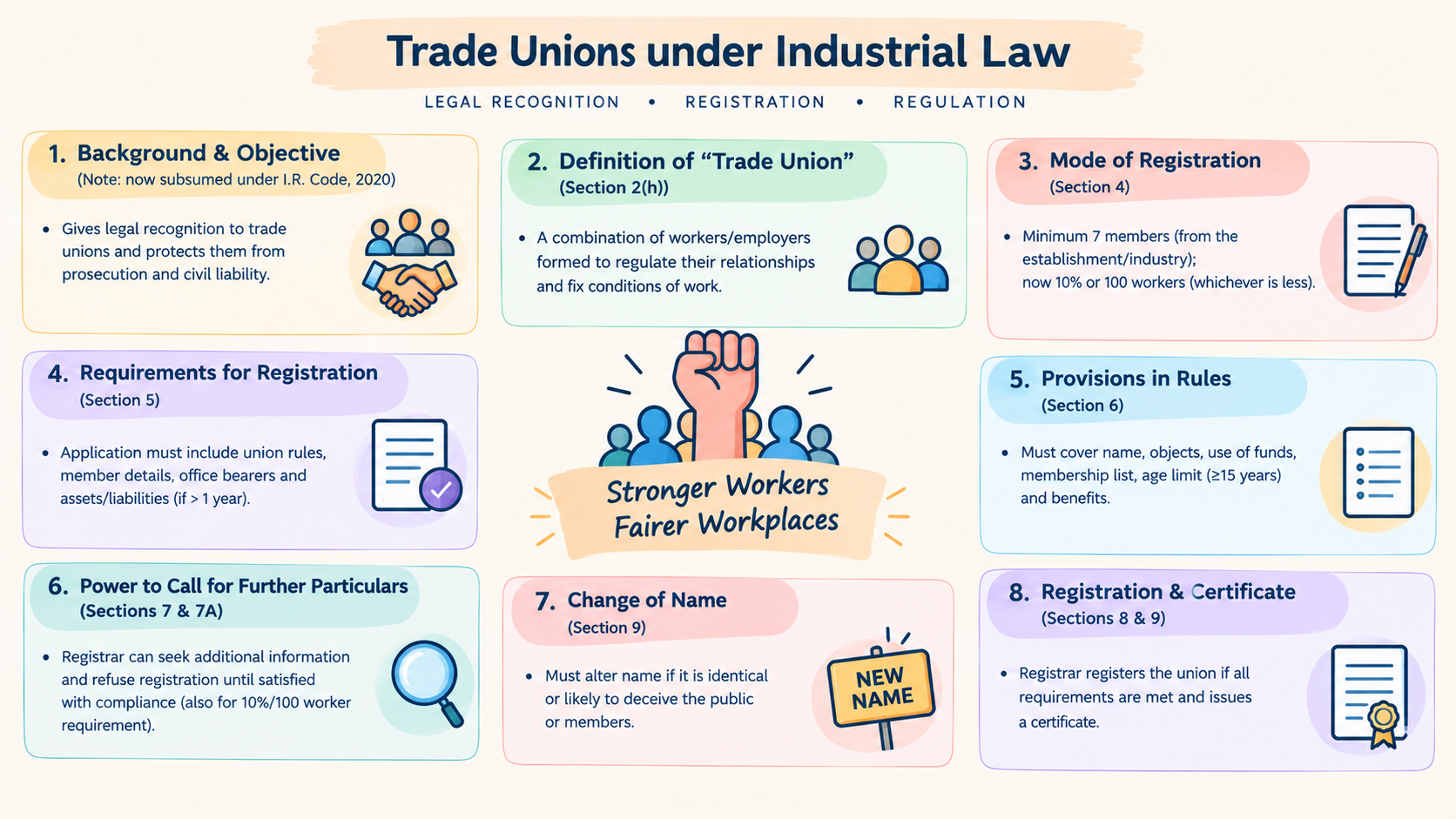
To allow for the lawful recognition of trade unions, the Trade Unions Act, 1926 was enforced by Parliament and it stipulates laws regarding registered trade union - before the enactment of this Act, unions were implementing their statutes but did not receive any form of acknowledgement from the law.
In this regard, members of trade unions and their office bearers were naturally liable to suit for offenses such as colluding to commit a crime and civil liability in case they took any action that led to the violation of existing contracts.
The essence of the Act is to provide legal bearing to labour unions thus permitting them to operate without fearing prosecution and civil liability.
Definition of "Trade Union": Section 2(h)
The definition of the term "trade union" is outlined in section 2(h) which states that trade unions are any combination either of a temporary or permanent nature, formed for the needs of the regulating of relationships between workers and employers and those among workers, and between employers or for fixing limitations by virtue of which the trade or other activity will be conducted.
The definition covers unions that engage in federative activities and refers to the unions whose intentions while forming unions are primarily meant for these purposes even where they have other ancillary objects.
This definition refers to the trade union’s operational purpose instead of any specific form of the organization, as courts have established that the name of the organization is not important as long as the main function involves regulation of relationships in between employers and employees.
Moreover, according to the definition, trade unions also include employer associations aimed at fulfilling the same function of relationships.
Mode of Registration: Section 4
According to Section 4 any trade union must be registered with a minimum of seven members that would subscribe their names to the rules of the trade union. These members should be members of the establishment or industry linked to the union.
The Trade Unions (Amendment) Act, 2001, explained a new requirement that the minimum number of members engaged in the industry or establishment should make 10% or one hundred workers, depending on which one is less at the moment of application, along with seven members from the establishment.
The 2001 amendment was introduced in order to solve a problem of growing number of small trade unions usually competing with one another within the same establishment thereby ruining the bargaining power of the union members.
Requirements for Registration: Section 5
According to section 5, all applications for registration need to have a copy of the union’s rules along with a statement giving details such as the names, occupations, and addresses of the members who are making the application, name and address of the trade union, and the titles, names, ages, addresses and occupations of its office bearers.
The applicants have to submit a general statement of the union’s assets and liabilities if the union is registering after having been in existence for over a year.
Provisions to be Contained in Rules: Section 6
Section 6 gives a list of all matters that the rules of the trade union have to cover such as name of the union, its objects, purposes for which its general funds would be used, maintenance of a membership list, admission of members of age not less than 15 years, and the conditions applicable for getting benefits.
Power to Call for Further Particulars and to Require Alteration of Name: Sections 7 and 7A
Section 7 empowers the Registrar to call for further information to satisfy themselves that an application complies with the Act, and to refuse registration until such information is furnished.
Section 7A similarly empowers the Registrar to call for further information where it appears necessary for verifying compliance with the ten percent or one hundred workmen membership threshold under Section 4.
Section 9 requires a trade union to alter its name where the proposed or existing name is identical to that of another registered union, or so similar as to likely deceive the public or members.
Registration and Certificate: Sections 8 and 9
According to Section 8, if the Registrar is satisfied with the fact that the requirements laid down in the law are met by the trade union, she has to register that trade union by writing down the details in the relevant register and is required to issue a certificate proving the union’s registered status.
Section 9A states that not just at the time of registration but at all times after that every registered trade union is required to meet the minimum requirement of membership, otherwise it will lose its registration.
Cancellation of Registration: Section 10
Section 10 states that the Registrar has the right to cancel or withdraw the registration of a trade union in certain specified cases, which include the trade union applying for such a cancellation (with all applicable verification done as per the rules), or situations where she is satisfied that the registration certificate was obtained through deception or error, or that the organization is no longer in existence, or that it has deliberately violated some requirements of the Act or allowed some rules which violate the requirements to continue to be in effect.
Before cancelling or withdrawing the registration of any trade union, the Registrar is required to give the trade union at least two months' previous notice in writing.
Appeal: Section 11
Registrar's decision on the refusal registration or for withdrawal/cancellation of a certificate in the relevant civil courts according to the location of the registered office of the union within the stipulated time after the order of the Registrar. This appellate provision ensures that the Registrar's vast powers of discretion relating to registration and cancellation will remain under the judicial supervision.
Incorporation and Legal Status: Section 13
Section 13 gives the registered trade union the legal personality of a corporate body having perpetual succession and a common seal which may own both movable and immovable properties, enter into contracts as well as sue and be sued in the name of the union.
The provision of this incorporation has provided a huge boost to the legal status of the trade union as it now functions as an independent juristic person with the capacity to acquire assets and initiate lawsuits in its own name without any reliance of its members.
Immunity from Criminal Conspiracy: Section 17
The first part of Section 17 addresses the fact that an office-bearer of a registered trade union or member of the union is exempted from the punishment provided under sub-section (2) of Section 120B of the Indian Penal Code, which deals with conspiracy, for any agreement among its members for achieving the objective of the trade union covered by Section 15, except in cases where the agreement amounts to an offence.
The immunity provided by this Section is due to the fact that collective action, by its very nature, entails a meeting of minds of the members of the trade union.
Without this immunity, the very act of organizing for the improvement of wages and working conditions could lead to conspiracy charges against the union members
Immunity from Civil Suit: Section 18
Section 18 grants similar immunity to a registered trade union along with its office-bearers and members even in respect of civil liabilities arising out of any action taken by it during the course of a trade dispute, merely on the ground that the act has induced another party to breach his contract of employment or has otherwise interfered with his trade, business or employment, or with that other person's right to dispose of their capital or labour as they will.
This provision shields legitimate trade union activities like strikes and peaceful picketing from civil liability that would otherwise arise under general tort principles, such as inducement to breach contract.
This immunity, however, remains conditional on the act being done in contemplation or furtherance of a genuine trade dispute, and courts have consistently held that acts involving violence, intimidation, or conduct unconnected to a legitimate trade dispute fall outside this protective umbrella.
Enforceability of Agreements: Section 19
Section 19 states that no contract entered into by members of a registered trade union shall be deemed void or voidable by virtue of its objectives which are contrary to the principle of restraint of trade, even in the light of the provisions in the Indian Contract Act, 1872.
It amends the common law position governing Section 27 of the Contract Act which makes agreements contrary to the principle of restraint of trade invalid and makes it an exception to facilitate the functioning of trade unions, despite their objectives being restricted in nature regarding their activities in the field of trade.
General Funds and Political Fund: Sections 15 and 16
Section 15 outlines the uses of the general funds of a registered trade union, such as the payments related to remuneration and expenses of the office bearers of the trade union, management and operating expenses of the trade union, employment of legal services in connection with trade disputes, compensation paid to the employees because of the trade disputes, and pension and retirement benefits to its members.
According to Section 16 , the registered trade union can open a special political fund for special political purposes which may include advocating for the political and civic rights of its members, assisting them in the financing of the electoral expenses of the candidates.
However , along with that, it's important to notice that this law provides for protections of those members who do not want to contribute to that fund in the following respects : they cannot be deprived of the benefits of the trade union and also will not incur disadvantages e.g. their status concerning political fund control and management.
Rights of Minors to Membership: Section 21
Section 21 allows for any person who is at least fifteen years old to be a member of a registered trade union, according to the rules of that union. Such a person can exercise all the rights of a member, besides the right to execute documents and give receipts, unless the rules provide otherwise in explicit terms.
This provision acknowledges the fact that young workers may start working before attaining majority and thus enables them to remain protected by the trade union.
Disqualifications of Office-Bearers: Section 21A
As per Section 21A, a person cannot be appointed or continue to be an office bearer of a registered trade union if he/she is less than eighteen years of age at the time of appointment or has been convicted of an offence involving moral turpitude by a court in India and has been sentenced to imprisonment but has not completed a period of five years from release.
Thus, this clause establishes minimum benchmarks of age and character for individuals selected to lead trade unions.
Proportion of Office-Bearers to be Connected with the Industry: Section 22
Section 22 stipulated that a certain minimum proportion of office-bearers of a trade union must be workers actually engaged or employed in the establishment or industry concerned but was amended in 2001 to the effect that now up to one-half of the office-bearers of a registered trade union, in the informal sector, i.e. having no employees in the establishment or sector.
The relaxation allows for the positions of office-bearers to be filled by persons not actually employed in the concerned establishment or industry keeping in view the practical requirement of leadership in the informal sector where workers lack experience in staying in the bargaining process.
Change of Name and Amalgamation: Sections 23 to 25
Section 23 of the Act provides that any registered trade union may change its name with the concurrence of at least two-thirds of all its members as per the approval of the Registrar confirming that the new name is not similar to another trade union.
Sections 24 and 25 are on the amalgamation of two or more trade unions with the provision that an approval is required from not less than 50 percent of members which is done through voting. Further, it has been provided in the sections that the merger does not affect any rights of the unions in receipt of payments.
Dissolution: Section 27
Section 27 provides that a notice of dissolution of a registered trade union should be given to the Registrar within 14 days of the dissolution and that it should be signed by at least seven members and the secretary of the union.
The Registrar is required to register the notice after the review of its accuracy. Further, in case the rules do not provide for the distribution of the funds in case of dissolution of a trade union, the Registrar would have to take care of the distribution of the funds among the active members as provided under the law.
Judicial Contributions
The issue of the Registrar's powers regarding registration was addressed by the Madras High Court in Rangaswami v. Registrar of Trade Unions.
The judgment held the view that the Registrar's inquiry should be limited to the provisions of the Act without any reference to other matters.
In B.R. Singh v. Union of India , the Supreme Court held that the right to organize through trade unions is a fundamental right, therefore unions should be allowed to work effectively through the right to strike and its exercise, with only reasonable restrictions as imposed by the law.
In the case of All India Bank Employees' Association v. National Industrial Tribunal, the Supreme Court took the position that the right to form an association under Article 19(1)(c) does not extend to the right to bargain collectively or strike freely, as such rights can be governed by the statute instead of having a constitutional status.
Subscribe for updates
Join 10,000+ subscribers.
HA
Hanspal Bakul
Contributing author
Have a doubt about this?Ask Doubts
